






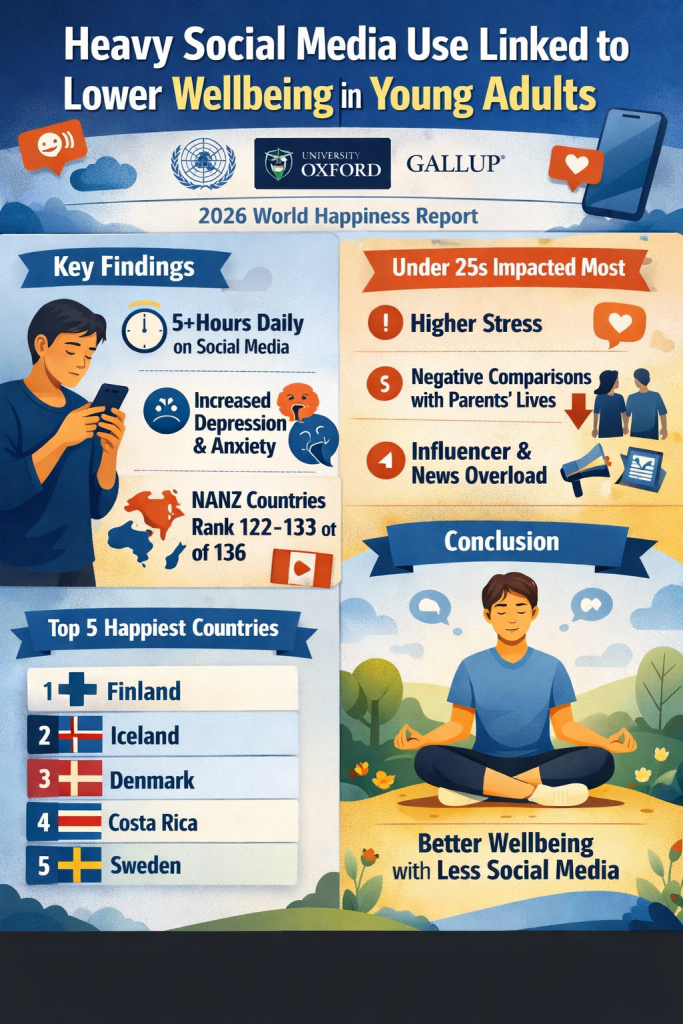
The 2026 World Happiness Report highlights a clear connection between heavy social media use and declining well-being, particularly among young adults. The report, sponsored by the United Nations in collaboration with the University of Oxford’s Wellbeing Research Centre and the American analytics firm Gallup, examines global trends in happiness and quality of life.
Findings show that excessive engagement with social media—averaging over five hours per day—is linked to higher rates of depressive symptoms, especially among individuals under 25. “In a ranking of happiness changes for under-25s, the United States, Canada, Australia, and New Zealand (the NANZ region) rank between 122 and 133 out of 136 countries,” the study reports. “Engaging with multiple platforms, relying on social media as a primary news source, and following influencers are associated with higher stress, increased depressive symptoms, and negative comparisons with parents’ quality of life.”

The report also emphasizes that social media’s impact varies by age. While older adults benefit from trust, attachment, safety, and moderate digital use, younger adults face erosion of these foundations in highly saturated digital environments. Interestingly, internet use can have positive effects when peer exposure is limited, but it tends to become harmful within highly connected peer networks.
The World Happiness Report ranks countries based on life expectancy, freedom, cost of living, corruption levels, and economic stability. This year, the top five happiest countries remain Finland, Iceland, Denmark, Costa Rica, and Sweden, with Finland retaining its number-one spot for the ninth consecutive year.
While research on the positive benefits of social media is still limited, the 2026 report concludes that most populations would experience higher overall well-being if social media platforms were less central to daily life.


