


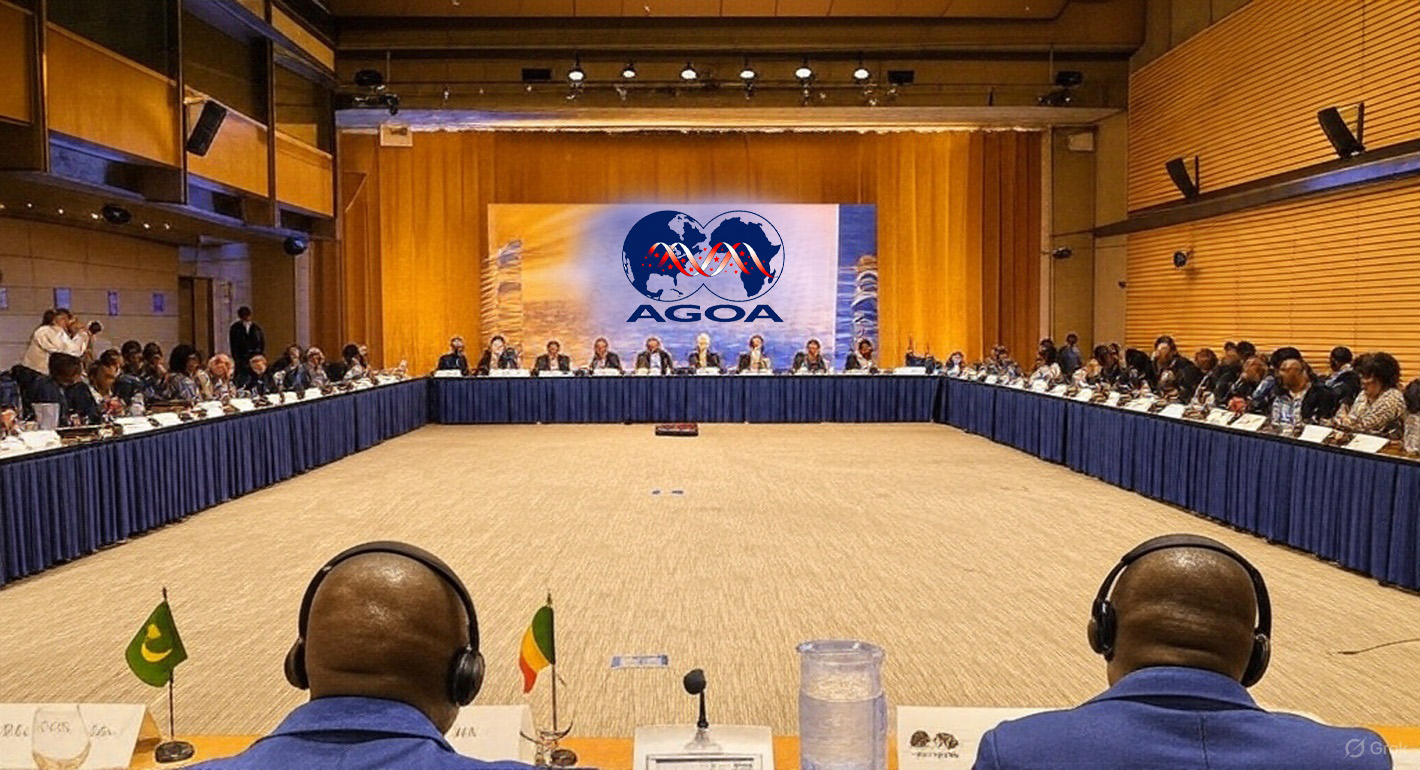
The recent decision by President Donald Trump to impose tariffs on most US trading partners marks a significant departure from nearly three decades of American trade policy aimed at fostering economic development in Africa. These new tariffs, which could reach as high as 50% for countries like Lesotho, threaten to undermine the longstanding African Growth and Opportunities Act (AGOA). Enacted in May 2000 under President Bill Clinton, AGOA provided many of the poorest African nations with duty-free access to the US market—a lifeline for their economies.
A White House official, who spoke on the condition of anonymity, confirmed that these tariffs will supersede AGOA, signalling a precarious future for countries such as Lesotho, Madagascar, and Mauritius. Just when these regions were hoping to recover economically, having also suffered Trump’s recent freeze on billions of dollars in aid for Africa, the imposition of tariffs threatens to deal a harsher blow.
The true ramifications of this trade policy can be better understood through the experience of Ethiopia. In 2021, Ethiopia was removed from AGOA due to civil unrest, resulting in a humanitarian catastrophe that drove several multinational corporations, including PVH Corp.—the parent company of Calvin Klein and Tommy Hilfiger—to exit the country. According to Ethiopia’s central bank, this led to a staggering loss of approximately 11,479 jobs.
Commenting on the broader implications, Jacques Nel, head of Africa Macro at Oxford Economics, indicated that AGOA is “effectively dead in the water.” While Lesotho may face the brunt of these changes, he warns that extremely interconnected global supply chains mean no nation involved will remain unaffected. Indeed, Lesotho’s Minister of Trade and Industry, Mokhethi Shelile, projects that up to 12,000 textile jobs across 11 factories are at risk—about one-third of the country’s textile employment.
“The tariffs literally will devastate Lesotho,” echoed Parks Tau, South Africa’s trade minister, during a press conference. With a population of 2.3 million, Lesotho heavily depends on exports of diamonds and textiles and is acutely reliant on South Africa for 85% of its imports. The ripple effects could also reverse the progress made by African nations to diversify their economies and move away from extractive industries—a strategy previously championed by the US to support low-income countries in achieving export-driven growth.
Yvonne Mgango, an Africa economist, assessed that African markets may struggle to absorb the surplus supply of goods, potentially forcing countries to seek alternative markets. This could culminate in job losses and factory closures across the continent.
The possibility of legal challenges arises as the benefits of AGOA dwindle, with Tau suggesting that nullifying the pact may be contested in US courts. As it stands, AGOA is due to expire in September, and the White House has been tight-lipped regarding potential extensions.
Last year, approximately 30 African nations exported $8.4 billion in cars, oil, and garments to the US, showcasing the significance of this trade relationship. While certain commodities, particularly energy products and critical minerals, remain exempt from new tariffs, countries like Angola, Nigeria, and Gabon have found themselves less impacted. The amorphous nature of the tariffs, calculated using trade surplus metrics, illustrates a stark shift from post-World War II trade policy, which focused on economic integration and aiding developing nations.