



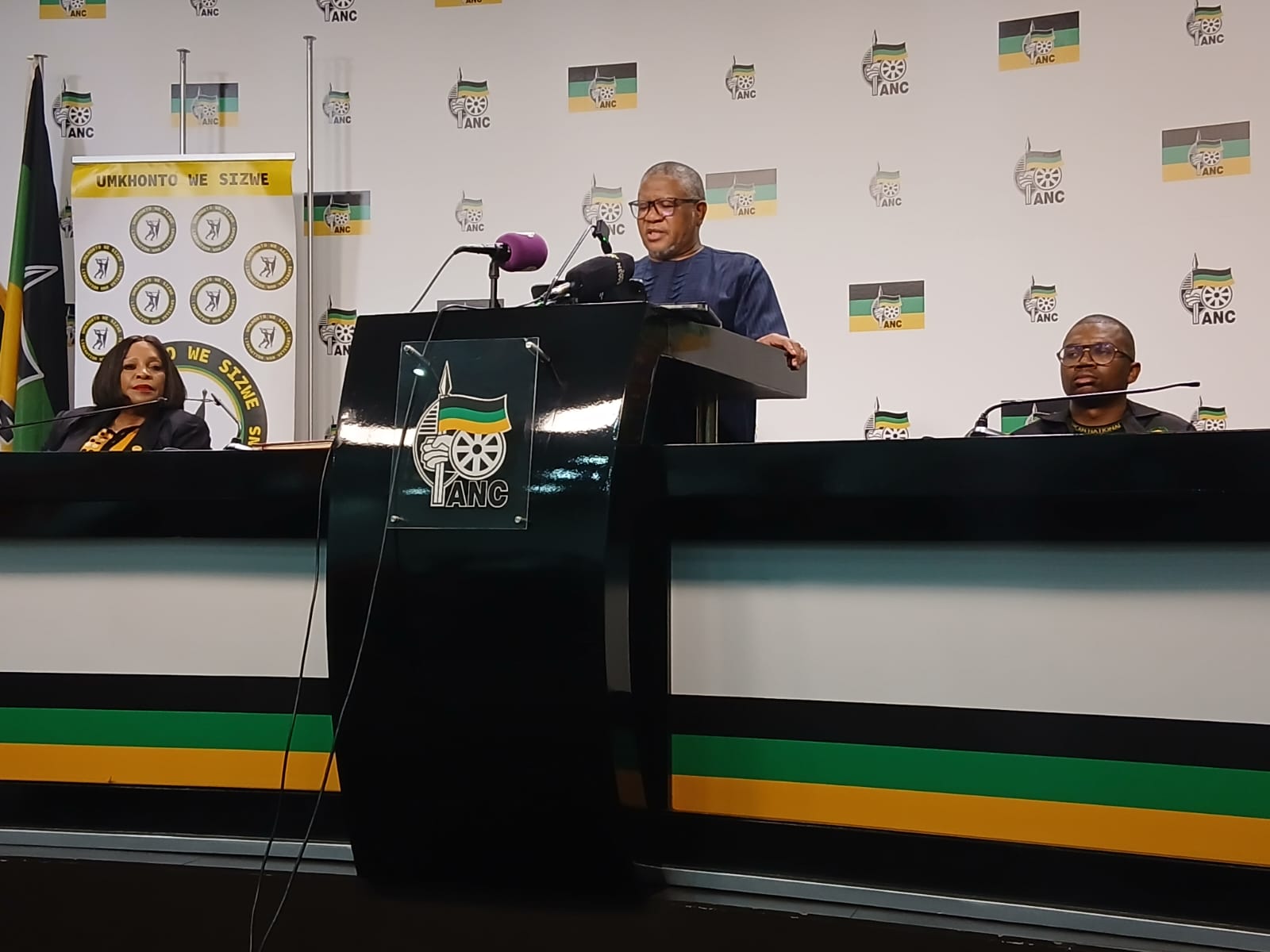
The African National Congress (ANC) has announced a nationwide “People’s March” set to take place on Human Rights Day, framing the mobilisation as a defence of South Africa’s constitutional democracy and sovereignty.
Addressing the media in Johannesburg, ANC Secretary-General Fikile Mbalula on Wednesday said the march comes at a time when the country’s Constitution is “under attack,” both domestically and internationally.
Mbalula called on South Africans to unite in defence of the country’s democratic framework, arguing that recent criticism of government policies particularly transformation laws has misrepresented South Africa on the global stage.
“The ANC calls for all South Africans to rise to defend our sovereignty, which in the past months has been under attack,” Mbalula said. “We have been painted as people who are engaged in genocide. We say no.”
He rejected claims that transformation policies are discriminatory, insisting they are necessary to address the deep inequalities inherited from apartheid.
“When we implement transformation laws in this country, it is said we are implementing racist laws and we say no,” he added.
Mbalula also took aim at international critics, singling out former US President Donald Trump, accusing him of undermining South Africa’s democracy and sovereignty.
“Especially coming from people who pose as the world’s policemen… led by the US… who have attacked our democracy and sovereignty,” he said.
The planned march comes amid heightened political tensions around issues of land reform, economic transformation, and South Africa’s position in global geopolitics. Government policies aimed at redressing historical inequality—such as Black Economic Empowerment and land redistribution—have drawn both domestic debate and international scrutiny.
The ANC and its alliance partners argue that these policies are essential to fulfilling the promises of the Constitution, while critics claim they risk entrenching new forms of inequality or undermining economic growth.
Acknowledging unfinished freedom
Despite his strong defence of the Constitution, Mbalula acknowledged that South Africa’s democratic project remains incomplete—particularly in terms of economic justice.
“For freedom to have arrived, it must be defined equally by economic emancipation. So we say, as the people, we have not arrived,” he said.
His remarks echo a long-standing position within the ANC and its allies that political freedom achieved in 1994 must be matched by meaningful economic transformation.
Alliance-backed mobilisation
The march is being organised in partnership with the ANC’s traditional alliance partners, including the South African Communist Party and the Congress of South African Trade Unions, as well as several civic organisations.
Organisers say demonstrations will take place across multiple provinces, with the aim of mobilising broad public support for the defence of constitutional values and democratic gains.
Human Rights Day, which commemorates the victims of the Sharpeville Massacre, is often used as a platform to reflect on the state of rights and freedoms in South Africa. This year’s march is expected to highlight both the achievements and ongoing challenges of the country’s democracy.

