


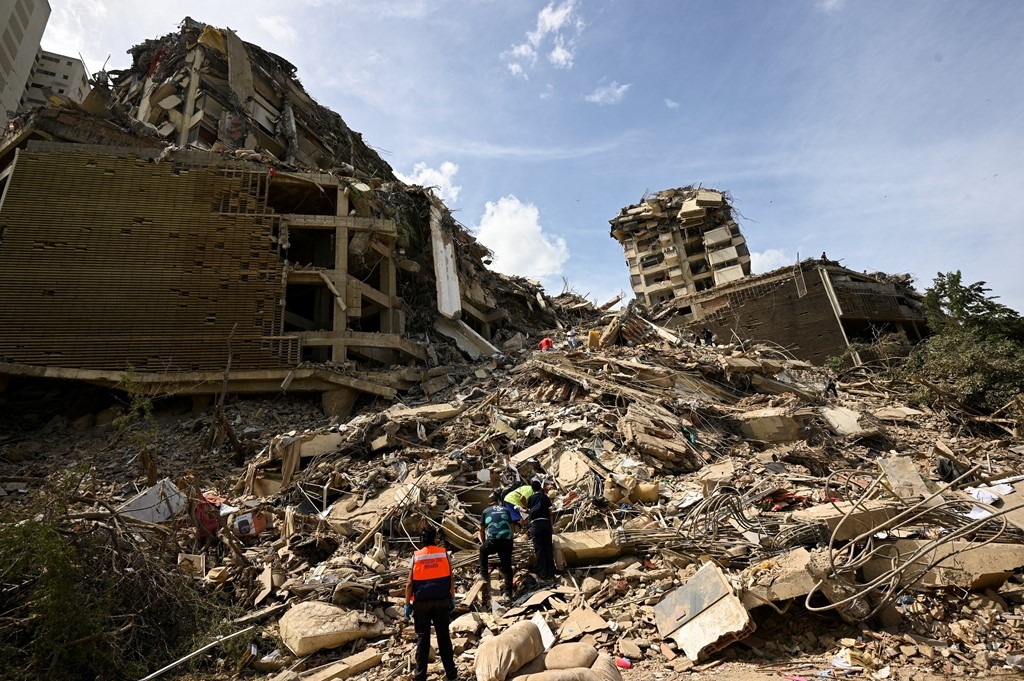
The death toll from Venezuela’s devastating twin earthquakes has climbed above 1,400, authorities said on Saturday, as international rescue teams continued arriving and operations intensified across the hardest-hit coastal regions.
Search teams and volunteers have been working through rubble in areas including La Guaira and parts of Caracas, where damaged buildings and limited heavy equipment have slowed recovery efforts. Officials said more than 1,600 foreign rescuers were now on the ground, with additional contingents expected in the coming days.
The disaster has triggered a large international response, with helicopters and specialist crews deployed into remote or heavily damaged zones such as Caraballeda, where entire residential blocks collapsed. Families continue to search desperately for missing relatives, many relying on ad hoc networks of volunteers and foreign rescue units.
Authorities also said tens of thousands remain unaccounted for, while humanitarian conditions remain fragile, with damaged infrastructure, disrupted power supplies and restricted access complicating relief operations.
The earthquakes have struck at a time when seismic activity has also been reported in several other regions around the world in recent days, underscoring ongoing global tectonic instability. While most of these events have been significantly smaller in scale and caused limited damage, they have added to broader concern among geologists monitoring increased stress along multiple fault lines.
In Venezuela, officials continue to prioritise clearing key routes into affected areas, while residents in shelters and on the streets brace for ongoing aftershocks and the slow return of basic services such as electricity and water.
The twin quakes, measuring magnitude 7.2 and 7.5, are now considered among the most destructive in Latin America in recent decades, according to early assessments by international geological agencies.