


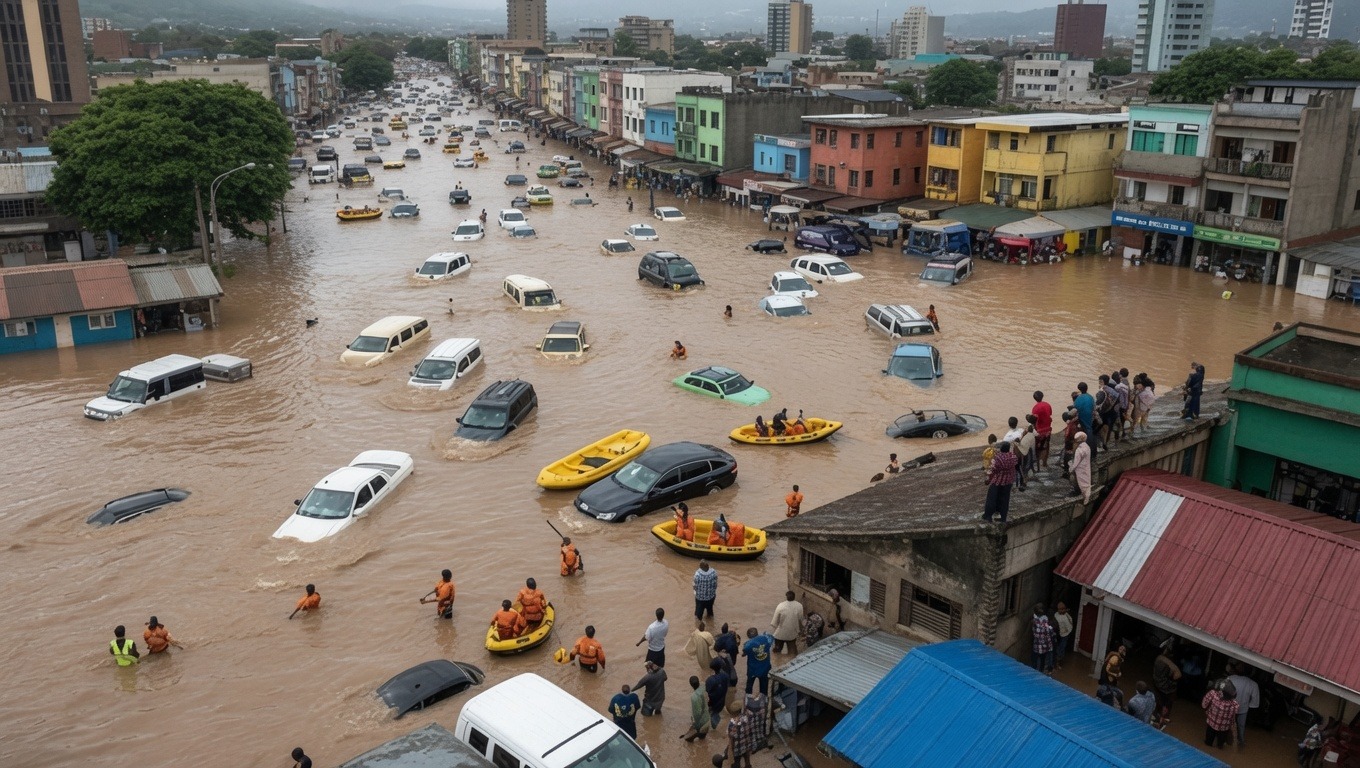
At least three people have died after torrential rainfall triggered severe flooding across Ghana’s capital, Accra, in one of the most disruptive weather events the city has experienced in recent years.
The flooding, which submerged homes, roads and entire neighbourhoods, has once again exposed long-standing weaknesses in urban planning, drainage infrastructure, and land-use enforcement in one of West Africa’s fastest-growing cities.
Extreme rainfall overwhelms capital infrastructure
Ghanaian authorities confirmed that around 140mm of rain fell within a single day, an unusually high volume for the region and the most recorded in several years.
President John Dramani Mahama described the deluge as part of a growing pattern of extreme weather, linking the intensity partly to climate change while also pointing to human-driven factors such as rapid urban expansion and informal construction in flood-prone zones.
Meteorological services warned that additional rain-bearing systems were still active over southeastern Ghana, raising fears that already saturated ground conditions could worsen in the coming days.
Rescue operations across submerged communities
Emergency responders were deployed across multiple districts in Accra as floodwaters surged through residential areas in the early hours of the morning.
In neighbourhoods such as Tse Addo, rescue teams used inflatable boats to reach stranded residents, including children and infants trapped inside homes surrounded by rising water.
Elsewhere, authorities confirmed the recovery of victims from low-lying districts where floodwaters rapidly overwhelmed streets and buildings. Vehicles were left submerged and structural damage was reported in several areas.
Local emergency services, supported by police and military units, have been working to evacuate affected residents and restore access to critical roads, though many areas remain difficult to reach.
Residents describe sudden and devastating impact
For many residents, the flooding struck with little warning and escalated quickly as drainage systems failed under the intensity of rainfall.
Some households reported water entering homes within hours, forcing families to salvage belongings or seek higher ground. In several areas, power outages compounded the danger, particularly where floodwaters came into contact with electrical wiring.
Officials have urged residents to avoid unnecessary travel and remain indoors where possible, warning that continued rainfall could trigger further flash flooding in already affected districts.
Climate pressure meets rapid urban growth
While flooding during the rainy season is not unusual in Ghana, experts and residents alike say the scale and frequency of recent events have worsened significantly.
Rapid urbanisation in Accra has led to increased construction in wetlands and drainage channels, reducing the city’s natural ability to absorb heavy rainfall. Combined with ageing infrastructure and limited stormwater capacity, this has created conditions where even short bursts of intense rain can produce widespread flooding.
The government has in recent years faced growing pressure to enforce building regulations and invest in large-scale drainage upgrades, though implementation has remained uneven.
Growing risk of repeat disasters
With climate patterns becoming increasingly unpredictable, Ghana’s coastal and urban regions are expected to face heightened flood risks in the years ahead.
Authorities have warned that without improved drainage systems, stricter urban planning enforcement, and expanded climate adaptation measures, Accra could continue to experience repeated flooding events with rising human and economic costs.
As clean-up operations begin, attention is now shifting to how the city can reduce vulnerability ahead of the remainder of the rainy season.