



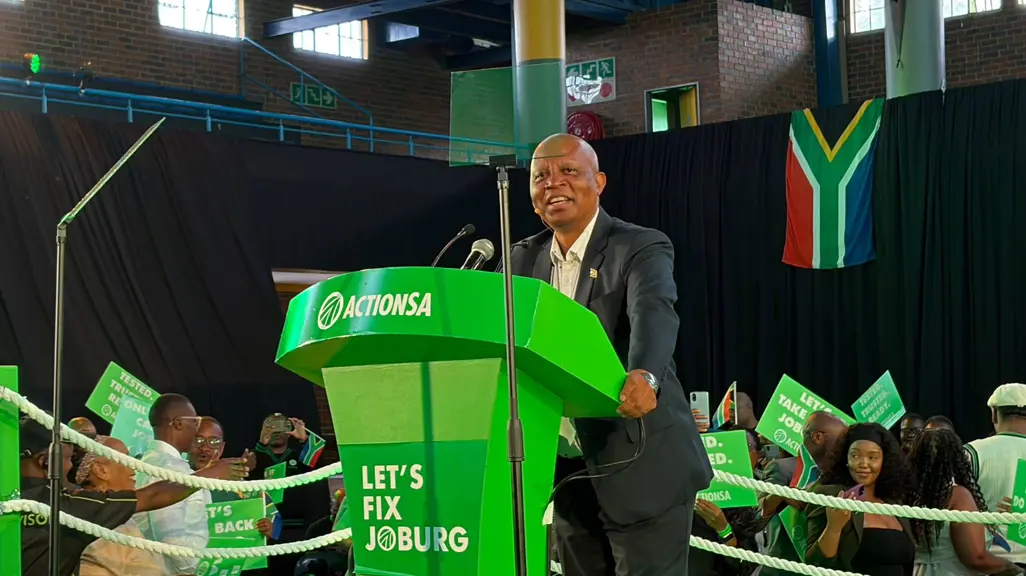
ActionSA leader Herman Mashaba appears to have abandoned — or simply forgotten — the party’s ideological stance as he continues to recruit political figures from across the ideological spectrum.
The party has increasingly become a destination for politicians who have either been poached from other parties or recruited soon after leaving them, with many quickly finding themselves in leadership positions under the self-proclaimed “green umbrella”.
Mashaba’s latest acquisition is Ayanda Allie, the former journalist who was last week expelled from Mmusi Maimane’s Build One South Africa (BOSA).
Mashaba unveiled Allie during a media briefing in Johannesburg on Friday, revealing that he had personally recruited her after the two met for coffee about a week before her expulsion from the largely inactive BOSA.
“I’ve always watched this young, vibrant, hardworking, proud South African. I’ve admired you from a distance for a long time and, as a career journalist, you did exceptionally well.
“And I watched you now in the legislature, alone. Your party, unfortunately, could only deliver one seat. But I can tell you, when you say someone punches above their weight, that’s exactly what you did. So when the opportunity presented itself for you to join our party, I can tell you I was overwhelmed,” said a visibly delighted Mashaba, with his left arm firmly around Allie’s shoulder.
He confirmed that he had personally recruited her.
“When I shared the news with my colleagues, it was like, ‘Herman, is this one of your jokes?’ I said, ‘No, it is real.’ Ayanda and I, a few weeks ago, had a lovely cup of coffee. It broke the internet. Yeah, and we just gave you guys an idea of what to expect.
“So today, we are here to formally announce Ayanda Allie as part of the ActionSA family.”
Mashaba also revealed that he had effectively imposed Allie on ActionSA’s Gauteng structures by creating a position for her that will see her play a leading role in the party’s election campaigns.
“In our discussions with the party, in particular our Gauteng colleagues, because of her enormous experience in the Gauteng government and legislature, the Gauteng province decided to appoint her as the ambassador for all the Gauteng municipalities’ campaigns. So she’s going to be working with all the regions of Gauteng.
“So I’m actually excited and personally feel, obviously, given the responsibility to work in all the municipalities in Gauteng, I’m going to need you more in Gauteng. I’m sure you’re aware of Johannesburg. I’m sure you’re aware I’m the mayoral candidate. I want to come back. I have unfinished business,” Mashaba said.
Allie now joins a growing list of political figures who have moved through several parties before finding a home in ActionSA.
The list includes Mary Phadi, who was expelled from the uMkhonto weSizwe Party; the little-known Limpopo-based Mike Ramothwala, who failed to secure a position as an ANC councillor candidate; and Ponani Makhubele, who left the ANC after an unsuccessful court bid to prevent the party from removing her from its parliamentary candidate list.
Before joining ActionSA, Makhubele led the MK Party in Limpopo before resigning to join Mashaba’s organisation. She now spearheads campaigns in the province alongside Ramothwala and other former ANC activists.
Phadi recently caused a stir during a TikTok Live hosted by pro-EFF influencer Ziipzipho when she declared that she preferred socialism and identified herself as a socialist.
Her comments raise questions about the ideological diversity within ActionSA, particularly given Mashaba’s previous pronouncements on political language and ideology.
Mashaba previously announced that he had banned the use of the word “comrade”, arguing that it was a communist concept associated with criminality, while specifically linking the term to the ANC and EFF.
Yet, in recent months, ActionSA members have increasingly attempted to sing struggle songs and adopt practices closely associated with South Africa’s liberation movements.
The contradiction is difficult to ignore.
In effect, many of those now occupying leadership positions within ActionSA have already belonged to three, and in some cases four, different political parties.
They come from sharply different political and ideological traditions, raising a fundamental question about what, if anything, holds ActionSA’s political project together beyond its opposition to the governing ANC.
For a party that has previously presented itself as ideologically distinct from the traditional liberation movement, its growing dependence on political recruits from those very movements suggests that ideology may be taking a back seat to electoral ambition.
Mashaba appears to be casting his net wherever he believes there are political spoils to be won.