


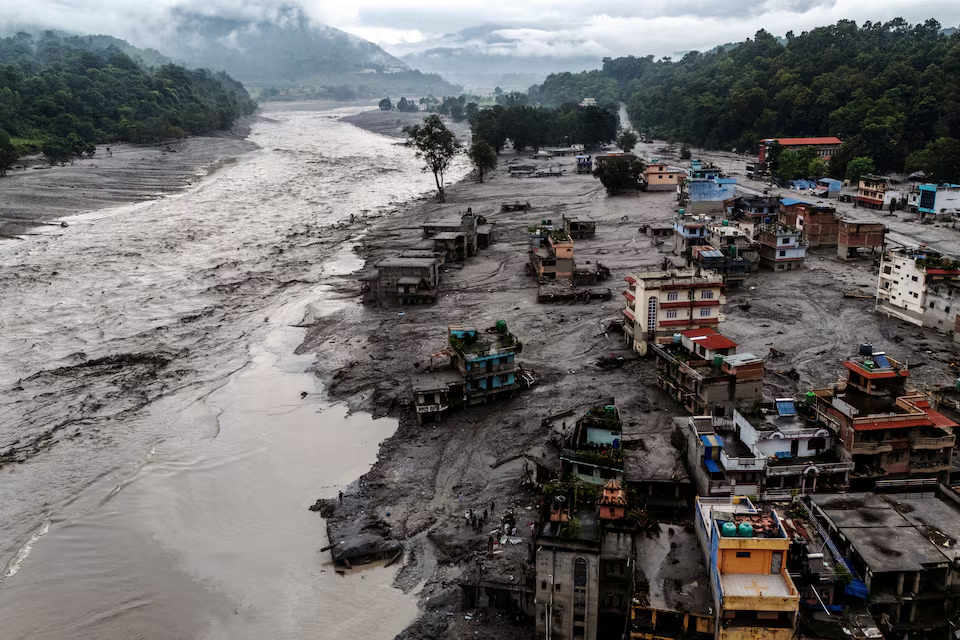
Nepal’s devastating floods have claimed more than 1,000 lives, while thousands of people remain missing as rescuers race to reach communities cut off by landslides, debris and collapsed infrastructure.
The death toll has risen to 1,050, according to Nepal’s disaster management authority, with around 4,000 people still unaccounted for, including 583 foreign nationals.
Rescue teams are facing increasingly difficult conditions nearly a week after a glacier collapse triggered a massive surge of ice, rock and mud through towns and valleys in the Himalayan nation’s border region with China.
Heavy machinery, helicopters and excavators have been deployed as rescuers concentrate on remote areas and hydropower facilities where hundreds of people are believed to remain trapped.
At least 639 people are still stranded at devastated hydropower stations, which have become a major focus of the rescue operation.
Specialist teams from Nepal, China and India have been working together to construct temporary bridges, reopen access routes and clear debris from damaged infrastructure.
At several hydropower sites, rescuers are also attempting to reach workers trapped inside collapsed tunnels.
Prime Minister Balendra Shah said more than 11,000 people had been rescued so far, while electricity and communications had been restored in some areas.
However, the scale of destruction continues to hamper relief efforts.
The United Nations Development Programme estimates that the floods have left about 2.2 million tonnes of debris, including damaged buildings, rocks and sediment.
“The amount of debris shows the scale of the destruction and the challenge communities face as they clear homes, roads and public spaces and begin to rebuild,” the UNDP said.
For survivors, the disaster has left many without homes or basic possessions.
“We did not have the time to grab anything before fleeing,” said a survivor from the badly affected Rasuwa district who walked to Nuwakot with other survivors.
“What we were wearing is the only pair of clothes we have. And even they are wet from rain.”
International assistance increases
As Nepal struggles to cope with the scale of the disaster, international assistance is increasing.
Chinese rescue teams have been working through the night to reopen access to the Nepali border, where steep gorges, unstable cliffs and fast-flowing rivers are complicating operations.
China has also announced plans to send DNA-testing specialists to affected areas, along with additional relief supplies, including drones and water-purification equipment.
South Korea is preparing to deploy a 44-member emergency relief team to support search-and-rescue operations in Rasuwa. Nine South Korean nationals working at a hydropower project in the area are among those reported missing.
Nepal had initially declined general offers of foreign search-and-rescue assistance but said it required specialised expertise and advanced equipment, including life-detection technology, large refrigeration units and prefabricated bridges.
Shah said more than $42 million in aid had already reached Nepal, with further contributions expected.
Hydropower sites become rescue hotspots
The search for survivors remains particularly urgent at hydropower projects, where large numbers of workers are believed to be trapped.
Shah said 279 workers had been rescued from hydropower facilities, with teams from Nepal, India and China involved in the operations.
But collapsed tunnels and floodwaters have made access extremely difficult at some sites.
At the Trishuli Hydro Power plant in Rasuwa, rescuers said entering the tunnels without heavy machinery was virtually impossible.
“Our first rescue observation at Trishuli Hydro Power plant shows that it is not humanly possible to go into the tunnel,” said mountain guide Asish Gurung, who is assisting with the rescue operation.
“We need machines like bulldozers and excavators… There may be about 500 people trapped inside,” he said.
Nepal has experienced rapid growth in hydropower development since the turn of the century, using its extensive Himalayan water resources to address domestic electricity shortages and increase power exports to neighbouring India.
The destruction of several hydropower facilities has therefore added further pressure to a country already struggling with the immediate humanitarian consequences of the floods.
Climate risks raise fresh concerns
The disaster has also renewed concerns over the growing risks faced by communities living in the Himalayan region as global temperatures rise.
Shah said Nepal needed to raise the issue more forcefully with the international community, particularly as the country depends heavily on glaciers for water resources and economic activity.
“The time has come for us to strongly raise before the international community the disasters we are experiencing as a consequence of climate change,” he said.
Kanni Wignaraja, a UN assistant secretary-general, said Nepal faced difficult choices as it confronted the increasing vulnerability of its mountain communities.
The country relies on its glaciers and Himalayan water systems for both water supplies and economic activity, leaving it particularly exposed to changes in the region’s climate.
China’s state broadcaster said the flooding had been caused by glacier instability linked to the long-term effects of global warming.
With thousands still missing and large areas inaccessible, rescuers continue to race against time to locate survivors while authorities begin the enormous task of clearing debris, restoring infrastructure and rebuilding communities devastated by the disaster.