



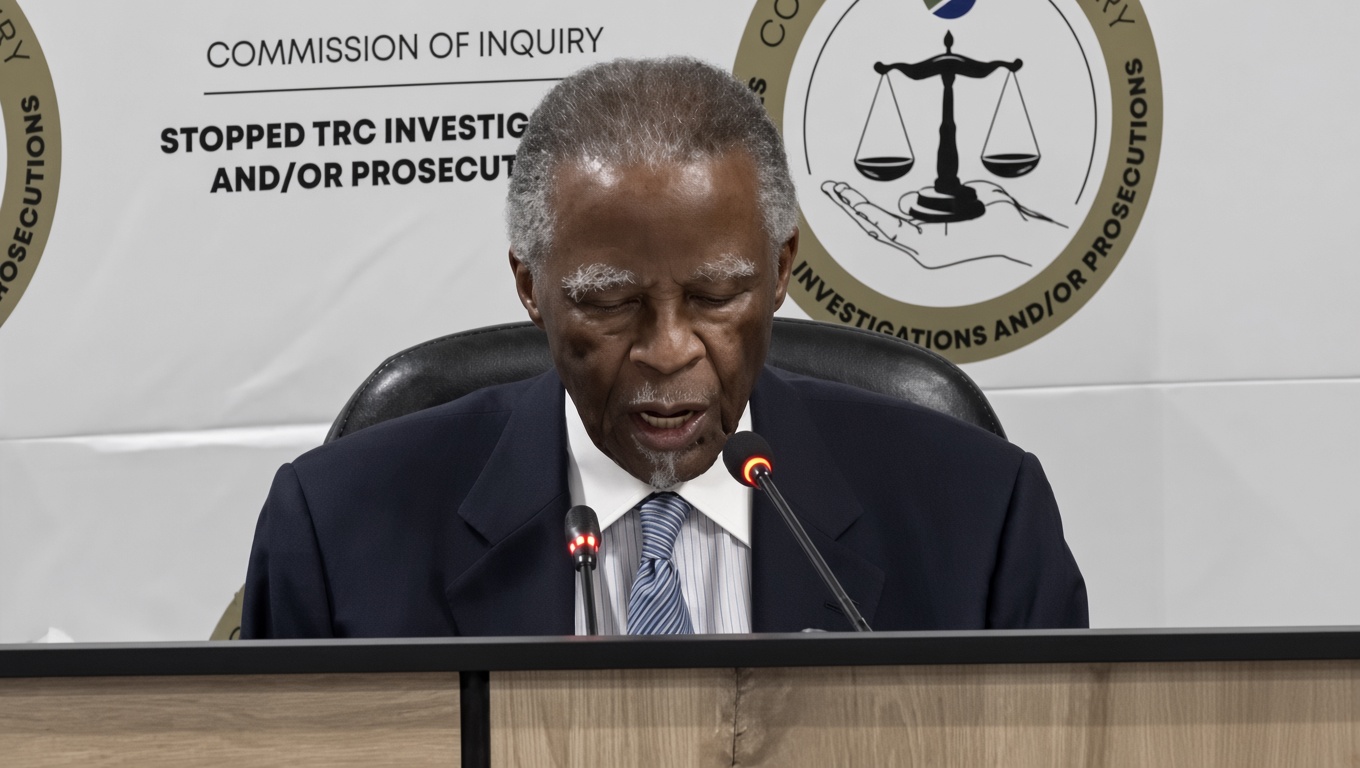
Former President Thabo Mbeki has rejected allegations that his administration interfered with the prosecution of apartheid-era crimes, telling the Commission of Inquiry into Stopped TRC Investigations and/or Prosecutions that claims linking him to an alleged agreement to halt prosecutions are based on hearsay.
Mbeki was responding to questions from evidence leader Advocate Ngwako Maenetje SC during his testimony before the commission, chaired by retired Constitutional Court Justice Sisi Khampepe in Johannesburg on Monday.
Reading from his statement, Mbeki addressed evidence presented by advocate Ackermann, who testified about an alleged agreement involving former senior members of the African National Congress (ANC) and the apartheid-era security establishment.
The allegation is that meetings took place between ANC leaders and senior members of the former South African Defence Force (SADF), at which it was agreed that a political solution should be found to avoid prosecuting members of the security forces.
Mbeki disputes the allegation, arguing that the evidence linking him to the alleged arrangement was not based on direct knowledge.
In his statement, he writes: “It is accordingly hearsay.”
He explains that Ackermann’s evidence was based on what attorney Jan Wagenaar allegedly told him, rather than on Wagenaar’s direct participation in the meetings.
Mbeki also addresses claims that he failed to instruct the relevant authorities to investigate and prosecute cases arising from the Truth and Reconciliation Commission (TRC).
He states that, despite receiving the TRC’s reports in 2003, he did not instruct ministers, the National Director of Public Prosecutions or police commissioners to ensure that cases were investigated and prosecuted.
The former president further rejects the suggestion that his administration interfered with the National Prosecuting Authority’s handling of TRC cases.
Referring to his earlier response to the allegations, Mbeki says he issued a statement through the Thabo Mbeki Foundation on 1 March 2024 denying that his administration had interfered with the NPA’s work.
The inquiry is examining allegations that cases involving apartheid-era crimes, identified by the TRC and referred to the NPA, were not properly investigated or prosecuted.
Mbeki says the history of the TRC process must be understood in the context of South Africa’s negotiated transition from apartheid to democracy.
In his statement, he writes that the choices facing the new democratic state were difficult, with one option being to prosecute those responsible for apartheid-era violations and another being to grant amnesty.
He argues that the TRC process was intended to balance accountability with reconciliation.
“The TRC was not established merely as an institution for investigating historical crimes,” Mbeki states, explaining that it formed part of a broader constitutional project aimed at addressing the conflicts of the past, acknowledging victims’ suffering, providing reparations and promoting national unity.
He also disputes suggestions that the executive or the NPA had the authority to exempt particular individuals from prosecution.
Mbeki maintains that the TRC’s amnesty process was governed by specific legal requirements, including full disclosure by applicants, and that the commission retained the power to refer cases to the relevant authorities for prosecution.
The former president’s testimony comes amid efforts by families and victims of apartheid-era crimes to hold the state accountable for the failure to pursue cases referred by the TRC.
The commission is also scheduled to hear evidence from former justice minister Brigitte Mabandla, former intelligence minister Ronnie Kasrils and former safety and security minister Charles Nqakula.
Their testimony is expected to shed further light on decisions taken by the former government and prosecuting authorities concerning apartheid-era crimes.

