


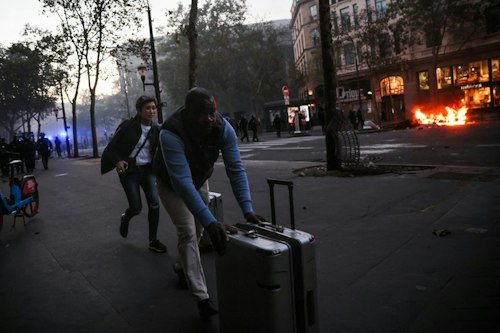
French President Emmanuel Macron is facing mounting political pressure after widespread violence during cost-of-living protests left nearly 1,000 police officers injured, public buildings damaged and businesses looted, raising questions about the government’s ability to maintain order.
Nearly 2,400 people were arrested during Saturday’s unrest, according to the Interior Ministry, in what officials described as some of the worst urban violence France has experienced in years.
As fresh clashes erupted in Paris on Sunday, Macron sought to reassure the public that authorities would take a tougher approach, while promising an investigation into the security response and support for businesses affected by the destruction.
In a televised address, the president said local authorities could ban certain demonstrations in the coming days if necessary. However, he stopped short of declaring a state of emergency or imposing a curfew.
“Tonight, we all feel anger and shame,” Macron said, condemning the destruction of public buildings and the looting of hundreds of businesses.
He distinguished between demonstrators with “legitimate demands” and those responsible for violence, vowing an uncompromising response to what he described as agitators and criminal elements.
Opposition questions government’s grip
The unrest has provided fresh ammunition for Macron’s political opponents ahead of France’s upcoming presidential election, in which he cannot stand for another consecutive term.
Marine Le Pen, leader of the far-right National Rally, said the government was “running on fumes, exhausted and disoriented”, accusing the administration of appearing incapable of containing the crisis.
Jean-Luc Mélenchon, leader of the hard-left France Unbowed party, also warned that the situation could deteriorate into events that become uncontrollable.
The criticism comes as the government faces questions over intelligence gathering, preparations for the demonstrations and the effectiveness of its response to the violence.
Macron said he had asked Interior Minister Laurent Nuñez to “draw all necessary lessons”, particularly concerning intelligence and the anticipation of unrest. He said he expected clear answers.
Some opposition politicians have already called for Nuñez to be dismissed.
Violence continues despite calls for calm
Police faced renewed confrontations in Paris on Sunday, firing tear gas and stun grenades at hundreds of people gathered in a square following social media calls for an unauthorised demonstration.
Protesters threw bottles and rocks at officers, while authorities reported 108 arrests across the capital. At least five shops around Place de la République were looted, and other businesses in central Paris had their windows smashed.
In Lyon, police confronted youths attempting to loot a luxury clothing store, while a tourist office in the city centre was set alight during the previous day’s unrest.
The destruction has extended beyond France’s largest cities. In Limoges, a fire destroyed the 19th-century town hall, with local prefect Maurice Barate telling French news channel LCI that the blaze had been deliberately started.
The violence has also caused serious injuries. A 17-year-old boy lost his right hand after a crowd-control grenade exploded in Saint-Etienne, while a 17-year-old girl lost an eye in Mulhouse, according to prosecutors.
The scale of the damage has intensified concerns about the government’s ability to prevent further confrontations and protect public infrastructure.
Cost-of-living anger fuels demonstrations
Saturday’s protests brought together trade unions, school students and members of the Yellow Vests movement, which challenged Macron’s government during the early years of his presidency.
The demonstrations reflect broader anger over the cost of living and concerns about the prospects facing young people. Student protests had already been taking place for several weeks before the latest mobilisation.
Macron insisted that legitimate grievances must be separated from criminal acts, arguing that France’s political disputes should be resolved through democratic debate rather than violence.
“Our country deserves a fine presidential election,” he said, calling for political parties to debate their differences rather than allowing confrontation to dominate the streets.
He also promised assistance for affected businesses and pledged transparency over the conduct of security forces.
International reaction adds to political pressure
The unrest has drawn international attention, with US President Donald Trump blaming immigration for the violence in a social media post.
“France is burning!” Trump wrote, claiming that immigration from people he described as coming from an “entirely different world” had contributed to the country’s problems.
His comments added to an increasingly polarised debate as France’s political parties sought to frame the crisis in terms of security, immigration and economic hardship.
For Macron’s administration, the immediate challenge is to restore order while demonstrating that it can respond to the underlying grievances driving the demonstrations.
With the presidential election approaching, the government’s handling of the crisis could become a major political issue, particularly if further violence exposes continued weaknesses in its security preparations.
Macron has promised tougher action and accountability. Whether those measures can contain the unrest — without deepening public anger — remains a central test for his government.