



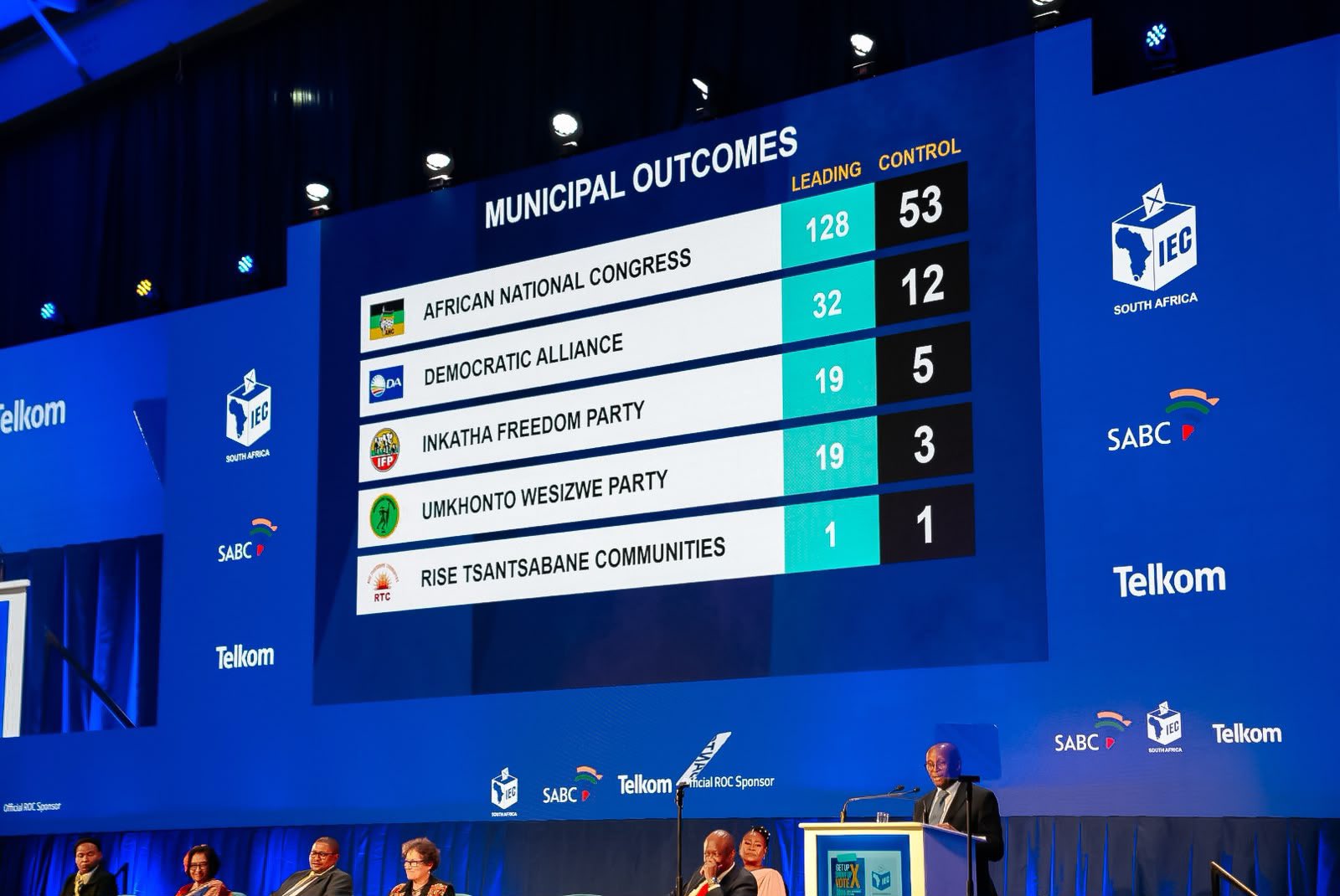
The Electoral Commission of South Africa (IEC) has officially concluded the 2026 Local Government Elections, describing the process as a major logistical achievement despite a last-minute Constitutional Court order that forced the reprinting of millions of ballot papers.
In his address following the conclusion of the elections on Sunday, Chief Electoral Officer Sy Mamabolo framed voting not merely as an electoral choice, but as an expression of constitutional dignity.
Quoting former Constitutional Court Justice Albie Sachs, Mamabolo said:
“The vote of each and every citizen is a badge of dignity and personhood. Quite literally, it says that everybody counts.
“In a country of great inequality such as South Africa, the right to vote declares that we all belong to the same nation and that our destinies are intertwined in a single interactive polity.”
According to Mamabolo, 15.2 million citizens participated in the elections across 23,696 voting stations nationwide.
To administer the elections, the IEC mobilised approximately 188,000 electoral staff, making it one of the largest temporary workforces ever deployed by a public institution in South Africa.
For the first time, the IEC introduced a Virtual Results Operating Centre (Virtual ROC), allowing political parties and candidates to access results, the Issue Tracker and other ROC applications remotely, without having to be physically present at a results centre.
The commission also transmitted preliminary results through an application programming interface (API) to media organisations, political parties and researchers as soon as they had been audited. The system received 14.3 million information requests.
The IEC deployed an additional 16,000 Voter Management Devices (VMDs) for the elections. Of these, 8,000 were newly procured, while another 8,000 were donated by the Gauteng Provincial Government. This brought the total fleet to 56,000 devices, up from 40,000 in 2021.
The devices were used to monitor voter participation, track ballot paper consumption, record staff attendance and report on the opening and closing of voting stations.
The IEC printed just over 100 million ballot papers for the 2026 elections.
However, the printing programme was significantly disrupted by a Constitutional Court order issued on 15 October 2026, which necessitated changes to candidate lists.
The order concerned 181 ANC candidates across six municipalities. In the interests of fairness and equal treatment, the IEC extended the same dispensation to a further 32 political parties in similar circumstances.
Consequently, approximately 28 million ballot papers were superseded and had to be reprinted, repackaged and redistributed within an already tight electoral timetable.
“This placed considerable demands on our logistical and administrative systems. Nevertheless, the exercise illustrated the importance of operational agility in election management,” Mamabolo said.