



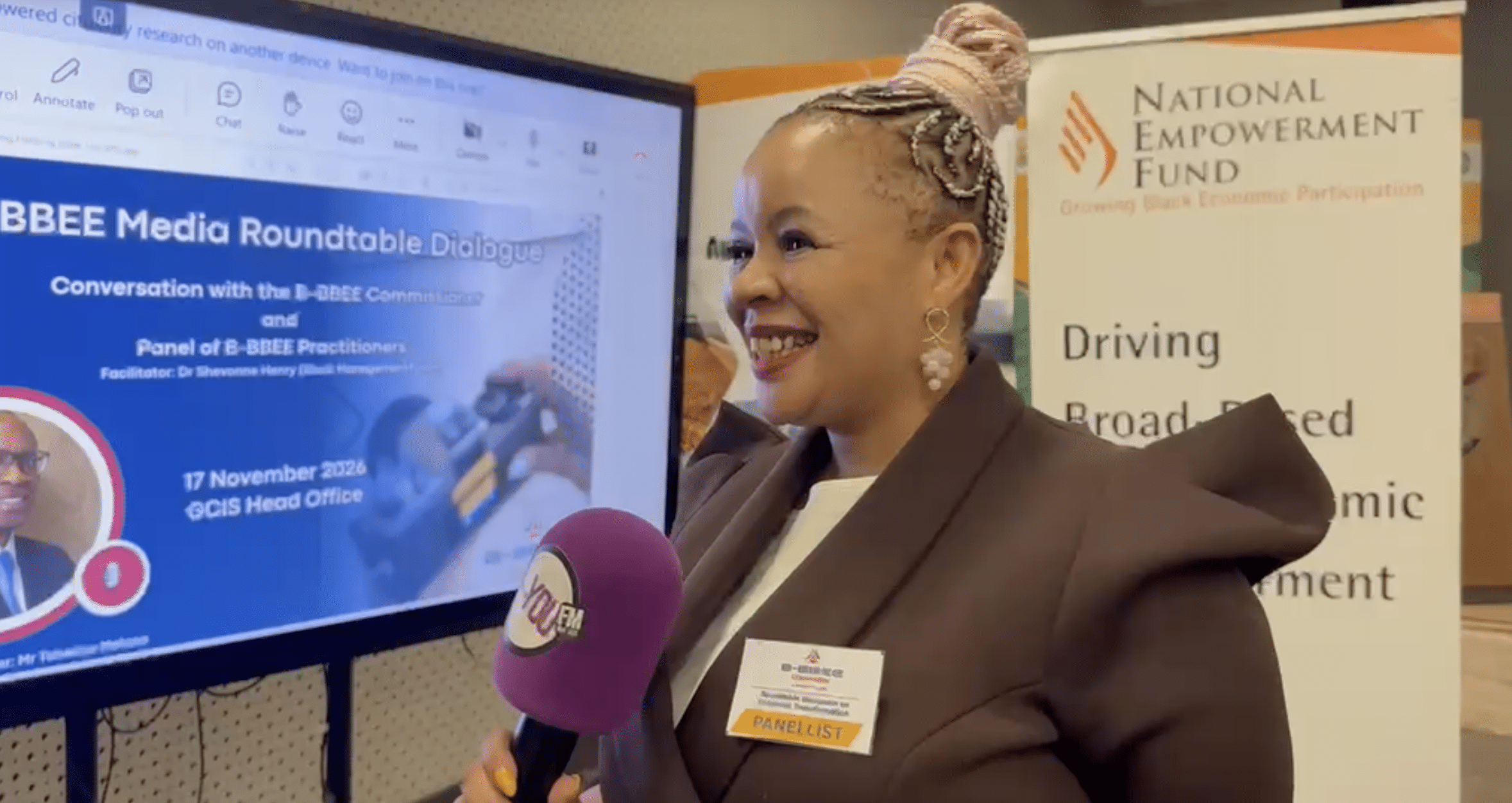
It is too early to debate the relevance of Black Economic Empowerment (BEE) and the country’s other redress laws, according to participants at a transformation roundtable in Pretoria.
The discussion, hosted by the Black Economic Empowerment Commission, comes as the DA, AfriForum and the Solidarity Movement prepare to challenge the country’s transformation laws in court, seeking to have them scrapped.
Andile Stemela, Divisional Executive at the National Empowerment Fund (NEF), said it was premature to question the relevance of BEE, arguing that the country could not undo centuries of inequality within just three decades of democracy.
“You can’t create inequality over more than 300 years and then, just 30 years into democracy, say, ‘No, let’s drop everything’,” Stemela said.
He said there had been a concerted effort over the past five years to discredit Broad-Based Black Economic Empowerment (BBBEE) and other transformation laws, despite what he described as their progress.
Stemela rejected claims that empowerment policies benefited only politically connected individuals, arguing that the programmes had supported a broader range of black businesses and beneficiaries.
Chairperson of Public Procurement Policy at the Black Business Council, Tumelo Mahusi, said criticism of BEE often focused on implementation failures rather than the policy itself.
Mahusi argued that transformation should not be considered complete until black businesses were thriving and economic representation reflected the country’s demographics.
She acknowledged concerns about fronting and corruption but said these were implementation challenges that should not be confused with the objectives of the policy.
The roundtable also rejected claims that black empowerment legislation had benefited only politically connected individuals. Speakers pointed to employment equity, skills development, enterprise development, procurement opportunities and community ownership schemes as some of the ways ordinary South Africans had benefited.
Stemela said the NEF had funded numerous transactions and disputed the perception that beneficiaries were exclusively politically connected individuals.
Mahusi added that beneficiaries were found across the country, including small businesses receiving procurement opportunities from municipalities and entrepreneurs participating in enterprise and supplier development programmes.
The discussion comes amid an intensifying legal and political battle over transformation, with the DA, AfriForum and the Solidarity Movement arguing that race-based redress is unconstitutional, unfair and has failed to meaningfully address poverty and inequality.
Government and pro-transformation business organisations maintain that redress remains necessary to address the economic exclusion inherited from apartheid.
Panellists acknowledged that transformation remained unfinished, arguing that scrapping the laws at this stage could deepen existing inequalities rather than address their shortcomings.
The legal challenge is expected to put the constitutionality, effectiveness and future of South Africa’s transformation policies under scrutiny.
For supporters of transformation, the message from Pretoria was clear: the debate should focus on improving BEE and strengthening its implementation, rather than scrapping it altogether.