


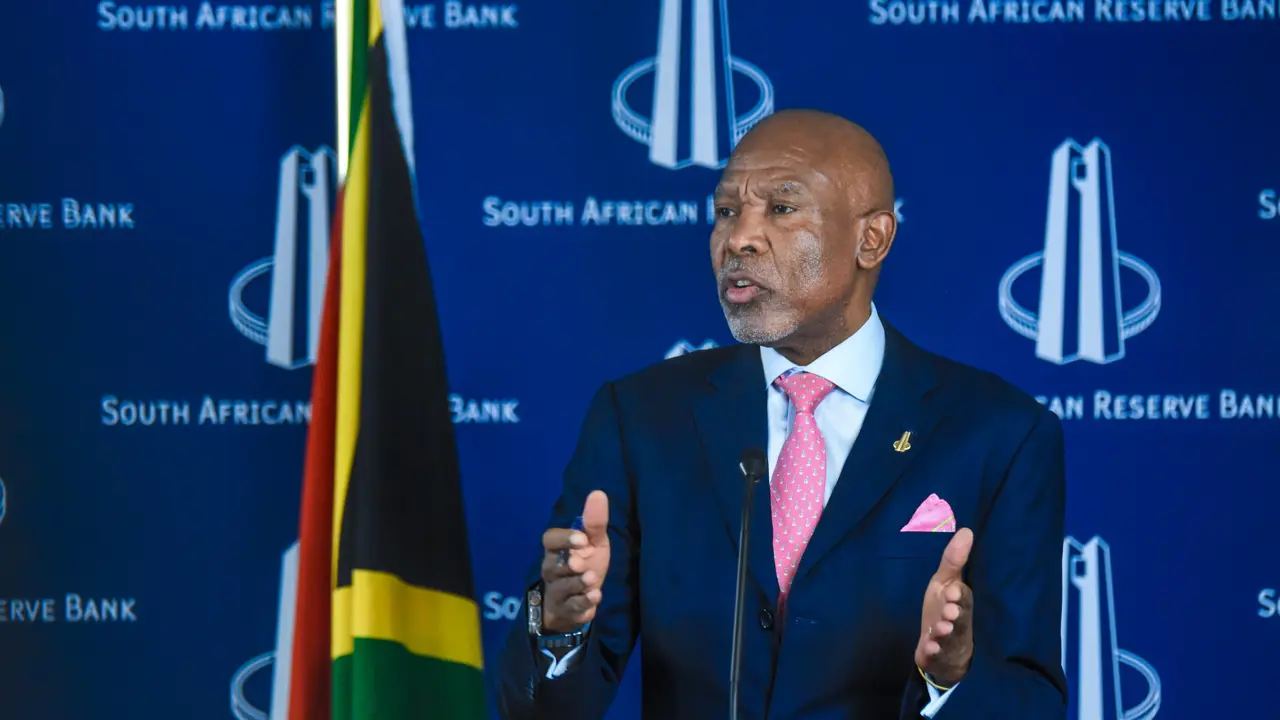
South African businesses, consumers and investors face renewed economic uncertainty after the South African Reserve Bank (SARB) decided to keep interest rates unchanged, despite accelerating inflation and a weakening rand.
The South African Reserve Bank has kept its benchmark repo rate unchanged at 7.25%, leaving the prime lending rate at 10.75%, as policymakers weigh growing inflationary pressures against the country’s fragile economic recovery.
The decision was announced on Thursday, 19 November 2026, following the Monetary Policy Committee’s (MPC) latest meeting, chaired by Reserve Bank Governor Lesetja Kganyago.
However, the decision exposed divisions within the committee. Four members supported keeping interest rates unchanged, while three favoured an increase.
Inflation and a weakening rand raise concerns
The interest rate decision comes at a difficult time for South Africa’s economy.
Statistics South Africa reported that annual consumer inflation accelerated to 5.2% in October, up from 4.5% in September. This represents the highest inflation reading since May 2024.
Rising petrol and diesel prices have been among the major contributors to the increase, placing additional pressure on households and businesses already struggling with high operating costs.
Meanwhile, the rand has experienced a significant decline against the US dollar, briefly weakening to R17.35 before recovering slightly to approximately R17.22 on Thursday afternoon.
The currency’s performance has been influenced by a stronger US dollar and growing expectations that the US Federal Reserve could increase interest rates.
A potential US rate increase could make American investments more attractive relative to South African assets, putting further pressure on the rand.
A weaker currency also creates additional risks for South Africa because imported goods, fuel and production inputs become more expensive.
Why the Reserve Bank decided against another rate hike
Despite mounting inflation concerns, the MPC believes that the current monetary policy position remains sufficiently restrictive.
Governor Kganyago explained that the Reserve Bank had already implemented two policy adjustments earlier in 2026, making it appropriate to pause and assess their impact.
“After two policy adjustments this year, and with a moderately restrictive policy stance, we decided to pause for now,” Kganyago said.
However, the Governor warned that the Reserve Bank remains prepared to increase interest rates if inflation risks intensify.
He reiterated that the central bank remains committed to bringing inflation down towards its 3% target.
Businesses and consumers remain under pressure
The decision to maintain interest rates provides some relief to borrowers who were facing the possibility of another increase in monthly loan repayments.
Homeowners with mortgages, businesses relying on credit and consumers servicing personal loans will continue operating under the existing prime lending rate of 10.75%.
However, the absence of another interest rate increase does not mean South Africans are escaping rising living costs.
Higher fuel prices, currency weakness and persistent inflation could continue affecting household budgets and business profitability.
Import-dependent companies could face particularly difficult conditions as the weaker rand increases the cost of purchasing goods, machinery and raw materials from international suppliers.
Economists largely anticipated the decision
The Reserve Bank’s announcement was largely in line with market expectations.
According to a Bloomberg survey, 19 out of 20 economists expected the MPC to leave interest rates unchanged.
Some economists had also warned that another rate increase could place additional pressure on an already fragile South African economy.
The central bank’s inflation forecast remains largely unchanged from its September projections, with inflation expected to remain above 5% into early 2027 before gradually declining.
Kganyago explained that the anticipated moderation would partly reflect the changing comparison with previously elevated fuel prices.
What happens next?
South Africa’s economic outlook will depend heavily on inflation developments, international oil prices, exchange-rate movements and the direction of US monetary policy.
Although the Reserve Bank has opted against another rate increase, its warning that further tightening remains possible means borrowers and businesses cannot assume that interest rates have reached their peak.
For now, South Africans will have to navigate a challenging economic environment characterised by rising living costs, currency volatility and uncertainty over the direction of interest rates.
The coming months will be crucial in determining whether inflation begins to ease or whether renewed pressure forces the Reserve Bank to reconsider its decision.