


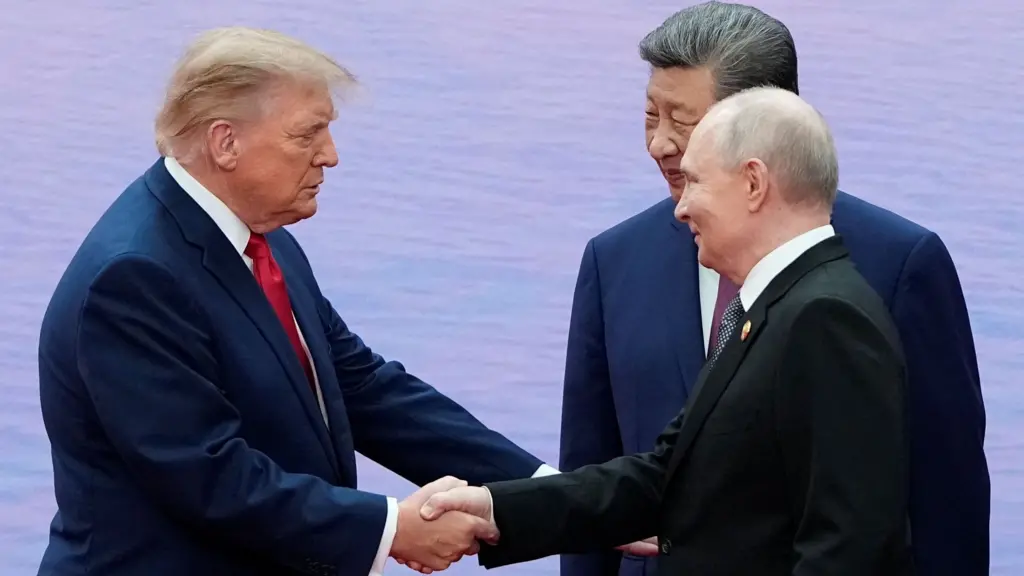
The leaders of the United States, Russia and China have issued a joint declaration on peace following an unprecedented 90-minute summit in Shenzhen, China. However, despite promises of international cooperation, the meeting ended without a concrete breakthrough on the war in Ukraine, nuclear disarmament or other major global conflicts.
In a meeting that could have far-reaching implications for international relations, US President Donald Trump, Russian President Vladimir Putin and Chinese President Xi Jinping brought three of the world’s most powerful leaders together on Thursday, 19 November 2026.
The historic trilateral meeting took place on the sidelines of the Asia-Pacific Economic Cooperation (APEC) summit in Shenzhen.
The three leaders discussed international security, nuclear weapons, energy supplies, United Nations reform and the ongoing conflicts affecting global stability.
Following the discussions, the countries released a four-point joint declaration committing themselves to maintaining strategic stability and strengthening international security.
Trump described the gathering as historic, while Putin called it an important chapter in diplomatic history. Xi Jinping emphasised the responsibility of major powers to protect global peace.
However, international observers have questioned whether the summit will produce meaningful results beyond diplomatic statements and symbolic political engagement.
Four major commitments emerge from the summit
The joint declaration outlined four areas where the United States, Russia and China intend to pursue cooperation.
First, the three countries committed to promoting reform of the United Nations to make the international organisation more effective in addressing global challenges.
Second, they announced plans to increase the production and supply of refined petroleum products, highlighting the importance of stable energy supplies for countries around the world.
Third, the leaders emphasised respect for the immunity of state officials and argued that the International Criminal Court (ICC) and similar institutions should not abuse their jurisdiction.
Finally, the three countries reaffirmed that nuclear war cannot be won and must never be fought. They committed to conducting dialogue aimed at reducing nuclear risks and preventing the proliferation of nuclear weapons.
The declaration was published by the White House and Chinese authorities following the meeting.
Despite these commitments, the agreement did not establish specific implementation deadlines, production targets or a detailed nuclear disarmament framework.
Ukraine war casts a shadow over peace declaration
One of the biggest questions surrounding the summit is whether the diplomatic engagement between Trump, Putin and Xi can contribute to ending Russia’s war against Ukraine.
Although the conflict was discussed, the joint declaration made no direct reference to Ukraine and did not announce a ceasefire or peace agreement.
Following the meeting, Putin accused Ukraine and European countries of being unwilling to make the compromises necessary to resolve the conflict.
He also warned that Russia would respond more forcefully to attacks on the Crimean Bridge.
The timing of the summit was particularly significant because Russian attacks on Kyiv continued while the leaders were discussing international peace in China.
Ukrainian authorities reported drone attacks, explosions and damage to buildings in the capital.
The developments raised further questions about the effectiveness of the peace commitments announced by the three leaders.
Trump and Putin’s relationship attracts international criticism
Trump’s warm public reception of Putin has also generated controversy in Washington and Europe.
During the meeting, Trump referred to the Russian president as his friend, describing their relationship as positive.
The comments prompted criticism from Democratic Senator Jeanne Shaheen, who described Putin as a war criminal.
Former British foreign secretary Jeremy Hunt also criticised the summit, arguing that the meeting gave Putin greater international legitimacy while Russia’s war against Ukraine continues.
Meanwhile, some American lawmakers questioned whether Trump’s engagement with the Russian and Chinese leaders could undermine Western security interests.
The criticism reflects broader concerns about the changing relationship between Washington, Moscow and Beijing.
Energy markets could feel the impact
Beyond geopolitics, the summit’s energy commitments could attract significant attention from international markets.
The three countries announced plans to increase the production and supply of refined petroleum products, reaffirming the importance of stable energy flows.
The announcement is particularly important because energy security remains a major concern for governments and businesses dealing with geopolitical uncertainty, international trade restrictions and fluctuating fuel prices.
Russia remains a major international energy producer, while China and the United States are influential players in global energy markets.
However, the declaration did not provide details about how the proposed increase in petroleum production would be implemented or how international sanctions and existing trade restrictions would affect cooperation.
Consequently, any immediate impact on global oil and fuel prices remains uncertain.
Trump and Xi discuss artificial intelligence
Another significant development emerged after Trump revealed that he and Xi had discussed artificial intelligence during his visit to China.
According to Trump, both leaders recognised the importance of introducing safeguards around advanced artificial intelligence technology.
The US president indicated that they supported having at least minimal guardrails, although no detailed regulatory framework or formal agreement was announced.
The discussion highlights the growing importance of artificial intelligence in relations between the world’s two largest economies.
Competition over advanced technology, semiconductor manufacturing and AI development remains a major issue in US-China relations.
Nuclear weapons remain a major concern
The declaration’s nuclear security commitments are among its most important elements.
The United States, Russia and China possess significant nuclear capabilities, making their relationship central to international security.
Xi called for stronger efforts to prevent nuclear war, while the three countries agreed to engage in dialogue on reducing nuclear risks and preventing nuclear proliferation.
However, the summit did not produce a new nuclear arms control agreement.
The discussions come amid concerns about the future of existing arms control arrangements and the possibility of renewed competition between major nuclear powers.
The real test will be whether the countries move beyond diplomatic language and establish practical measures to reduce nuclear threats.
Putin raises possibility of attending G20 summit
Another development following the meeting was Putin’s indication that he could consider attending the December 2026 G20 summit in Miami.
His possible attendance would be diplomatically significant, given the tensions between Russia and Western governments over the war in Ukraine.
Putin indicated that his participation would depend on circumstances in Russia and discussions with Trump.
Such a visit could create further diplomatic complications for European leaders and other Western governments expected to attend.
What happens next?
The Shenzhen summit has demonstrated that Washington, Moscow and Beijing are prepared to engage directly on issues affecting global security and economic stability.
However, the absence of a concrete agreement on Ukraine, the lack of a new nuclear arms control framework and uncertainty surrounding energy cooperation highlight the limitations of the meeting.
China’s role as host has also strengthened its visibility as an international diplomatic power, while Trump and Putin have used the gathering to reaffirm their willingness to engage directly.
For the international community, the central question is whether the three leaders can turn their promises into meaningful action.