



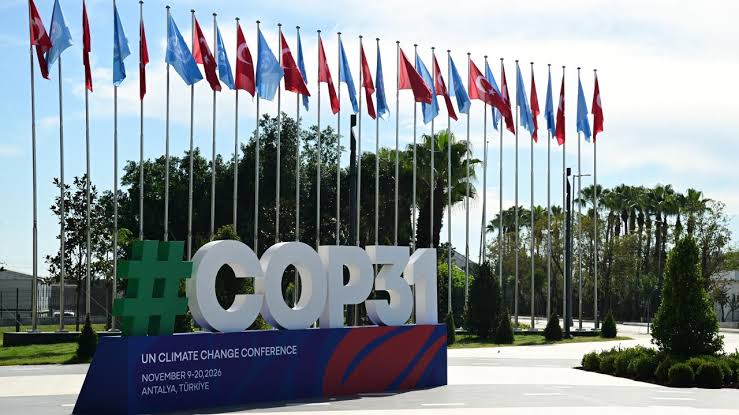
United Nations Secretary-General António Guterres has expressed deep disappointment after the COP31 Climate Summit in Antalya, Türkiye, ended without consensus, following disagreements over the transition away from fossil fuels.
The deadlock was confirmed by COP31 President Murat Kurum, who also serves as Türkiye’s Environment Minister.
Addressing delegates, Kurum acknowledged that countries had failed to reach an agreement on the proposed text, meaning the decisions could not be adopted.
“I understand that there is no agreement on this text. For that reason, these decisions have not been adopted. There is nothing to do, we did all that we could. Since there are 196 countries, they will make the decision and we will respect their decision,” said Kurum.
One of the major sticking points was whether countries should explicitly reaffirm the COP28 commitment to transition away from fossil fuels.
According to Kurum, fossil fuel-exporting nations, including Saudi Arabia, Russia and India, resisted calls to phase out coal, oil and gas. Meanwhile, the European Union, the United Kingdom, Panama, Pacific island nations and more than 130 countries opposed a draft agreement that omitted explicit references to fossil fuels.
Guterres said he was deeply disappointed that the summit had ended without an overarching agreement, sharing the frustration of those who had expected governments to take stronger action against the climate crisis.
“I am deeply disappointed that COP31 has ended without consensus on an overarching outcome. I share the very profound frustration of all those who expected governments to rise to the moment the climate crisis demands.
“But this setback does not change the facts. There may be no consensus in the negotiating room, there is no ambiguity in the science,” said Guterres.
He warned that global temperatures continue to break records, climate impacts are intensifying and greenhouse gas emissions remain dangerously high.
“Every delay makes our task harder and more costly. The world is now poised to exceed the globally agreed limit of a 1.5-degree temperature rise.
“The window to keep that overshoot as short and shallow as possible is rapidly closing. The take-home message from COP31 is clear: the world must do much more to confront the climate crisis – and it must do it now,” he warned.
The UN chief also cautioned against allowing countries and industries that profit from fossil fuels to influence decisions on addressing climate change.
He maintained that fossil fuels remain the primary driver of global warming, warning that continued dependence on coal, oil and gas was worsening climate impacts, exposing economies to price shocks and undermining energy security.
“The continued addiction to coal, oil and gas is fuelling climate chaos, exposing economies to price shocks, and undermining energy security. We can’t put out the fire while pouring fuel on it.
“Yet powerful fossil fuel interests continue to take a page from Big Tobacco’s playbook: distorting the science, delaying policy, blocking action, and piling up huge profits while people everywhere pay the price,” Guterres said.
He called on countries to commit to rapid emissions reductions, urging major emitters to take the lead and deliver on climate finance commitments.
Guterres stressed that developing countries, which have contributed least to the climate crisis, should not be left to bear its most severe consequences.
“The countries that did least to cause this crisis cannot be left to face its worst consequences alone. This is a matter of climate justice,” he said.

