



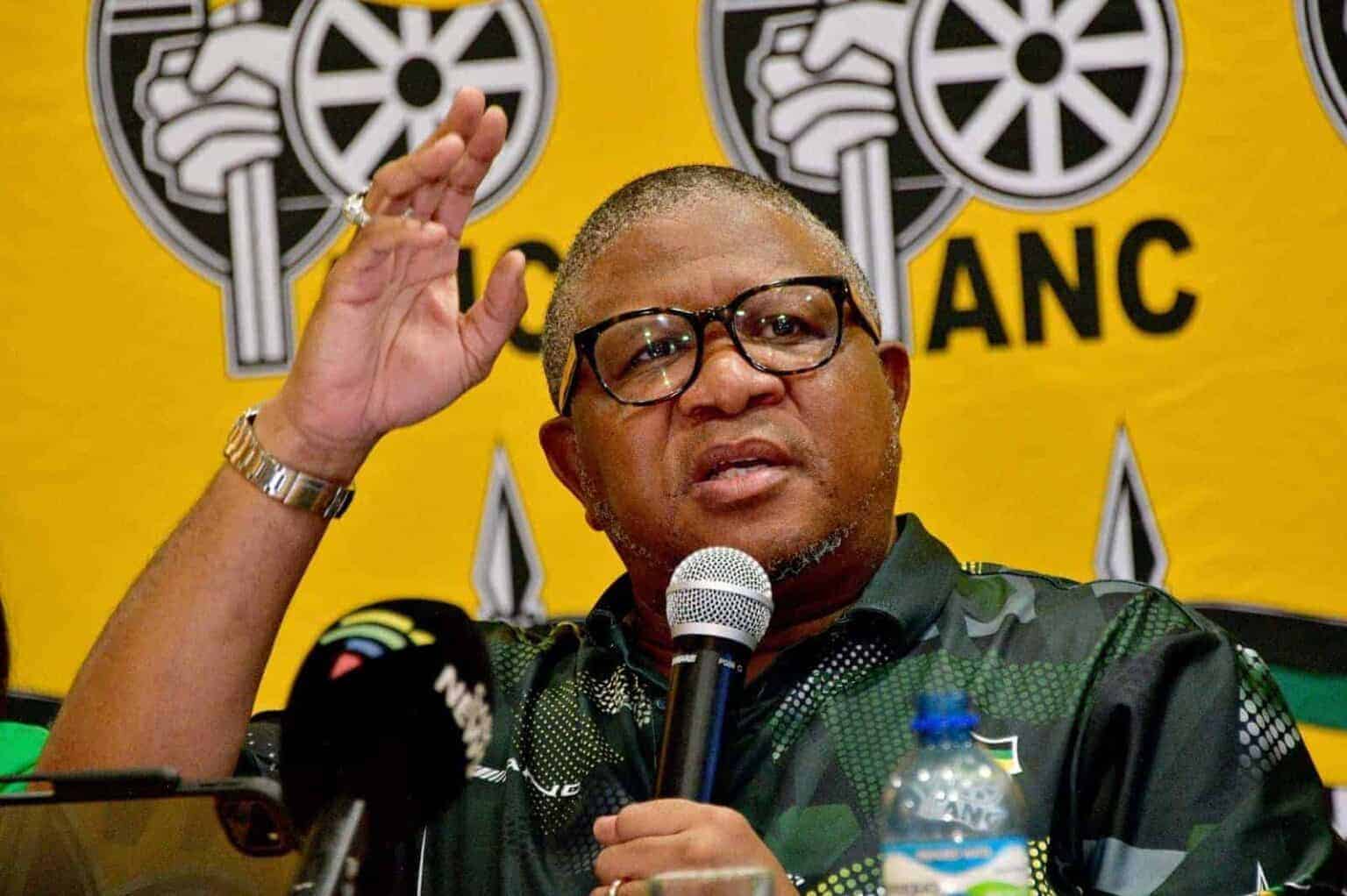
ANC Secretary-General Fikile Mbalula has rejected former president Thabo Mbeki’s call for President Cyril Ramaphosa and the ANC’s entire top seven leadership to consider resigning following the party’s disastrous performance in the 2026 local government elections.
Mbalula insists there is no discussion within the ANC about Ramaphosa stepping down, maintaining that the party’s leadership was elected to serve a full term.
“Leadership is elected for a full term. And in this term, we have had our own ups and downs, in particular, the last election and this election. It requires deep reflection by the leadership of the ANC.
“The president is not going anywhere, and there are no such considerations in the ANC of the president stepping down,” Mbalula said.
His remarks directly challenge Mbeki, who recently argued that Ramaphosa and the ANC’s top leadership should take responsibility for the party’s dramatic electoral decline.
Mbeki calls for leadership to take responsibility
Speaking on Dr Mbuyiseni Ndlozi’s African Renaissance Podcast, Mbeki responded to reports that Ramaphosa had offered to resign following the ANC’s disappointing election performance.
The party’s national vote share reportedly dropped from 45.59% in the 2021 local government elections to 30.76% in 2026. Mbalula himself described the latest result as a “catastrophe”.
Mbeki said he believed Ramaphosa would have been right to resign if reports of his willingness to step down were accurate.
“And when I saw that, I said, I think he’s taking the correct position. Because normally, in all of these democratic countries where you have a major disaster like that, the leaders resign. They take responsibility.
“We are at fault for this, what Mbalula called a catastrophe. How do you continue to lead if you are responsible for a catastrophe?” Mbeki asked.
The former president went further, questioning the performance of the entire ANC top seven, which includes Ramaphosa, Deputy President Paul Mashatile, National Chairperson Gwede Mantashe, Mbalula, First Deputy Secretary-General Nomvula Mokonyane, Second Deputy Secretary-General Maropene Ramokgopa and Treasurer-General Gwen Ramokgopa.
Mbeki also questioned what the ANC could point to as a significant achievement under Ramaphosa’s leadership since he became party president in 2017 and president of South Africa in 2018.
“President Ramaphosa was elected president of the ANC in 2017 and president of the Republic in 2018. We are now in 2026. What has happened between 2018 and 2026 of a positive nature that you can point to?
“The economy goes down, levels of unemployment increase, levels of poverty increase, levels of violence and crime in the society increase, ANC loses massive support in terms of the people. Nothing positive happens,” Mbeki said.
Mbalula accuses Mbeki of undermining party discipline
Mbalula dismissed reports of Ramaphosa’s possible resignation, arguing that there is no formal ANC process or decision supporting such a move.
He also criticised Mbeki for publicly attacking the party’s leadership through a podcast rather than raising his concerns through the organisation’s internal structures.
“It’s not constructive to go to a real podcast and blast leadership and want to be listened to after. No, it’s not right. It can’t be right. And we are not a movement that closes its ears from criticism.
“We are not. We accept dissent, but dissent cannot be equated to lawlessness, where the organisation falls apart. We are a movement in crisis,” Mbalula said.
His comments suggest that while the ANC leadership acknowledges the severity of its electoral decline, it remains opposed to calls for an immediate leadership shake-up.
Ramaphosa rules out resignation
Ramaphosa has also dismissed reports that he intends to resign, describing them as “preposterous”.
The president has indicated that he intends to remain in office until the end of his term in 2029.
Mbalula’s position is that the ANC must respond to its electoral setbacks through introspection, organisational renewal and improved service delivery rather than creating a leadership vacuum.
His argument comes at a particularly sensitive time for the governing party, which faces the challenge of navigating coalition negotiations across 140 hung municipalities.
ANC Youth League pushes back against Mbeki
The ANC Youth League has also challenged Mbeki’s criticism, arguing that the party’s institutional decline did not begin under Ramaphosa’s leadership.
The youth organisation has pointed to the 2007 Polokwane conference, where Mbeki lost his bid for a third term as ANC president, as a significant turning point in the party’s internal political trajectory.
It has further argued that the ANC’s older generation of leaders cannot position itself as the solution to a crisis it also helped create.
The intervention highlights the growing divisions within the ANC over who should take responsibility for the party’s declining electoral support and what measures are needed to restore public confidence.
ANC divided over leadership accountability
Mbeki’s intervention has exposed a deepening divide within the ANC.
Some senior party members have reportedly echoed his position, arguing that the election results demonstrate that voters have lost confidence in the current leadership and that decisive action is needed before the 2029 national elections.
Others, led by Mbalula, believe that forcing the leadership to resign at this stage would weaken the organisation further and undermine efforts to rebuild the party.
The central question is no longer whether the ANC is facing a political crisis, but whether its current leadership has the credibility and capacity to reverse its decline.
For now, Mbalula has made the party leadership’s position clear: Ramaphosa will not be forced out, there are no plans for an early leadership change, and the ANC’s response will focus on reflection, renewal and rebuilding.
Reflection, yes. Resignation, no.