

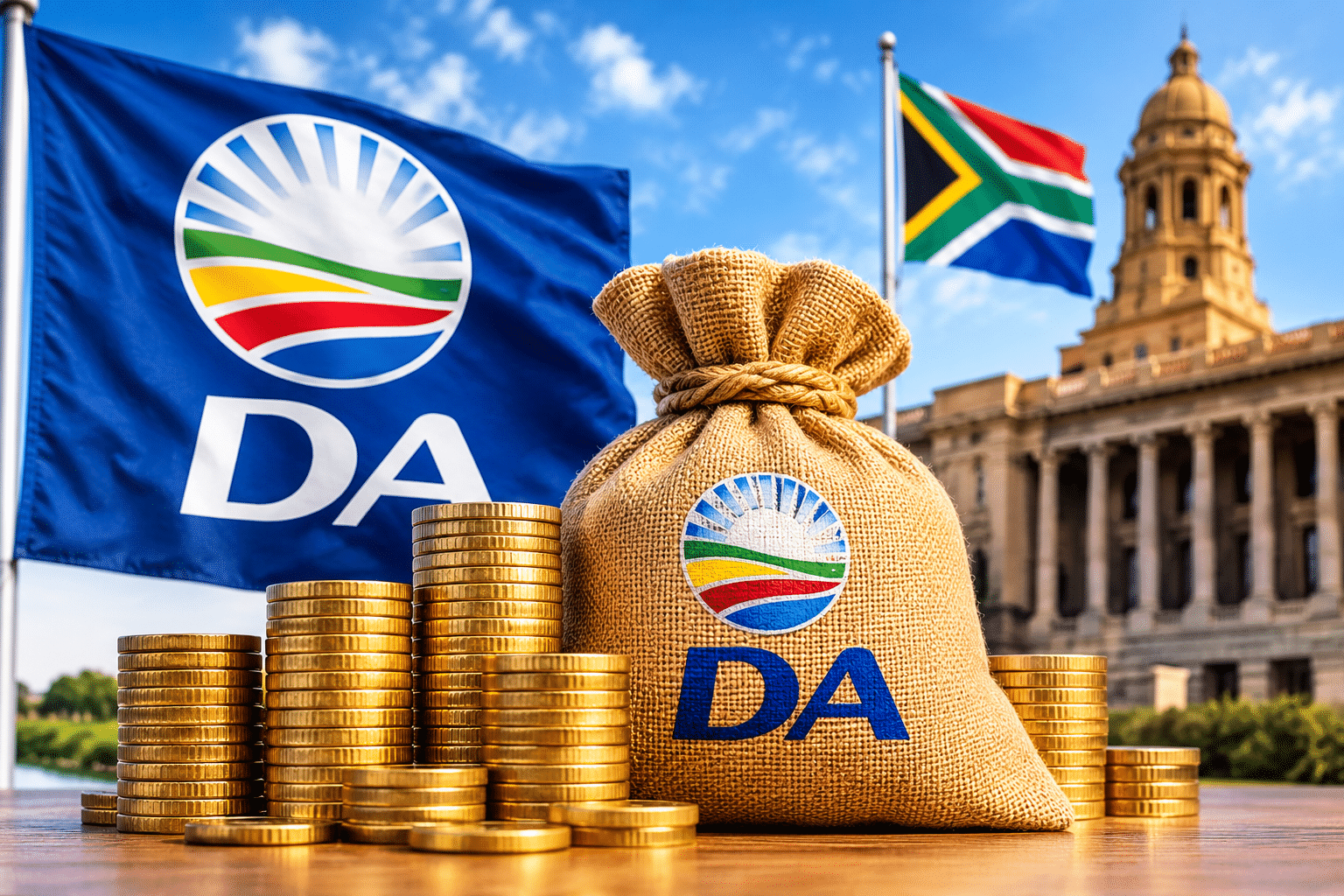
The Democratic Alliance (DA) received more political donations in three months than all other political parties combined, reinforcing its position as South Africa’s best-funded political party ahead of the 2026 Local Government Elections.
According to the Independent Electoral Commission’s (IEC) declaration for the second quarter of the 2026/27 financial year, covering 1 July to 30 September 2026, nine political parties declared R153.1 million in donations.
The DA alone received R82,926,672.72, accounting for approximately 54.2% of the declared total.
When late and cumulative declarations are included, the overall reported figure for the quarter rises to R168,216,407.95.
The IEC described the quarter as one of the highest fundraising periods since the Political Funding Act came into effect in 2021, with political parties intensifying fundraising efforts ahead of the 4 November elections.
DA raises more than five times the ANC’s donations
The funding gap between the DA and other political parties was significant.
The declared donations were as follows:
| Political party | Donations |
|---|---|
| DA | R82,926,672.72 |
| ANC | R15,000,000 |
| Patriotic Alliance | R13,485,000 |
| ActionSA | R11,613,000 |
| Service Delivery Party | R9,400,000 |
| IFP | R8,307,500 |
| BOSA | R6,000,000 |
| ACDP | R6,000,000 |
| Afrika Mayibuye Movement | R400,000 |
The DA raised more than five times the amount declared by the ANC and exceeded the combined donations of several rival parties.
It also marked the DA’s second consecutive quarter as the country’s leading fundraising political party.
Of the DA’s total donations, R69,688,233.68 came in cash, while R13,238,439.04 was received in non-monetary, or in-kind, contributions.
Who is funding the DA?
The IEC disclosures reveal contributions from several wealthy individuals, businesses and trusts.
Among the biggest contributors were:
- Ball Family Trust, linked to Antony Charles Ball: R16.028 million, the largest single contribution to a political party during the quarter.
- Martin Paul Moshal: R15 million, paid in three instalments of R5 million between July and September.
- Meaker family-linked companies: R10 million collectively through several associated entities.
- African Rainbow Minerals and Harmony Gold, both associated with Patrice Motsepe: approximately R4.13 million each, bringing their combined contributions to R8.27 million.
- Nick Jonsson: R2.5 million.
- Mary Slack: R2 million.
- Jufrapi Investments, linked to Petrus Johannes Mouton: R2 million.
- Oryx Partnerof, linked to Christoffel Hendrik Wiese: R2 million.
- Safdev SSDC, linked to Hendrik Francois Bekker: R1 million.
- Robert Breyer: R1 million.
Other contributors included Main Street 1564, the Friedrich Naumann Foundation, the Danish Liberal Democracy Programme, Queen Sheba Brands and Discovery Central Services.
Moshal spreads R54.5 million across six political parties
Although the DA received the largest individual contribution from Moshal, the businessman also distributed substantial donations to other political parties.
According to the IEC, Moshal donated R54.5 million across six parties during the quarter.
The contributions were:
- DA: R15 million
- Patriotic Alliance: R10 million
- ActionSA: R10 million
- IFP: R7.5 million
- BOSA: R6 million
- ACDP: R6 million
The IEC highlighted this distribution of donations, raising questions about whether similar financial support could be directed towards the Multi-Party Democracy Fund (MPDF).
Unlike direct contributions to individual political parties, the MPDF supports the multiparty democratic system as a whole.
However, the fund received only R250,000 during the quarter, with Discovery Central Services being its sole contributor.
ANC declares R15 million from Batho Batho Trust
The ANC declared just one donation during the quarter: R15 million from the Batho Batho Trust, received on 13 August 2026.
This brought the trust’s cumulative contributions to the ANC for the 2026/27 financial year to R30 million, reaching the legal maximum after an earlier R15 million contribution in the first quarter.
Big donations, but did the DA secure political power?
Despite its substantial fundraising advantage, the DA’s financial strength did not translate into outright control of Gauteng’s major metropolitan municipalities.
In Johannesburg, the DA secured the most votes and 91 council seats but was excluded from the coalition government formed by the ANC, ActionSA and EFF.
In Tshwane, the DA also lost the mayoral position to ActionSA’s Dr Nasiphi Moya.
The figures therefore highlight an important distinction in South African politics: financial resources can strengthen a party’s electoral campaigns and organisational capacity, but they do not automatically guarantee political power.
The DA remains the leading recipient of declared political donations, yet coalition negotiations and council arithmetic continue to play a decisive role in determining who governs major municipalities.
IEC flags political funding compliance failures
The IEC also raised concerns about compliance with political funding disclosure requirements.
The National Freedom Party failed to submit its audited Annual Financial Statements within the required timeframe, while BOSA submitted its statements late.
Both parties were issued directions in terms of Section 15 of the Political Funding Act.
The commission said the figures demonstrate the strong relationship between election cycles and political fundraising, highlighting the importance of transparency, disclosure and oversight during periods of heightened electoral activity.
For now, the IEC’s figures reveal a clear financial picture: the DA continues to attract the largest share of declared political donations in South Africa, even as its ability to convert financial strength into governing power remains shaped by the country’s coalition politics.