


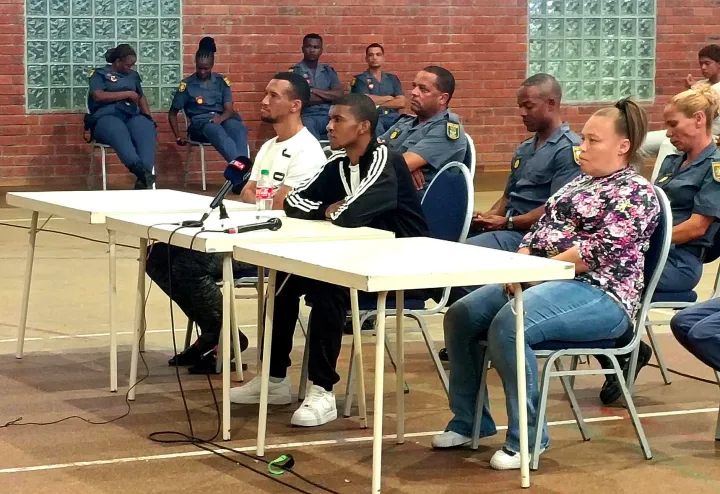
At the Western Cape High Court, Steveno van Rhyn, one of the accused in the high-profile Joshlin Smith case, detailed harrowing claims of police torture during his interrogation, asserting he was subjected to brutal treatment without ever witnessing the missing child on the day in question. This alarming testimony came to light through his lawyer, Nobahle Mkabayi, who presented van Rhyn’s plea explanation at court proceedings held in the White City Multipurpose Centre in Saldanha.
Van Rhyn stands trial alongside Jacquen ‘Boeta’ Appollis and Kelly Smith, with all three charged with kidnapping and trafficking in persons, alongside denying any wrongdoing. The case has captured significant media attention due to its disturbing nature and the serious accusations involved.
In his statement, van Rhyn, a cell phone repairman, indicated he had a close friendship with Appollis, mentioning their shared drug use, and further claimed to have been familiar with Kelly Smith through her relationship with Appollis, including her three children who lived with them. Van Rhyn recounted the events of February 19, 2024, stating that he first visited Boeta’s residence to ask for drugs before eventually partaking in smoking drugs with them. Throughout the day, he stated he did not see any of Kelly’s children, nor did he witness Smith’s youngest child.
The timeline van Rhyn provided continued with a series of visits to and from Boeta’s home, where he appeared engrossed in activities relating to his business, fixing cell phones and negotiating purchases of stolen items, all while denying ever seeing Joshlin. His account paints a picture of a normal day spent in casual exchanges, devoid of any evidence that would implicate him in the child’s disappearance.
However, the stark turn in the courtroom narrative emerged when van Rhyn recounted his apprehension by police while hitch-hiking into Saldanha. Describing an alarming encounter in which he was forced into a double cab bakkie by armed officers, van Rhyn alleged torture ensued, detailing violent threats to his life. He claimed he was mercilessly assaulted, handcuffed, and subjected to suffocation with a plastic bag, whereby he desperately had to agree to provide information, fearing for his life.
“They promised to kill me and burn me in the sand or throw me in the ocean,” van Rhyn recounted, illustrating a desperate plea to survive the ordeal. The sustained violence inflicted upon him by several officers led to a panicked resolve to comply with his captors’ demands during their interrogation.
He contended that, despite having previously communicated the details of what he knew, the police intimidation and relentless torture forced him into a precarious position—one of potential death if he did not conform to their expectations of a confession.
Lamentably, van Rhyn added that upon seeking a medical examination following the episode, he had been warned to keep silent about the details of his injuries if he wished to live. As the trial progresses, the courtroom remains tense, grappling with the volatilities of the case and the shocking allegations of police brutality.