


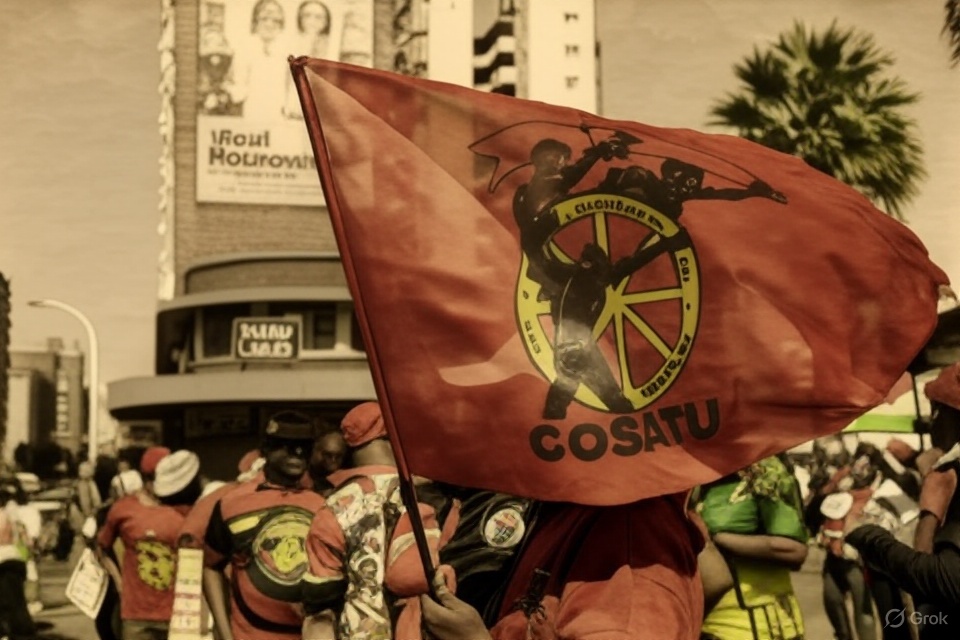
The Congress of South African Trade Unions (Cosatu) has sounded the alarm over the One Stop Border Bill, warning that its lack of clarity regarding the management of illegal migration and the expedited movement of goods could jeopardise local employment, businesses, and critical public service funding. The federation’s concerns were amplified during recent submissions to the Portfolio Committee on Home Affairs, where it was joined by the Catholic Parliamentary Liaison Office to voice its apprehensions about increasing corruption at border posts.
Matthew Parks, Cosatu’s Parliamentary spokesperson, articulated the federation’s dissatisfaction regarding the bill’s failure to distinctly outline the responsibilities of key entities, including the Border Management Agency (BMA), South African Revenue Service (SARS), South African Police Service (SAPS), and the South African National Defence Force (SANDF). He stressed that the lack of clear legislative mandates risks the BMA overstepping its bounds and infringing on the established roles of these institutions, particularly that of SARS.
“Failure to uphold and clearly state these mandates in the Bill could lead to unintended consequences, such as the BMA encroaching upon the constitutional responsibilities of SARS and other autonomous state organisations,” Parks warned, highlighting the potential for increased opportunities for corruption and mismanagement at border posts.
Additionally, Parks raised concerns about the impression that the One Stop Border Bill may encourage officials to bypass the collection of customs duties, suggesting that rushing the movement of goods could harm the state’s ability to generate revenue and protect local industry. “The collection of customs duties is not merely a revenue tool; it enforces tariffs that safeguard our local businesses, industries, and the livelihoods of South African workers,” he said.
Parks also admonished the government for not presenting the Bill for engagement at the National Economic Development and Labour Council (Nedlac), a decision he believes undermines crucial stakeholder discussions. “Nedlac is a place where businesses and labour can come together to seek resolutions. By bypassing this platform, the government is hindering productive dialogue that could help build a cohesive state,” he asserted.
Historically, Cosatu cautioned against the dangers of hastily liberalising border policies while underscoring the significant job losses experienced during the 1990s when South Africa’s borders opened too quickly, resulting in a sudden influx of inexpensive foreign goods. “If we cannot enforce control at our borders, how can we expect other nations to do the same?” Parks questioned, referencing past issues with the Southern African Customs Union and the mislabelling of products as locally produced when they originated from countries such as China.
In response to border efficiencies, a recent Time Release Study (TRS) conducted jointly by SARS and the Eswatini Revenue Service demonstrated noteworthy improvements in customs processing times. The study revealed that the turnaround time for cargo trucks exporting to Eswatini at the Oshoek/Ngwenya port of entry dropped dramatically from 1 hour 42 minutes to just 10 minutes. These improvements were achieved after identifying bottlenecks that previously led to extended delays, signaling possible paths toward smoother border operations.