


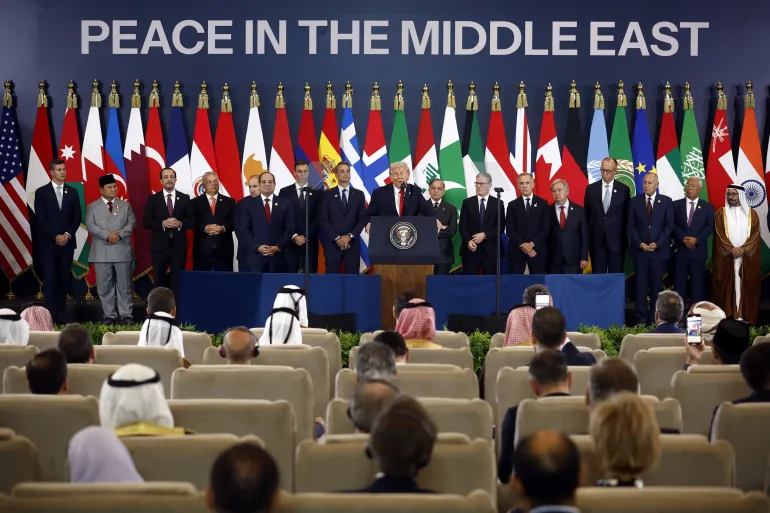
Political leaders from across the globe have gathered in Sharm el-Sheikh, Egypt, to ratify a ceasefire agreement in Gaza. The event, steered by United States President Donald Trump, also saw mediation support from influential regional players, including Egypt, Qatar, and Turkiye. This summit comes in the aftermath of Israel’s devastating two-year military campaign, which has left the Gaza Strip largely uninhabitable and claimed an alarming number of lives.
Addressing attendees on Monday, Trump painted a vision of hope and renewal for Gaza, emphasising the region’s potential as a burgeoning centre of development and investment. “A new and beautiful day is rising and now the rebuilding begins,” he stated, commending the collective efforts of those who brokered the fragile peace between Israel and the Palestinian group Hamas. “Rebuilding is maybe going to be the easiest part,” he assured, underscoring the United States’ perceived expertise in reconstruction.
Yet, under the backdrop of this hopeful rhetoric lies a stark reality that reflects the enormous toll of the Israeli offensive. Recent reports indicate that an estimated 67,869 people have perished in the conflict, with many more presumed buried beneath the rubble of destroyed homes. Al Jazeera correspondent Hani Mahmoud, reporting from Gaza, painted a harrowing picture: “There’s no place here for people to stay,” he lamented, as countless families surveyed what little remained of their neighbourhoods, now reduced to debris.
While discussions unfold about the future of Gaza, Trump’s remarks have been underlined by a narrative that prioritises Israeli security. “Gaza’s reconstruction also requires that it be demilitarised,” he insisted, signalling a complex interplay of international diplomacy and regional security concerns. These statements elicit a mix of relief and trepidation among Gazans, as they ponder the viability of sustained peace and reconstruction amidst a landscape of devastation.
Leaders from the Arab world, including Egypt’s President Abdel Fattah el-Sisi, voiced their support for the ceasefire but underscored the necessity of establishing a Palestinian state for any durable resolution. “Peace remains our strategic choice, and justice and equality in rights are essential,” he noted, highlighting a fundamental national aspiration that remains unfulfilled amidst ongoing hostilities.
However, achieving progress towards the creation of a Palestinian state seems daunting. Israel’s longstanding refusal to entertain the notion of Palestinian sovereignty casts a shadow over diplomatic efforts. Despite this, the United States has extended considerable military support to Israel, leading to mounting tensions both regionally and internationally regarding its role in the conflict.
Furthermore, the spectre of post-war governance looms large, particularly with the involvement of pro-Israel advocates such as former British Prime Minister Tony Blair and Trump’s son-in-law Jared Kushner in overseeing future developments in Gaza. Their participation raises critical concerns about the authenticity and legitimacy of the governance structures being proposed for a prospective Gaza administration.
Zeidon Alkinani, a lecturer at Georgetown University in Qatar, expressed cautious optimism about the summit. “We’re seeing these global leaders gathering together, ensuring that they’re all aligned, that they want to end this conflict,” he remarked. However, he posed a poignant question regarding the long-term sustainability of peace in the region: “How sustainable is the long-term future after this peace treaty?”