


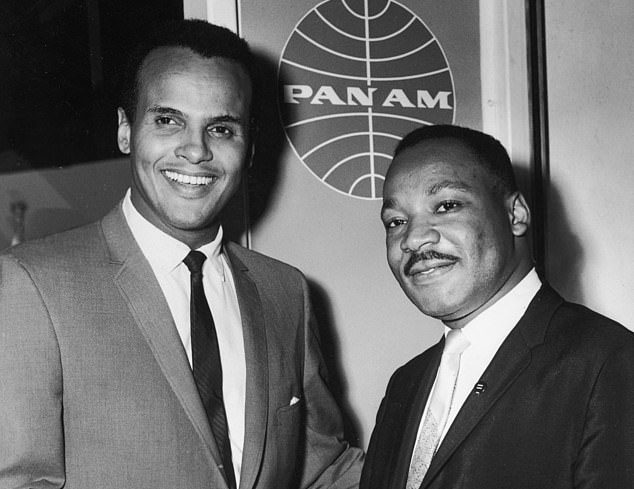
American singer Harry Belafonte has died of congestive heart failure at the age of 96, his spokesman has confirmed. The civil rights icon was pronounced deceased at his home in the Upper West Side of Manhattan with his wife Pamela by his side on Tuesday.
Belafonte made a splash in Hollywood in the 1950s, becoming a star with his hit songs Day-O (The Banana Boat Song) and Jump in the Line. That success ultimately led to leading roles in films like Carmen Jones and Island in the Sun.
But as he became more and more of a household name, Belafonte started to speak out against the racism he experienced in Hollywood as he described himself as a singer of music with ‘roots in the black culture of American Negroes, Africa and the West Indies.’
Following the news of his death, Sen. Bernie Sanders hailed Belafonte as ‘not only a great entertainer’ but also a ‘courageous leader in the fight against racism and worker oppression.’
Civil rights attorney Ben Crump also tweeted: ‘Through his extraordinary contributions, including his notable advocacy for human rights and social justice, he leaves an indelible mark on this world.’
And Bernice King, the daughter of Martin Luther King Jr., wrote: ‘When I was a child, #HarryBelafonte showed up for my family in very compassionate ways.
‘In fact, he paid for the babysitter for me and my siblings,’ she said, sharing a photo of him comforting Coretta at her father’s funeral service.
‘I won’t forget,’ King wrote. ‘Rest well, sir.’
Harold George Bellanfanti Jr. (whose father later changed the family’s name) was born in Harlem to West Indian immigrants in March 1927.
He grew up with family members who were often unemployed or ‘above the law,’ he later recalled, and in 1944, Belafonte dropped out of high school to join the Navy, where his black shipmates introduced him to the works of WEB Du Bois and other African American authors.
While stationed in Virginia, Belafonte met Marguerite Byrd, the daughter of a middle-class Washington family who was studying psychology at the Hampton Institute, and they married in 1948, going on to have two children together.
Following his discharge, Belafonte became interested in acting and enrolled under the GI Bill at Erwin Piscator’s Dramatic Workshop, where his classmates included Marlon Brando and Tony Curtis.
He first took the stage at the American Negro Theater, where he worked as a stagehand and became lifelong friends with fellow actor Sidney Poitier.
But he had trouble finding roles as a black man, and instead sought fame with music, developing his own takes on popular folk songs.
Belafonte’s album, Calypso, was said to be the first by a single artist to sell more than 1 million copies after it reached the tip of Billboard album charts in 1956 and stayed there for more than 30 weeks straight.
And by 1959, he was the most highly paid black performer in American history, with contracts for appearances in Las Vegas, at the Greek Theater in Los Angeles and at the Palace at New York.
Speaking of his hit song, The Banana Boat Song, in a 2011 interview, Belafonte told how the song is about rebellion.
‘When I sing the Banana Boat Song, the song is a work song,’ he said. ‘It’s about men who sweat all day long, and they are underpaid, and they’re begging the tallyman to come and give them an honest count — counting the bananas that I’ve picked, so I can be paid. And sometimes, when they couldn’t get money, they’ll give them a drink of rum.
‘There’s a lyric in the song that says, “Work all night on a drink of rum” People sing and delight and dance and love it, but they don’t really understand unless they study the song that they’re singing a work song that’s a song of rebellion.’ bbc/dailymail.co.uk