




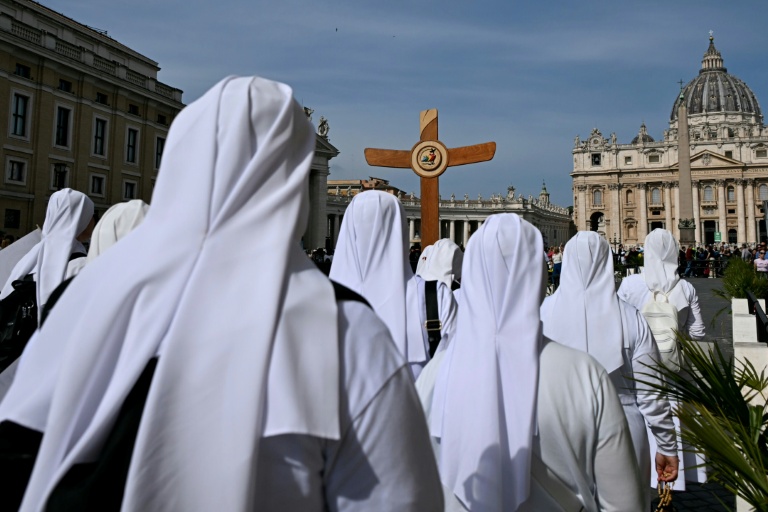
the scourge of sexual abuse among nuns is stepping out of the shadows, becoming one of the last Catholic taboos to be challenged. With incidents occurring at alarming rates, the burden falls on the shoulders of the next pope to confront a scandal that can no longer be ignored.
Last month, Sister Cristina Schorck, a 41-year-old Brazilian nun from the Daughters of Mary Help of Christians, walked through St Peter’s Square, sharing insights about the harrowing silence that has historically enveloped cases of abuse within the Church. “In the past, the nuns suffered a lot and couldn’t talk about it to anyone; it was like a secret,” she told AFP.
The death of Pope Francis has created uncertainty about the future of this dialogue, yet many believers are hopeful that his legacy will continue to inspire change. Under Francis, the Vatican hosted an unprecedented summit on clerical sexual violence in 2019, resulting in pivotal measures designed to break the silence. These moves, which included lifting the pontifical secret on abuse and creating mandates to report cases within Church structures, have established a vital avenue for victims to voice their experiences.
While progress is evident, the acknowledgment of abuse against nuns remains fraught with complexity. Sister Veronique Margron, the President of the Conference of Religious of France, described the situation as a duality of taboo and development. “It’s both still a taboo and something that has progressed because it’s never been talked about as much as it is today,” she remarked.
A particularly striking example is the case of Marko Rupnik, a Slovenian priest known for his influential mosaics and accused of sexual and psychological violence against nuns back in the early 1990s. Only with significant pressure did Francis lift the statue of limitations in 2023, allowing proceedings to commence against Rupnik, a move hailed by victims’ advocates as a crucial step towards justice. Laura Sgro, an Italian lawyer representing five of his accusers, emphasised the need for stronger protections for nuns by both civil and ecclesiastical law, asserting that the next pope must act “immediately.”
Critics remain steadfast that the Vatican’s efforts are insufficient. Calls for an end to confessional secrecy—including the protection of abusers under the guise of sacred confidentiality—continue to persist among victims’ associations.
“Things are moving forward step by step,” shared a senior ecclesiastical official, who spoke on the condition of anonymity. This official pointed to Francis’ fierce denunciation of all forms of abuse as a promising sign for the future.
Nuns clad in traditional habits, from black to beige, bustle through St Peter’s Square, pursuing their studies or accompanying pilgrims, often away from the focus directed toward cardinals. Sister Marthe from Cameroon expressed a desire for the Church to have effective mechanisms in place to address sexual or power abuses. “The Church must know how to respond,” she stated emphatically.
The Church has seen noted advancements regarding the representation of women, with Francis appointing a woman to lead a Vatican ministry for the first time in 2,000 years. However, many still argue for increased representation, as women comprise significantly more members of religious orders than men—559,228 female members versus 128,559 male priests globally, according to the Vatican.
Marta Gadaleta, Secretary General of the Augustinian Servants of Jesus and Mary, lamented the Church’s prevailing “pyramidal” and “macho” mindset, which inadvertently perpetuates abuse. Echoing these sentiments, Sister Eugenia, aged 67, stated, “By fighting against clericalism, we are also fighting against all abuses.” Francis himself recently called for the Church to “overcome” this mentality, advocating for nuns not to be perceived as mere servants.
The International Union of Superiors General (UISG), representing approximately 600,000 nuns worldwide, is at the forefront of this shifting landscape. Initiatives since 2016 that encourage the reporting of violence, alongside training sessions to raise awareness about abuses, indicate a shift in institutional culture. Moreover, a commission established in 2020 aims to foster a “culture of care and protection” within congregations.
“We mustn’t expect everything from the Vatican,” Sister Margron cautioned. “We need to take initiative at local levels, so we do not fall into the trap of waiting for men to speak.”