


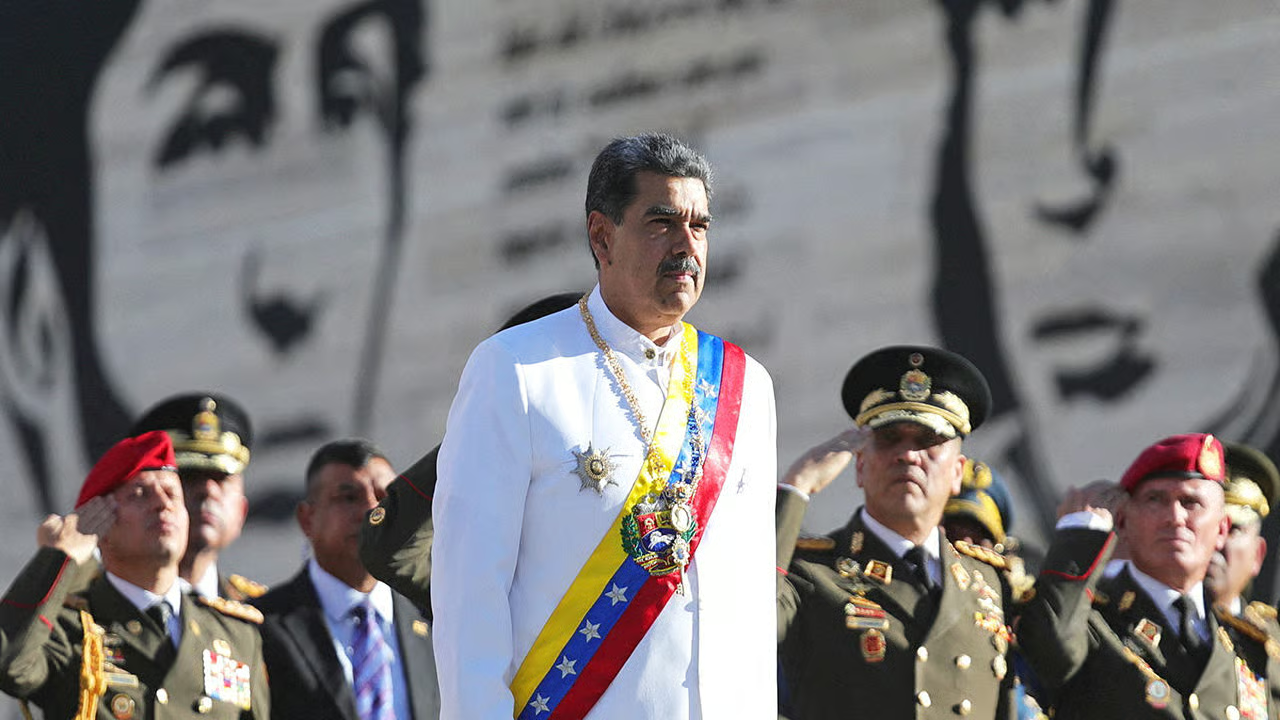
The South African government has joined several countries around the world in condemning the United States following a large-scale military operation in Venezuela that reportedly led to the capture of President Nicolás Maduro and his wife, Cilia Flores.
On Saturday, former US President Donald Trump announced that Maduro had been detained and flown out of the country after explosions were reported in the Venezuelan capital, Caracas. The operation is being described as the most significant US military action in Latin America since the 1989 invasion of Panama, during which former leader Manuel Antonio Noriega was seized.
In a statement, the Government of the Republic of South Africa said it viewed the developments with “grave concern,” noting that the United States had confirmed carrying out a military strike against Venezuela and capturing its head of state. Pretoria said the action constituted a clear violation of the United Nations Charter, which obliges member states to refrain from the use of force against the territorial integrity or political independence of another state.
South Africa emphasised that the UN Charter does not authorise external military intervention in the domestic affairs of a sovereign nation. “History has repeatedly demonstrated that military invasions against sovereign states yield instability and deepening crisis,” the statement said, warning that unilateral actions of this nature undermine international order and the principle of equality among nations. The government called on the UN Security Council to convene urgently to address the situation.
Several countries in South America also condemned the operation. Brazilian President Luiz Inácio Lula da Silva said the bombing of Venezuelan territory and the capture of its president crossed “an unacceptable line” and amounted to a “flagrant violation” of international law.
Mexico, Chile, Cuba and Uruguay rejected any form of foreign military intervention. Mexico’s Ministry of Foreign Affairs said dialogue and negotiation were the only legitimate and effective means of resolving disputes, and strongly condemned what it described as unilateral US action.
Argentina’s President Javier Milei, a close ally of President Trump, welcomed the developments, celebrating the operation as a victory for freedom. Panama’s President José Raúl Mulino said his government supported democratic processes and the will of the Venezuelan people as expressed at the polls.
Colombia’s outgoing President Gustavo Petro said his government had mobilised to preserve stability along the Colombian-Venezuelan border and rejected any unilateral military action that could exacerbate the crisis or endanger civilian lives.
In Europe, British Prime Minister Keir Starmer said he would seek to establish the facts and consult with allies before making a definitive statement, stressing that the United Kingdom was not involved in the operation. Spain and Denmark called for restraint and de-escalation, urging respect for international law.
Russia condemned the operation as an act of armed aggression, saying it warranted strong international condemnation and reaffirming its solidarity with the Venezuelan people.
The European Union reiterated that while it questions the legitimacy of President Maduro, all actions must comply with international law and the UN Charter. France welcomed Maduro’s removal and expressed support for a political transition in Venezuela.
China’s Ministry of Foreign Affairs said it was “deeply shocked” by what it described as a blatant use of force against a sovereign state. Beijing said the US action seriously violated international law and Venezuela’s sovereignty, warning that it posed a threat to peace and security in Latin America and the Caribbean.

