


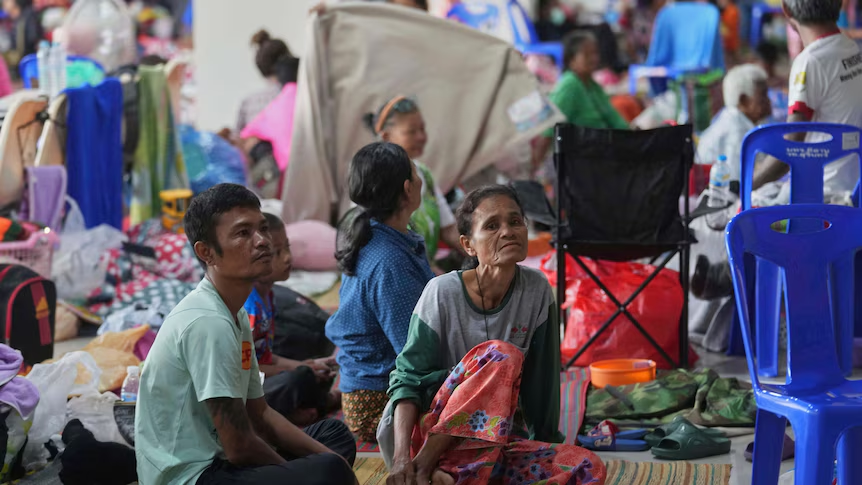
Thailand and Cambodia have agreed to an “immediate and unconditional ceasefire” following five days of intense fighting along their border that resulted in at least 33 fatalities and displacing tens of thousands. The announcement was made by Malaysian Prime Minister Anwar Ibrahim, who stated that this ceasefire marks “a vital first step to a de-escalation and a restoration of peace and security,” while standing alongside his Thai and Cambodian counterparts.
Initially hesitant to accept international mediation, Thailand changed its stance after US President Donald Trump issued a warning, suggesting that tariff negotiations would stall until hostilities ceased. The long-standing tensions between the two Southeast Asian nations flared dramatically after a Cambodian soldier was killed in May, igniting a series of retaliatory attacks that have severely impacted local communities.
Both nations witnessed rising tensions as Thailand imposed restrictions on its citizens and tourists traveling to Cambodia, while Cambodia reacted with its own measures, banning specific imports from Thailand. Reports indicate that hundreds of thousands of Cambodian workers have returned from Thailand since the flare-up began.
The conflict escalated further last week when a Thai soldier suffered life-altering injuries due to a landmine explosion. As the violence spread, Thailand temporarily closed several border crossings and expelled Cambodia’s ambassador, continuing the cycle of hostility. Early on Thursday, skirmishes erupted, with both parties accusing the other of initiating the conflict.
Official reports reveal that most casualties have been civilians, with rockets striking villages in Thailand, while Cambodia reported the death of 13 individuals on its side, including eight civilians. Despite the ongoing peace negotiations in Kuala Lumpur, artillery fire persisted across the border, signifying an unstable ceasefire agreement.
The mediation efforts, backed by Malaysia and other members of the Association of South East Asian Nations (ASEAN), aim to monitor the ceasefire’s implementation and ensure both countries pull back their reinforcements stationed at the border. Prime Minister Hun Manet of Cambodia expressed optimism about the meeting’s outcome, hoping it would effectively halt the conflict. In a brief statement, Thailand’s Acting Prime Minister Phumtham Wechayachai committed to honouring the ceasefire terms.
Reports suggest that Thailand has claimed victory in controlling several strategically important hills held by Cambodian forces, utilising its advanced arsenal to conduct sustained artillery bombardments and airstrikes against Cambodian positions.
The Thai government’s reluctance to engage in peace talks stemmed from a desire for a sincere commitment from Cambodia to stop rocket attacks that had resulted in numerous civilian casualties. However, the fundamental motivation for the truce likely ties back to external pressures, particularly from Washington, as both countries remain heavily dependent on exports to the US. The impending threat of a 36% tariff on their goods without a resolution serves as a formidable incentive toward peace.
Despite the ceasefire agreement, maintaining peace will be a challenge. Both armies harbour deep-seated mistrust, stoked by rising nationalist sentiments. Witnesses to the conflict have described the situation as the worst since the Cambodian Civil War of the 1980s, with nearly 140,000 civilians evacuated across Thailand to designated shelters. In Cambodia, approximately 135,000 people have also been relocated due to the escalating violence.