


Diplomatic efforts to free more than 200 people held hostage by Hamas were intensifying on Monday as reports from the region suggest a significant number – perhaps up to 50 – may be freed imminently.
Though Israel continues to intensify its bombardment of Gaza in an attempt to exert more pressure on Hamas, experts warn that negotiations are likely to be the only way to obtain their freedom.
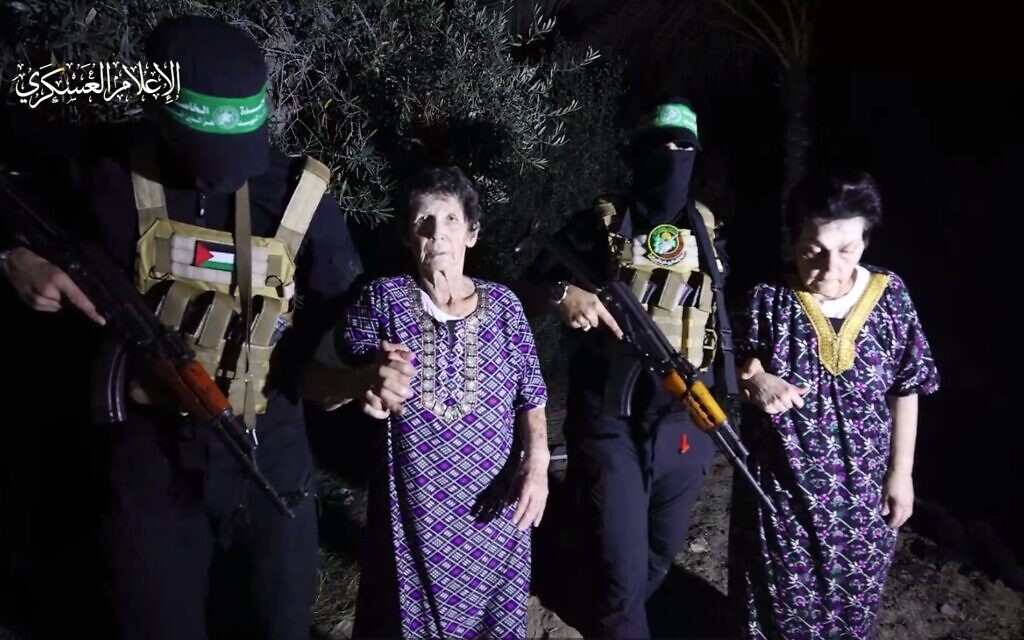
Two elderly Israeli women were freed late on Monday, after an Israeli American mother and daughter were released on Friday – in both cases after mediation by Qatari officials – but 220 are thought to remain held in Gaza. All were taken captive during the 7 October Hamas attacks on Israel in which 1,400 people, mainly civilians, were killed.
Hamas said it had freed Yokheved Lifshitz and Nurit Yitzhak, who also goes by the name Nurit Cooper, for humanitarian reasons, in response to mediation by Qatar and Egypt. The women were airlifted to a Tel Aviv hospital to be reunited with family. The women were wheeled into the facility on a stretcher and wheelchair, as relatives gathered nearby.
In an interview with local media after her release, Lifshitz recounted being bundled onto the back of a motorbike and taken to Gaza.
“They loaded me on a motorcycle sideways so I wouldn’t fall, with one terrorist holding me from the front and the other from behind,” she said.
“They crossed the border fence into the Gaza Strip, and at first they held me in the town of Abesan, which is near Be’eri. After that, I don’t know where I was taken.”
Earlier, in a statement confirming her mother’s release, Sharone Lifschitz, Yokheved’s daughter, said: “While I cannot put into words the relief that she is now safe, I will remain focused on securing the release of my father and all those – some 200 innocent people – who remain hostages in Gaza.”
Benjamin Netanyahu, the Israeli prime minister, has demanded the unconditional release of all hostages held in Gaza as Israel continues the bombardment that has so far killed more than 5,000 people, according to local health authorities in the Hamas-controlled territory.
Military experts have said there is almost no chance that a military effort to rescue the hostages would succeed. The ruined urban environment in Gaza, the presence of large numbers of civilians, a lack of clear intelligence and the scattered locations in which hostages are thought to be held would make the risk to them and rescuers unacceptable, they said.
Hamas has made a series of demands for the hostages. Officials of the organisation have said the captives could be exchanged for some or even all of the thousands of Palestinians in prisons in Israel.
Hamas has also called for fuel and other supplies to be reconnected to Gaza, the opening of the Rafah border crossing with Egypt and a suspension of Israeli airstrikes and shelling in return for the release of some or all of the hostages. The Guardian

