


The leadership of the Economic Freedom Fighters (EFF) is navigating turbulent waters as tensions rise between the party and its former spokesperson, Dr Mbuyiseni Ndlozi. With whispers of betrayal echoing in the halls of power, EFF leader Julius Malema has vehemently dismissed any notion that Ndlozi holds sway over the party’s trajectory, insisting that the organisation is ‘bigger than all of them’.
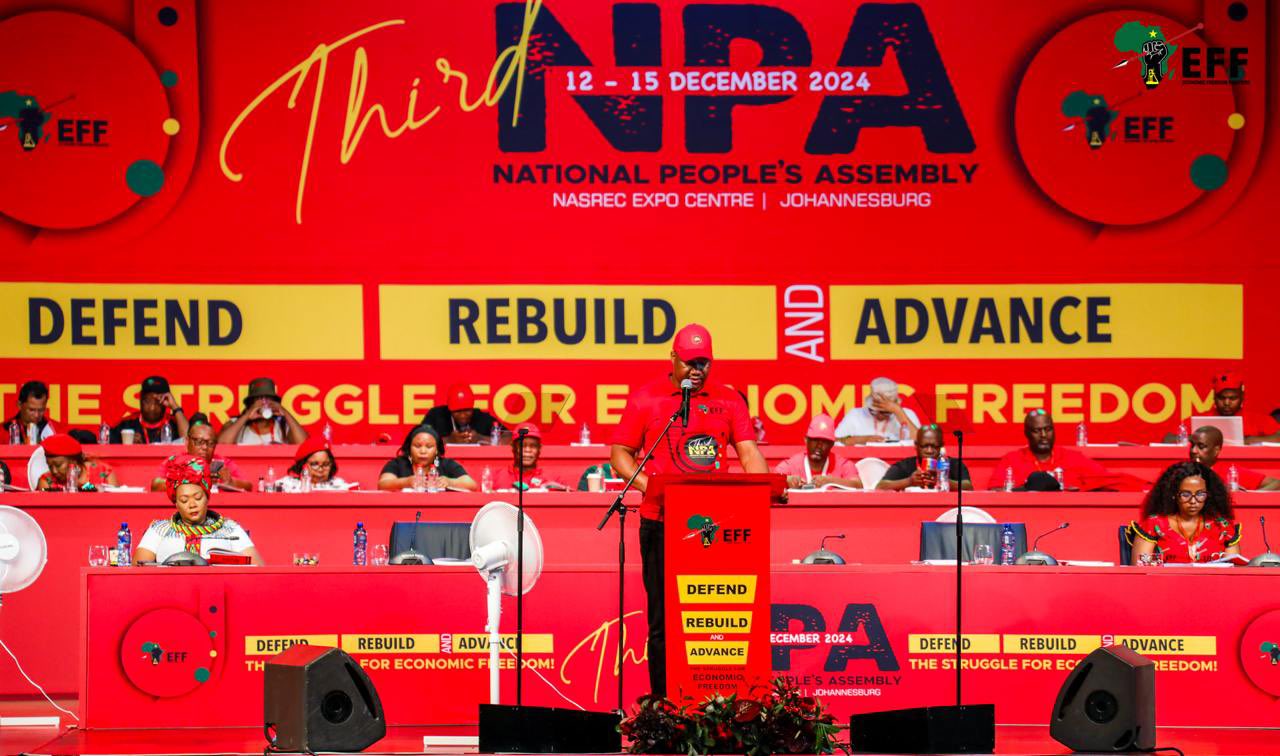
The rift comes on the heels of concerns that Ndlozi might follow the example set by former deputy president Floyd Shivambu, who recently defected to the uMkhonto Wesizwe party (MKP), a move that has sent shockwaves rippling through the EFF. Malema’s ire was evident as he spoke to the media regarding the party’s 3rd National People’s Assembly, labelling any attempt to reduce the event’s significance to Ndlozi’s absence as ‘nonsense’.
“He is not here. It’s not in our interests to entertain such nonsense,” Malema stated, making a clear point that the EFF is united against attempts to destabilise the party from within. He implied that Ndlozi, who is reportedly on an informal suspension, may have resorted to media blackmail tactics amidst the internal strife.
Revealing insights about Ndlozi’s connections, Malema referred to the entrepreneur behind Sunday World, suggesting that Ndlozi has leveraged this relationship to further his agenda against the EFF. “We know Mbuyiseni Ndlozi’s friendship with the owner of Sunday World – and by that extension, we know his relationship with Sunday World,” Malema asserted, hinting that further revelations could follow.
As the fallout from Shivambu’s dramatic exit continues to unfold, the political landscape within the EFF is tense and closely monitored. Ndlozi’s silence during the media frenzy surrounding the party’s struggles has raised eyebrows, especially considering he was privy to Shivambu’s defection before it became public knowledge, a fact attributed to his growing isolation.
Social media has proven to be a battleground for EFF supporters and MKP members alike, with the latter actively hoping to recruit Ndlozi amidst escalating tensions. In this online fray, Ndlozi’s failure to publicly distance himself from earlier comments has seemingly alienated him from the party leader.
Interestingly, Ndlozi is not the first in the ranks to face an informal suspension from the EFF, as evidenced by the earlier sidelining of Sinawo Thembo. Themes of poor performance during the crucial May 29 elections extended to Thembo, who was omitted from the party’s list of MPs but was later reinstated following Shivambu’s departure, thanks to Malema’s intervention.
As the EFF continues to grapple with these internal dynamics, the question looms large: can the party maintain its unity and purpose in the face of such disputes? With Malema at the helm, the message remains clear—disloyalty will not be tolerated, and the EFF’s objectives will not be overshadowed by individual agendas.