


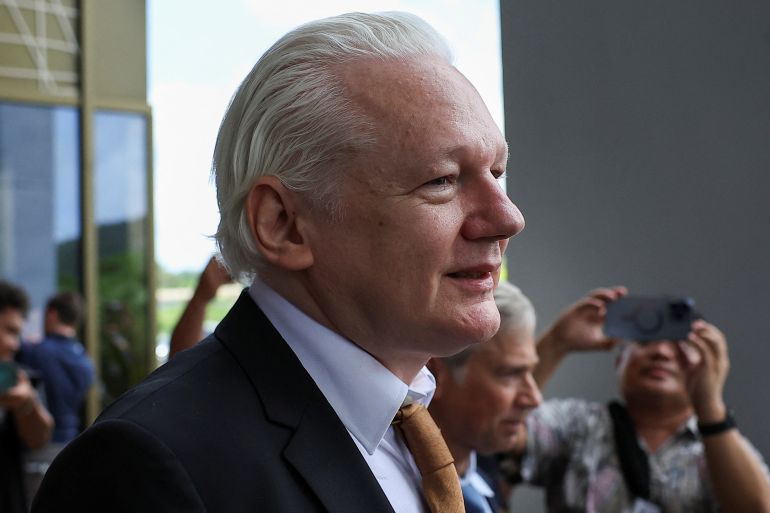
Julian Assange is officially a free man on his way home to Australia, after pleading guilty to obtaining and publishing United States military secrets.
Twelve years after he first locked himself in a London embassy to avoid possible extradition to the US, the WikiLeaks founder on Wednesday boarded a flight to Canberra after a US judge declared he had already served his sentence in Belmarsh Prison.
Judge Ramona Manglona wished an “early happy birthday” to Assange, who turns 53 next week.
“I hope you will start your new life in a positive manner,” she said.
Assange faced a cumulative sentence of up to 175 years on charges connected to his website’s publication of hundreds of thousands of sensitive documents supplied in 2010 by Chelsea Manning, a former Army intelligence analyst who was later imprisoned for seven years before her sentence was commuted.
Appearing at a hearing on the remote Pacific island of Saipan, Assange formally pleaded guilty to violating the Espionage Act by publishing top-secret information about the Iraq and Afghanistan wars. The Australian has now agreed to destroy the classified material, the court heard.
“It appears that your 62 months in prison is very reasonable and proportionate to Ms Manning’s actual prison time,” Judge Manglona told Assange.
Assange is expected to land in Canberra at 7.30pm (local time) where he will reunite with family including his wife and their children whom he fathered while living inside Ecuador’s Embassy.
“I can’t stop crying,” Stella Assange wrote on social media, alongside a video of her husband walking from court.
Anthony Albanese, the Australian Prime Minister, said “this is what standing up for Australians looks like”.
“Regardless of your views about his activities – and they will be varied – Mr Assange’s case has dragged on for too long,” Albanese said.
“I have said repeatedly that there was nothing to be gained by his continued incarceration. I am pleased that he is on his way home to Australia to reunite with his family here.
“Over the two years since we took office my government has engaged and advocated, including at leader level, to resolve this….[and] this outcome has been the product of careful, patient and determined work.”
President Joe Biden is yet to comment on Assange’s release but in a statement posted to social media Caroline Kennedy, Washington’s ambassador to Australia, said the US was “grateful” to Canberra for the “commitment and assistance”.
“The return of Julian Assange to Australia brings this longstanding and difficult case to a close,” Kennedy said.
Leaks ‘a grave risk to human life’
While the judge said there had been “no personal victim” in Assange’s crime, the US Department of Justice (DOJ) argued in a 1,161-word statement that he had endangered the lives of journalists, religious leaders, human rights advocates and political dissidents.
“Unlike news organisations that published redacted versions,” the statement read, Assange released “raw or unredacted” information that “placed individuals who had assisted the US government at great personal risk”.
“Assange’s decision to reveal the names of human sources illegally shared with him by Manning created a grave and imminent risk to human life,” the statement read.
“By publicly releasing these documents without redacting the names of human sources or other identifying information, Assange subjected these individuals to serious harm and arbitrary detention.”
Assange was banned from re-entering the US, the DOJ said.
WikiLeaks will continue
Assange was said to have maintained an air of defiance in court, declaring that while he agreed that publishing classified material was a “violation of the Espionage statute” he believed his actions should have been protected by law.
“Working as a journalist, I encouraged my source to provide information that was said to be classified in order to publish that information,” Assange said. “I believed the First Amendment protected that activity.”
He added: “I believe the First Amendment and the Espionage Act are in contradiction.”
The work of WikiLeaks would continue, his lawyers said after the four-hour hearing.
“I want to encourage everyone that stood up and fought for Julian to continue to stand up and fight against this dangerous precedent,” said his lawyer, Jennifer Robinson.
The “historic” victory “against all of the odds and against one of the most powerful governments in the world” should give hope and courage to other journalists, Robinson said. Telegraph
Advertisement