


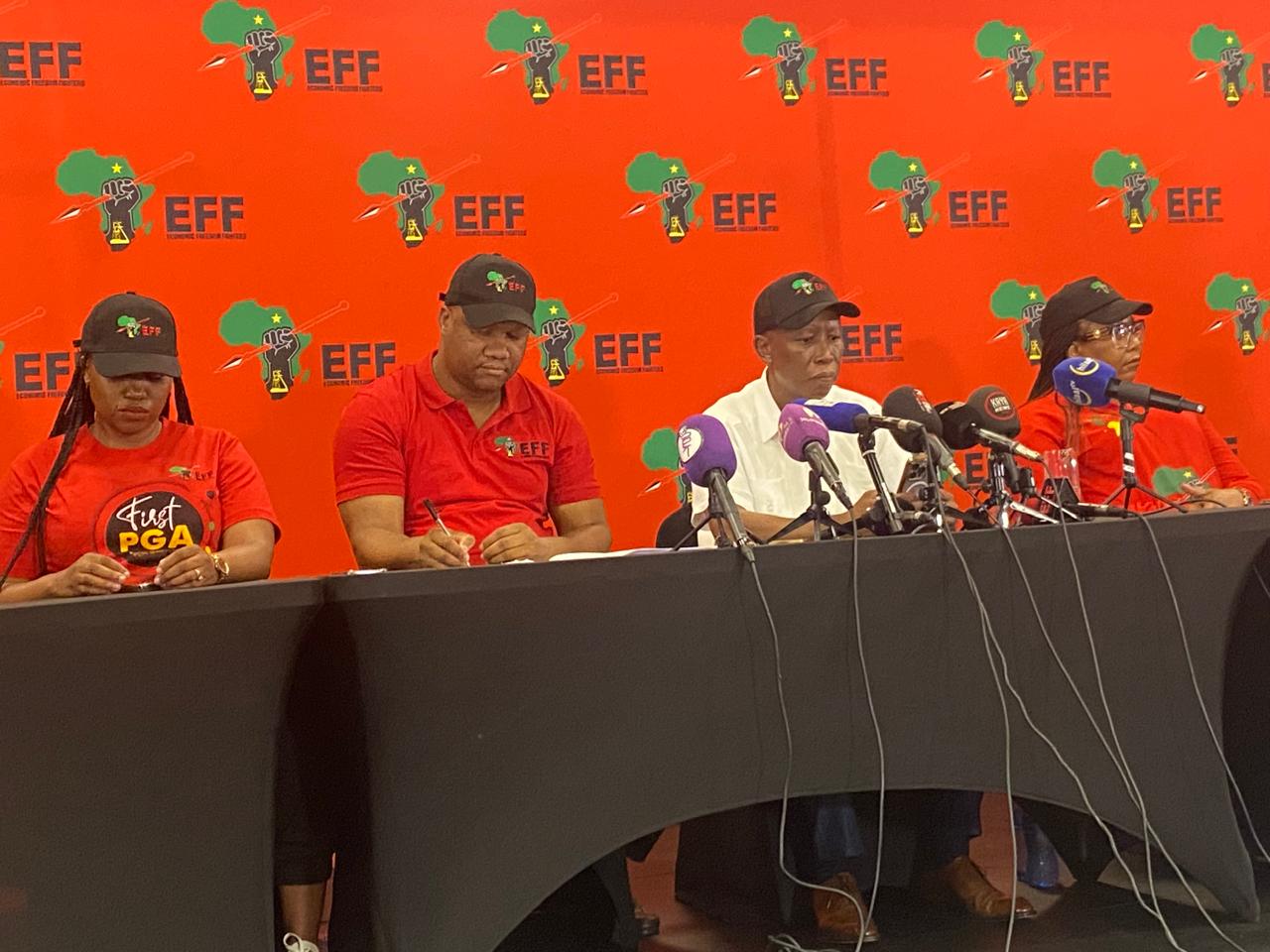
In a striking prelude to the Economic Freedom Fighters (EFF) party’s much-anticipated elective conference scheduled for December, leader Julius Malema has not held back in his critique of both former President Jacob Zuma and current President Cyril Ramaphosa. Speaking at a media briefing at the Nasrec Expo Centre in Johannesburg, Malema emphasised the need for accountability among South Africa’s political elite, asserting that both leaders have evaded scrutiny from the media.
“Me and President Zuma, we are very good. The same way me and President Ramaphosa are very good. But it doesn’t stop me from saying he is corrupt,” Malema declared, referring to his former comrades in the African National Congress (ANC). The fiery politician underscored this point by recalling the EFF’s firm opposition to Zuma during his presidency, particularly in relation to the Nkandla scandal. “We held him accountable on Nkandla. We were in parliament singing payback the money. I have nothing against the man; I’m just telling the truth which is that he’s corrupt,” he asserted.
As South Africa continues to grapple with issues of transparency and governance, Malema’s current focus has shifted towards Ramaphosa. The EFF leader is set to lead a significant march to the Constitutional Court in Johannesburg, intended to confront Ramaphosa regarding the controversial Phala Phala scandal. This incident, which involves the theft of millions of dollars from Ramaphosa’s farm in Limpopo, has sparked widespread outrage and calls for accountability from various sectors of society.
“Tomorrow we are marching to the Constitutional Court with everyone except the MKP. The MKP won’t be part of our march. If they want to march, they must go organise their own,” Malema stated, clearly delineating his plans for the protest and underscoring the EFF’s commitment to confronting the alleged misdeeds of the country’s leadership.
The confrontation arises at a crucial time as party dynamics continue to shift and the EFF gears up for its major conference. With tensions mounting within the political landscape, Malema’s unambiguous rhetoric serves both as a rallying cry for supporters and a reminder to those in power that scrutiny and accountability remain paramount in the eyes of the public.