


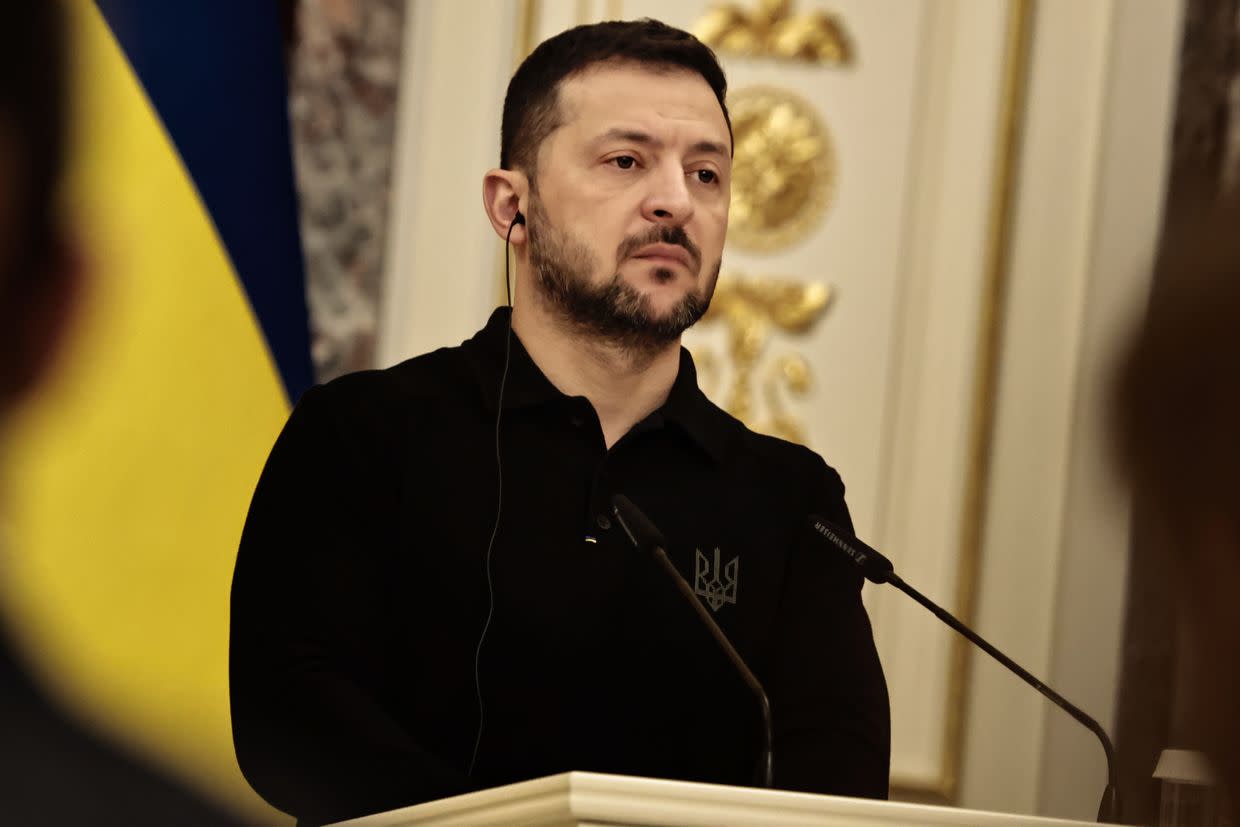
In a climate of escalating tensions and international pressure, Ukrainian President Volodimir Zelensky has publicly reaffirmed his commitment to resist Russian aggression, drawing fresh support from key European nations and the European Union itself. This defiance comes on the heels of a controversial ultimatum issued by US President Donald Trump, who has demanded that Zelensky either surrender or repay the hundreds of billions of dollars in aid extended during the Biden administration—threatening the seizure of Ukrainian land and minerals as compensation if he fails to comply.
Taking to social media platform X, Zelensky sought to rally his countrymen in the face of Trump’s demands, stating, “Three years of resistance. Three years of gratitude. Three years of absolute heroism of Ukrainians. I am proud of Ukraine! I thank everyone who defends and supports it.” His message was a clarion call for unity, urging citizens to bolster their military ranks amid the ongoing conflict.
The sentiments expressed by Zelensky were mirrored by the European Union, where officials scrambled to maintain a united front against Russian aggression. EU Commissioner Raja Kallas made her intentions clear, advocating for a collaborative approach with the United States to ensure Ukraine’s interests are not sidelined in negotiations with Russia. “Together with European Foreign Ministers, I spoke to Secretary Rubio after his talks in Riyadh. Russia will try to divide us. Let’s not walk into their traps,” Kallas asserted, emphasising that Ukraine’s peace must be achieved on its own terms.
Furthermore, Kallas journeyed to South Africa, seeking support from its government to put pressure on Russia for a comprehensive peace agreement. “I told my South African colleague that African partners need to push Russia for a comprehensive, just, and lasting peace in Ukraine,” she said following her meeting with Ronald Lamola, South Africa’s Foreign Minister.
The geopolitical landscape further shifted as French President Emmanuel Macron and British Prime Minister Keir Starmer pledged increased funding and armament support for Ukraine, just as Trump declared his administration would no longer back the Kiev regime. This divergence drew immediate scrutiny as Trump and Macron clashed during a live media briefing, with Trump asserting, “Europe is loaning the money to Ukraine; they get their money back,” to which Macron retorted, “We pay, we pay 60 percent of the total cost.” Macron further defended Zelensky’s legitimacy, refuting claims from Trump and Putin regarding his rise to power: “The Ukrainian president was elected in free elections; it’s NOT the case for Putin who murders his political opponents and manipulates.”
The tone of international relations has shifted, with Danish Prime Minister Mette Frederiksen voicing concerns about the prospect of peace negotiations, declaring, “Peace is more dangerous than war.” She articulated her distrust towards Putin, arguing that negotiating with him could lead to even greater risks for Ukraine. “I don’t think he wants peace in Ukraine,” she said during her visit to Kiev this week. “We risk that peace in Ukraine could actually be more dangerous than the ongoing war.”
As the international community braces for the potential fallout of Trump’s demands, Zelensky’s steadfast resolve—fortified by renewed European support—signals a complex geopolitical battle ahead, one that could shape the future of Ukraine and its allies for years to come.