



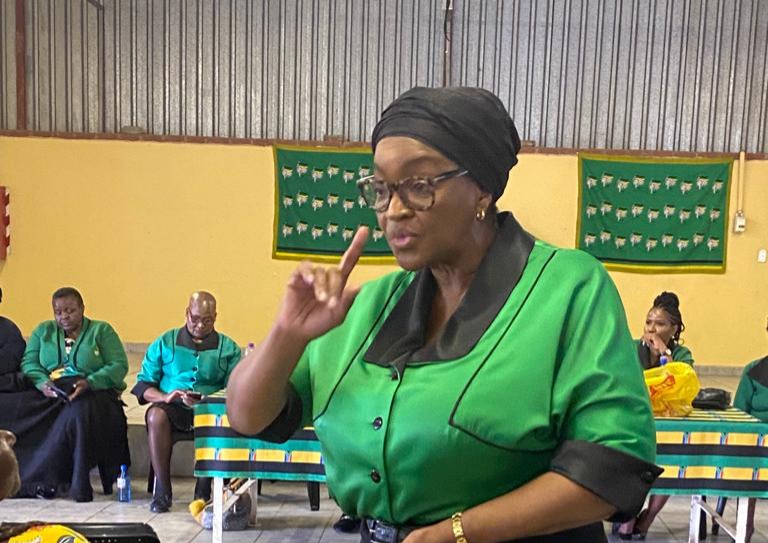
Former Social Development Minister and ANC Women’s League interim leadership structure member Bathabile Dlamini invited more than 500 ‘widows’ living in Marikana North West to discuss the challenges faced by women-headed households and to find solutions.
Dlamini met with the women in Marikana on Saturday and promised and the women took turns sharing and talking about their living conditions as women looking after and supporting families alone.
Manteboheleng Nonyana, said she’s been struggling to provide for her kids and grandmother ever since her husband died. She said she can’t even get assistance with getting identity documents, since she’s a Lesotho national and came to the country with her husband.
Nonyana said she was forced to send her children back to Lesotho for schooling since they don’t have documents to get into South African schools.
For Phumza Malewa, life without a partner has been so tough that they can even go days without having food and she can’t pay school fees let alone clothe them.
The spotlight on Marikana and the abject poverty and the squalor in the area was highlighted by the Farlam Commission of Enquiry into the Marikana Massacre where 34 miners were shot and killed by the police after they went on strike for a living wage.
Despite promises made by mining houses to fix the area in terms of their Social Labour Plans, Marikana residents still live in abject poverty and face service delivery challenges such as a lack of clean running water, decent housing and sanitation.
Dlamini promised to approach and lobby the government departments in a bid to improve service
“We spoke about their challenges, and also gave them counseling but also agreed that we will come back, because we did not deal with all the problems,” said Dlamini.
Dlamini also delivered a memorial lecture in honour of one of her predecessors and struggle icon Winnie Madikizela-Mandela.
“The reason we came here is that Mom Winnie wanted a program to start in Marikana. So we are starting with that process and therefore, we are to talk about her role in the struggle, and how we emulate her and how we can advance our struggle for the economic revolution.
“We can see that there are many problems that are caused by unemployment, because the economy is still in the hands of a few, and they’re focusing on profits, rather than focusing on ensuring that everyone has a life, everyone has means of survival,” added Dlamini.

