



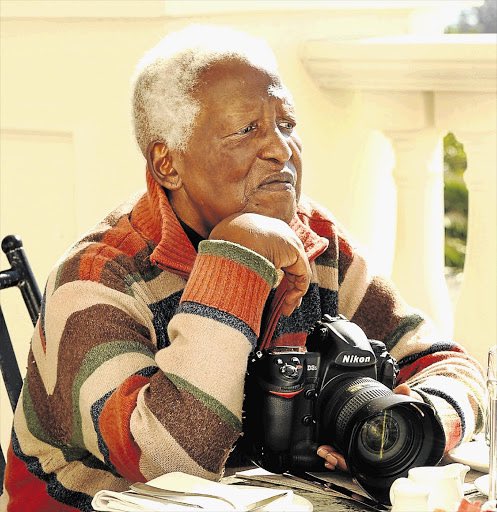
Tributes continue to pour in for veteran photographer an apartheid activist Peter Magubane who passed away at his home on Monday.
According to the family, the legendary photographer had not been well for a long time and passed away just days before his 92nd birthday.
President Cyril Ramaphosa joins other South Africans in paying tribute to Magubane and sent a message of condolence to his family, describing him as someone who managed to capture most the country’s historic events.
“For most of his life, Peter Magubane created iconic visual records of our struggle for freedom and of the full range of life in our country.
“He documented our nation and the early years of freedom of President Nelson Mandela with a prosaic passion that was powered as much by what he felt from the heart as what he saw through his lens,” said Ramaphosa.
He said he is pleased that as the country marks 30 years of freedom, Magubane’s imagery will be an important part of our reflections.
The Minister of Sport, Arts and Culture, Zizi Kodwa, echoed Ramaphosa’s sentiment, adding that the country has lost a freedom fighter, a masterful storyteller and lensman, who fearlessly documented apartheid’s injustices.
“Dr Peter Magubane was an excellent photojournalist and freedom fighter, who fearlessly documented apartheid’s injustices.
“Dr Magubane used his camera as a mode of protest, never backing down against an oppressive regime,” said Kodwa.
The department recently recognised the lensman in the Van Toeka Af Living Legends Recognition Series, which gives flowers to South Africa’s creative and cultural sector legends while they can still smell them.
Meanwhile, the South African National Editors Forum, SANEF, also paid tribute to Magubane, describing him as a giant in the field of photojournalism.
“Magubane’s resistance was not only evident in his actions but also in his creative methods of capturing the truth.
“He ingeniously hid his camera in a hollowed-out Bible, firing with a cable release from his pocket.
On other occasions, he covertly took shots with his camera concealed beneath his jacket, inside a milk carton, or half a loaf of bread, pretending to eat while documenting crucial moments,” read a statement from SANEF.
Magubane worked for renowned publications such as Drum magazine, Rand Daily Mail, Time magazine, Sports Illustrated and for the United Nations.
He started his employment at Drum Magazine as a driver before he was employed as a photographer six months later.
He captured most of South Africa’s historic moments, such as Sharpeville in 1960, Rivonia trial in 1964 and June 16 uprisings.
The lensman spent one and a half year in prison in the 60’s for covering some of the events that were happening in the country.
He was also Nelson Mandela’s official photographer in 1990 after his release from prison, until he became the country’s President.
He was honoured with many local and international awards, including the Order of Luthuli in silver, the first black South African to win a photographic prize in the country, Martin Luther King Luthuli Award, Fellowship by the Tom Hopkinson School of Journalism and Cultural Studies, University of Wales, Cardiff, Honorary Doctorate degree from UNISA, and the Nat Nakasa Award for Media Integrity among others.

