



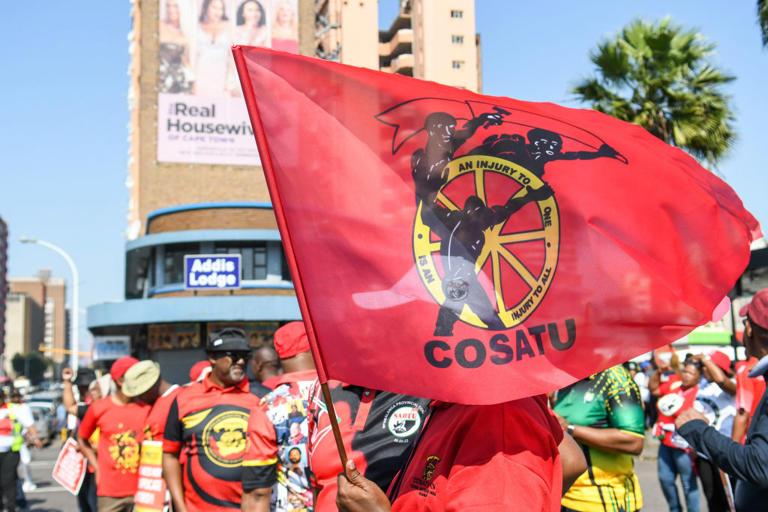
The Congress of South African Trade Unions (COSATU) has welcomed the National Minimum Wage (NMW) Commission’s recommendation for a CPI + 1.5% increase to the NMW, set to take effect from 1 March 2026. The proposal, gazetted by the Department of Employment and Labour in December 2025, marks a progressive real-terms adjustment and is now open for public comment until 12 January 2026. Final approval will rest with Minister of Employment and Labour Nomakhosazana Meth.
Key Details of the Proposal
Current NMW (effective since March 2025): R28.79 per hour.
Proposed Adjustment: Consumer Price Index (CPI) + 1.5% (using the inflation rate recorded six weeks prior to 1 March 2026).
Projected New Rate: Approximately R30.23 per hour (assuming average 2025 inflation of around 3.5–3.6%, resulting in a total increase of about 5%). This would mark the first time the NMW exceeds R30 per hour.
Speaking on YOU FM Newshour, COSATU Parliamentary Coordinator Matthew Parks expressed satisfaction with the outcome, despite the federation’s initial call for a higher CPI + 3% as a negotiating stance.
“We aimed high in negotiations, but we are pleased that our push for a genuine above-inflation increase was supported by the Commission,” Parks said.
COSATU is encouraging workers and civil society groups to submit supportive comments to the NMW Commission to bolster the recommendation.
Impact on Workers and the Economy
The increase is expected to benefit around 5.5 million low-paid workers, especially in sectors like agriculture, domestic work, construction, retail, transport, hospitality, security, and cleaning.
“The NMW Act obliges the Commission to protect the wage from inflation erosion, preventing deeper poverty and debt for vulnerable families,” Parks noted. “This adjustment will maintain purchasing power, support family needs, and inject stimulus into the economy, fostering growth and job creation.”
Progress Since Introduction
Since the NMW’s launch in 2019 at R20 per hour (with lower rates for domestic and farm workers), significant equalisation has occurred. Domestic and farm worker rates have been aligned to the standard NMW, a major advance from pre-2019 poverty wages that sometimes dipped as low as R6 per hour.
Further Demands and Enforcement
Parks called for urgent talks involving the Presidency, National Treasury, and relevant departments to raise Expanded Public Works Programme (EPWP) wages from the current R15.83 per hour—about 55% of the NMW—to full parity.
“This disparity for public-sector workers is unacceptable,” he stated.
COSATU committed to ensuring full implementation of the approved increase and praised the Minister’s plan to hire 20,000 additional labour inspectors over the next two years.
“Despite advances, the Department must ramp up action against the estimated 45% of non-compliant employers,” Parks emphasised. “Unions will expose violations, and business must cooperate. Non-compliance is a criminal offence—no employer should exploit workers in this way.”
h

