


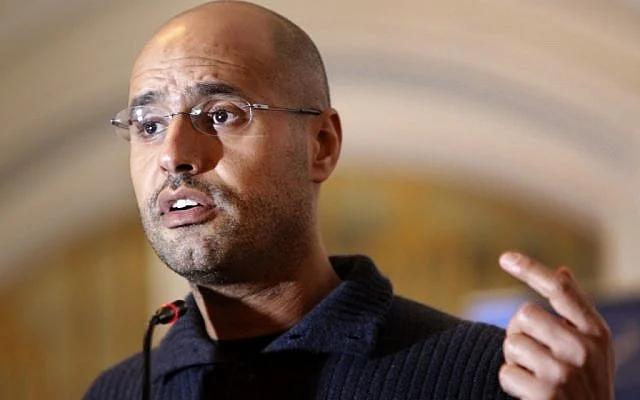
Saif al-Islam Gaddafi, the son of longtime Libyan leader Muammar Gaddafi, has been shot and killed in the western Libyan city of Zintan, where he had been based for the past decade. His death, confirmed by his political adviser Abdullah Othman, comes amid unclear circumstances, with investigators still seeking details of the attack.
Local reports indicate that Gaddafi was reportedly killed by gunmen, though their identities and motives remain unknown. Khaled al-Mishri, former head of Libya’s Tripoli-based High State Council, called for an “urgent and transparent investigation” into the killing.
Gaddafi, 53, never held an official government position but was widely regarded as his father’s number two from 2000 until the 2011 uprising that toppled Muammar Gaddafi. Captured and imprisoned in Zintan after the opposition took Tripoli, he was released in 2017 under a general pardon and remained largely underground to avoid assassination.
Educated in the West, including a PhD from the London School of Economics, Gaddafi had worked to present a progressive face for his father’s regime and sought to repair Libya’s relations with the West in the early 2000s. During the 2011 Libyan uprising, he warned of widespread bloodshed and chaos if the regime fell, and faced allegations of torture and other violent acts against opponents. He was also wanted by the International Criminal Court for crimes against humanity and was sentenced to death in absentia by a Tripoli court in 2015.
Following his release, Gaddafi maintained political influence, attempted a controversial presidential bid in 2021, and remained a polarizing figure in Libya’s fragmented political landscape. His death marks a significant turning point for Libya, where rival factions continue to struggle for control more than a decade after the fall of the Gaddafi regime.