


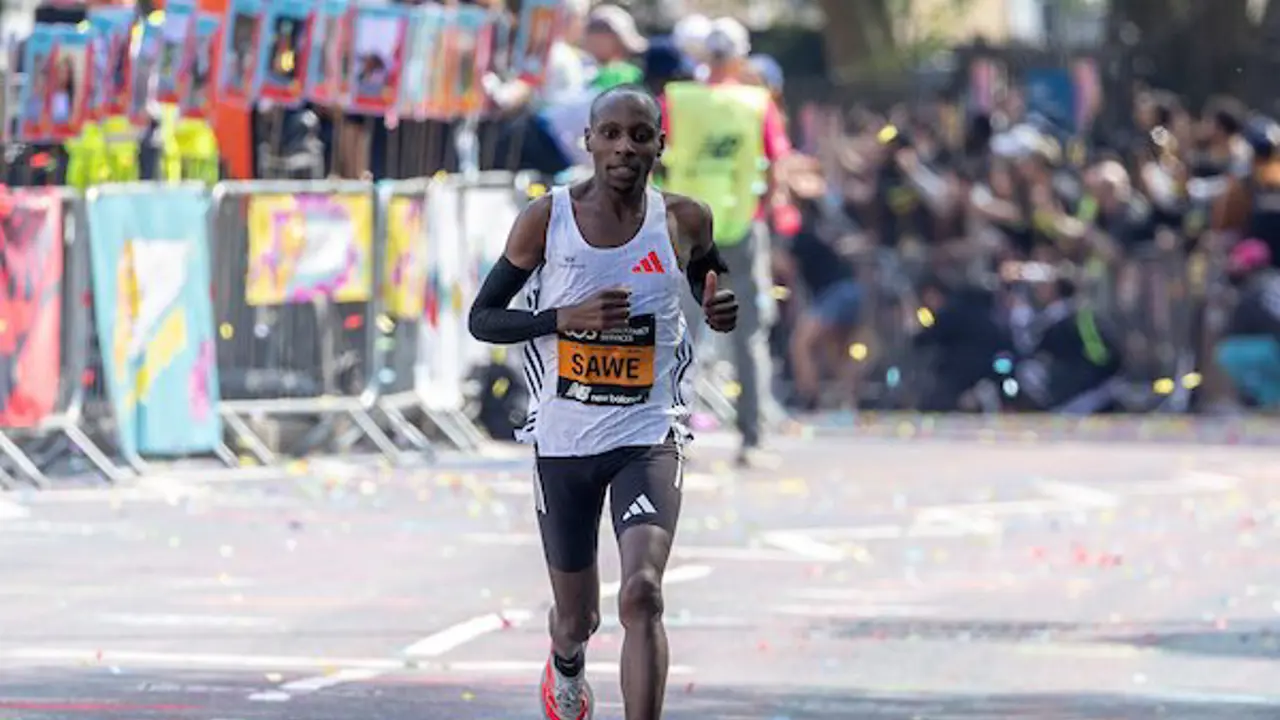
Africa celebrated a landmark moment in distance running as two athletes broke one of the sport’s most elusive barriers in a single race. At the London Marathon, Kenya’s Sabastian Sawe and Ethiopia’s Yomif Kejelcha both completed the 26.2-mile distance in under two hours under official competitive conditions—an unprecedented achievement.
Sawe claimed victory in a remarkable time of 1:59:30, with Kejelcha close behind in 1:59:41. Their performances mark the first occasion that two runners have dipped below the two-hour mark in a sanctioned race, signalling a new era in marathon running.
Sports scientist Dr Russ Tucker described the feat as both extraordinary and credible, highlighting Sawe’s proactive approach to anti-doping measures. Ahead of major competitions, Sawe voluntarily subjected himself to extensive additional testing funded by his sponsor, Adidas. This included a notable programme before the Berlin Marathon, where he underwent 25 tests in the lead-up to the race. A similar, though more extended, testing regime was reportedly implemented prior to London.
Tucker noted that such transparency should be acknowledged. While scepticism has often surrounded exceptional endurance performances due to inconsistent testing, Sawe’s willingness to undergo rigorous scrutiny strengthens confidence in his results.
Beyond credibility, Sawe’s performance has also raised expectations. His strong finish suggests untapped potential, and historical data indicates that the Berlin Marathon course typically yields faster times than London—by an average of around one minute over the past two decades. Should Sawe replicate his form in Berlin, further record-breaking performances could follow.
Kejelcha’s achievement is equally striking. Competing in his debut marathon, he delivered a time that not only broke the two-hour barrier but also suggests significant room for improvement. Elite marathon runners often improve with experience, making his 1:59:41 debut an indicator of even greater performances to come.
Uganda’s Jacob Kiplimo secured third place in 2:00:28, completing a podium sweep of historic significance. All three athletes surpassed the previous world record of 2:00:35, set in 2023 by Kenya’s Kelvin Kiptum, who tragically died in a car accident the following year.
Attention now turns to the Berlin Marathon on 27 September, where the world will be watching closely to see whether this new frontier in marathon running can be pushed even further.