


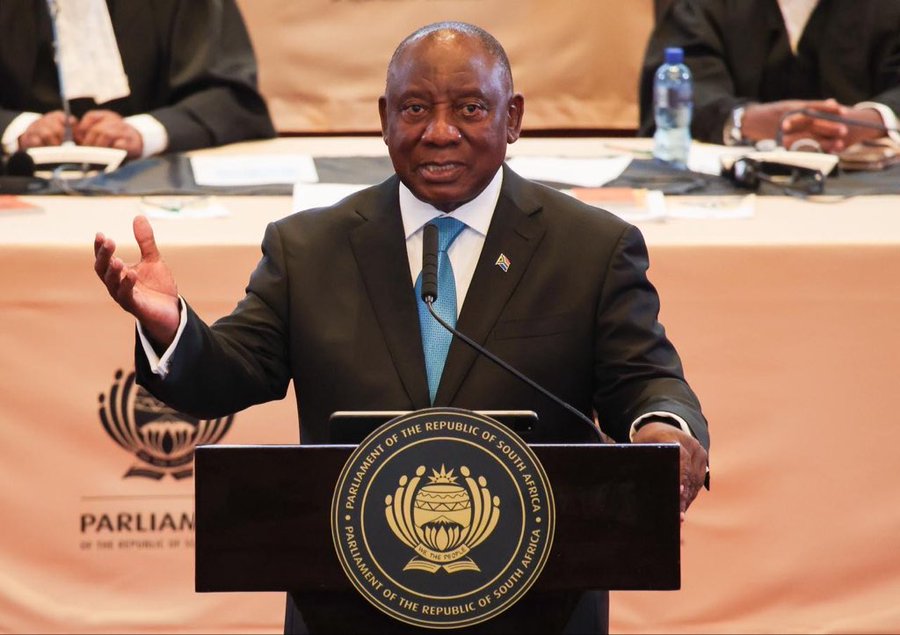
President Cyril Ramaphosa says South Africa’s economy is regaining momentum, citing four consecutive quarters of GDP growth and improvements in key economic indicators during his State of the Nation Address (SONA) at the Cape Town City Hall.
Ramaphosa said the recovery has been driven in part by government interventions in critical sectors such as electricity supply. He noted that the country has achieved two consecutive primary budget surpluses, improved its credit rating, and seen inflation fall to its lowest level in two decades. Interest rates are easing, national debt is stabilising, and the rand has strengthened against the dollar.
Through Operation Vulindlela, government has accelerated structural reforms aimed at unlocking investment and boosting competition. Ramaphosa said load shedding has ended, while reforms in the energy sector have created a more resilient system. Progress has also been made in ports and freight rail performance, and passenger rail services have been restored with new locally manufactured trains helping commuters reduce transport costs.
He added that infrastructure investment is being rolled out nationwide, covering roads, bridges, rail lines, ports, dams, and renewable energy projects.
Government of National Unity praised
Ramaphosa commended the Government of National Unity, saying it demonstrates that political parties can work together across ideological lines to pursue economic growth and social progress.
However, he acknowledged persistent challenges, including unemployment, crime, corruption, and failing local government services.
Army deployment to tackle crime
Describing organised crime as the most immediate threat to democracy and economic development, Ramaphosa announced the deployment of the South African National Defence Force to support police in combating gang violence and illegal mining.
He has instructed the Ministers of Police and Defence to develop a tactical deployment plan within days, focusing on the Western Cape and Gauteng. The intervention mirrors previous SANDF deployments to address illegal mining operations.
Water security and municipal reform
Addressing widespread water shortages — from major metros like Johannesburg to towns such as Knysna and rural areas like Giyani — Ramaphosa pledged more than R156 billion in public funding for new dams and upgraded water infrastructure to secure long-term supply.
On struggling municipalities, he announced plans to finalise a revised White Paper on Local Government, proposing a differentiated approach that recognises varying municipal capacities and responsibilities.
Foot-and-mouth disease declared national disaster
In response to the spread of foot-and-mouth disease, Ramaphosa declared it a national disaster, enabling the state to mobilise resources more effectively to contain the outbreak and protect the agricultural sector.
Youth employment and higher education expansion
To tackle youth unemployment, Ramaphosa said regulatory changes will soon make it easier for businesses to participate in the Youth Employment Service, encouraging job creation for young people.
He also directed the Ministers of Finance and Higher Education to develop proposals for building additional universities and TVET colleges with specialised focus areas. Addressing the acute shortage of student housing, he instructed the Higher Education Ministry to work with financial institutions on innovative funding models to expand student accommodation.
Despite progress, Ramaphosa stressed that economic growth must accelerate significantly to meet the country’s deep social and economic challenges, emphasising that safety, service delivery, and job creation remain urgent priorities.

