


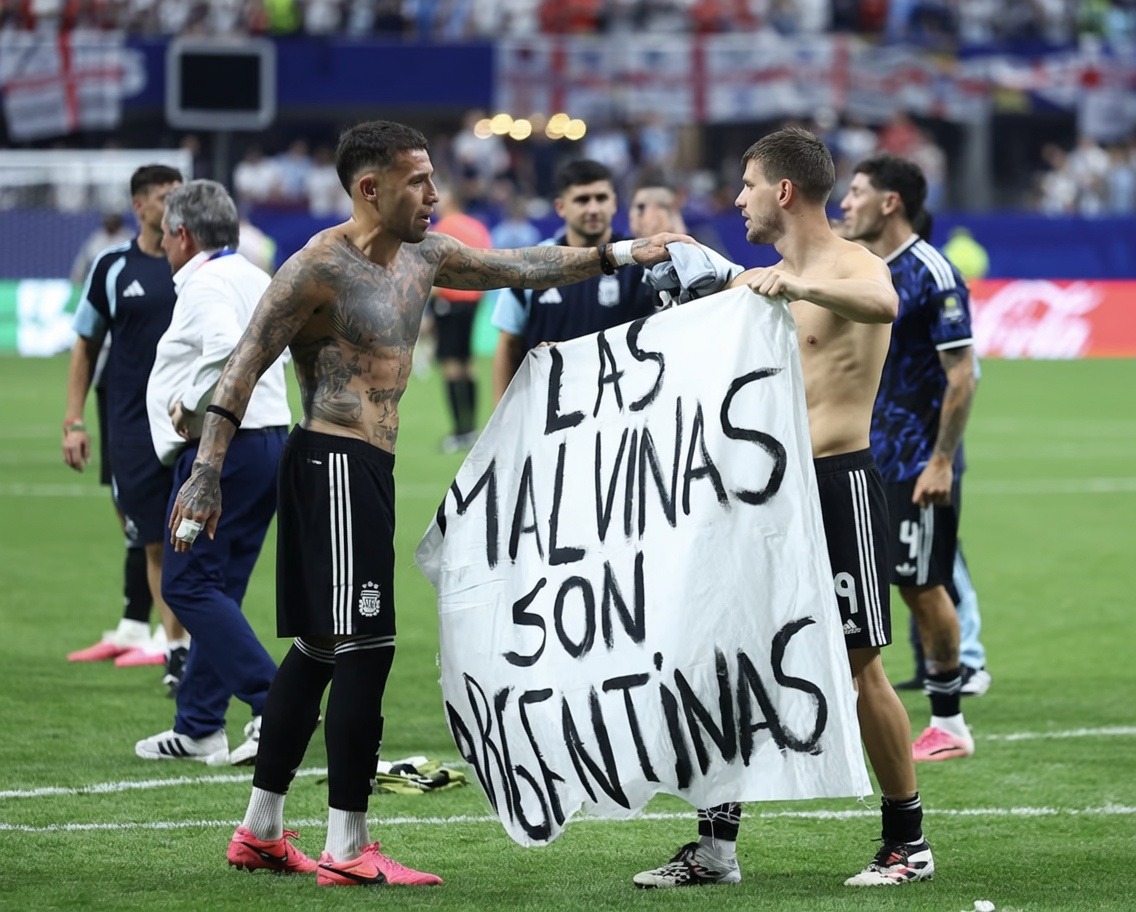
The White House has defended Argentina’s football players after they displayed a banner supporting their country’s claim over the Falkland Islands following their World Cup 2026 semi-final victory over England.
The controversy emerged after Argentina defeated England 2-1 in a tense semi-final match in Atlanta on Wednesday. Following the victory, several Argentina players held up a banner reading “Las Malvinas son Argentinas”, referring to the Falkland Islands by Argentina’s preferred name.
The display has triggered debate over the balance between freedom of expression and FIFA’s rules prohibiting political messages in football.
Andrew Giuliani, head of the White House FIFA taskforce, defended the players’ actions, saying the United States supports the right to free speech.
“We believe in our First Amendment rights here in the United States of America,” Giuliani said, adding that Argentina’s players had the opportunity to express their views while competing on US soil.
The comments have placed Washington’s position at the centre of a growing dispute involving football, diplomacy and international politics.
The UK government has maintained that sovereignty over the Falkland Islands rests with its residents, with Prime Minister Keir Starmer’s spokesperson reaffirming Britain’s commitment to the territory.
“The World Cup might not be ours, but the Falkland Islands definitely are. Our position is unchanged. Self-determination rests with the islanders and our commitment to the Falklands will never waver,” the spokesperson said.
UK officials have called on FIFA to investigate the incident, arguing that political messages should not form part of football events.
FIFA confirmed that its independent disciplinary committee is reviewing match reports and the circumstances surrounding the banner before deciding whether any action is required under its disciplinary regulations.
The dispute comes decades after the 1982 Falklands War between Britain and Argentina, which resulted in more than 900 deaths following Argentina’s invasion of the islands.
The incident has renewed debate over whether political statements should be allowed in international sport, with FIFA facing pressure to balance freedom of expression against its policy of keeping politics separate from football.