


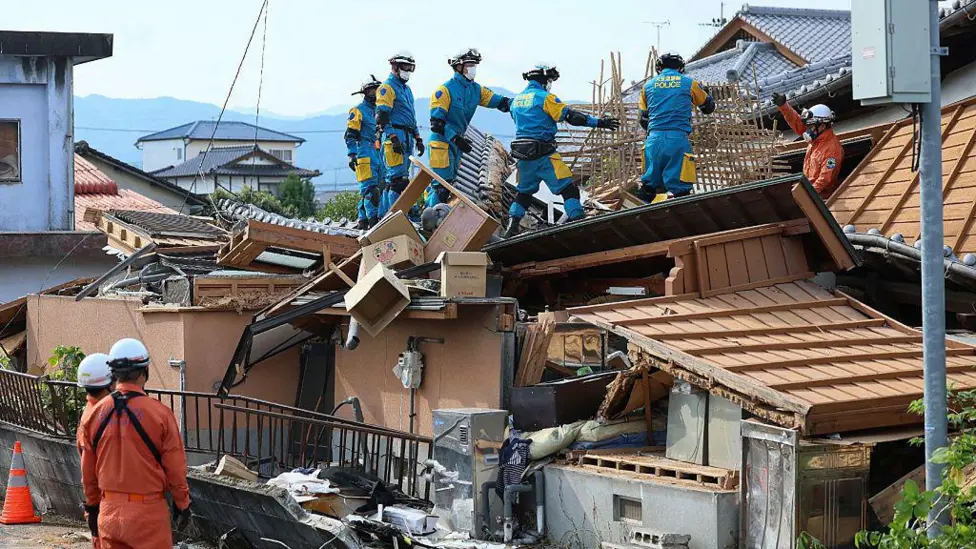
The death toll from this week’s powerful earthquake in Japan has risen to 30, as emergency crews continue searching for survivors amid aftershocks and scorching temperatures in Kumamoto Prefecture. More than 62 people have been injured, while rescue operations remain focused on a collapsed shopping centre, a paper mill and damaged residential areas.
Authorities said six of the fatalities occurred at the Aeon shopping centre, where a suspected gas explosion struck after the magnitude-7.1 earthquake, trapping employees who had re-entered the building following an evacuation. At the Nippon Paper mill in Yatsushiro, eight workers have died after a chimney collapsed, while search teams continue looking for another missing worker.
The disaster has also left around 23,000 households without electricity and 75,000 without running water, forcing thousands of residents into evacuation centres as temperatures climb above 35°C. The Japanese government has deployed about 5,000 Self-Defence Force personnel to assist with rescue operations, restore essential services and distribute emergency supplies.
Rescue efforts have been hampered by strong aftershocks, including a magnitude-5.8 tremor, raising fears of further structural collapses. Authorities have prioritised the search for survivors while warning residents to remain alert as seismic activity continues.
The earthquake has also disrupted manufacturing across Kyushu, with several major companies, including Toyota, Honda and Sony, temporarily suspending production as damage assessments continue.
Japan, one of the world’s most earthquake-prone countries, sits on the Pacific “Ring of Fire” and experiences frequent seismic activity. The latest disaster has revived memories of the devastating 2016 Kumamoto earthquakes and the 2011 earthquake and tsunami that triggered the Fukushima nuclear disaster.