



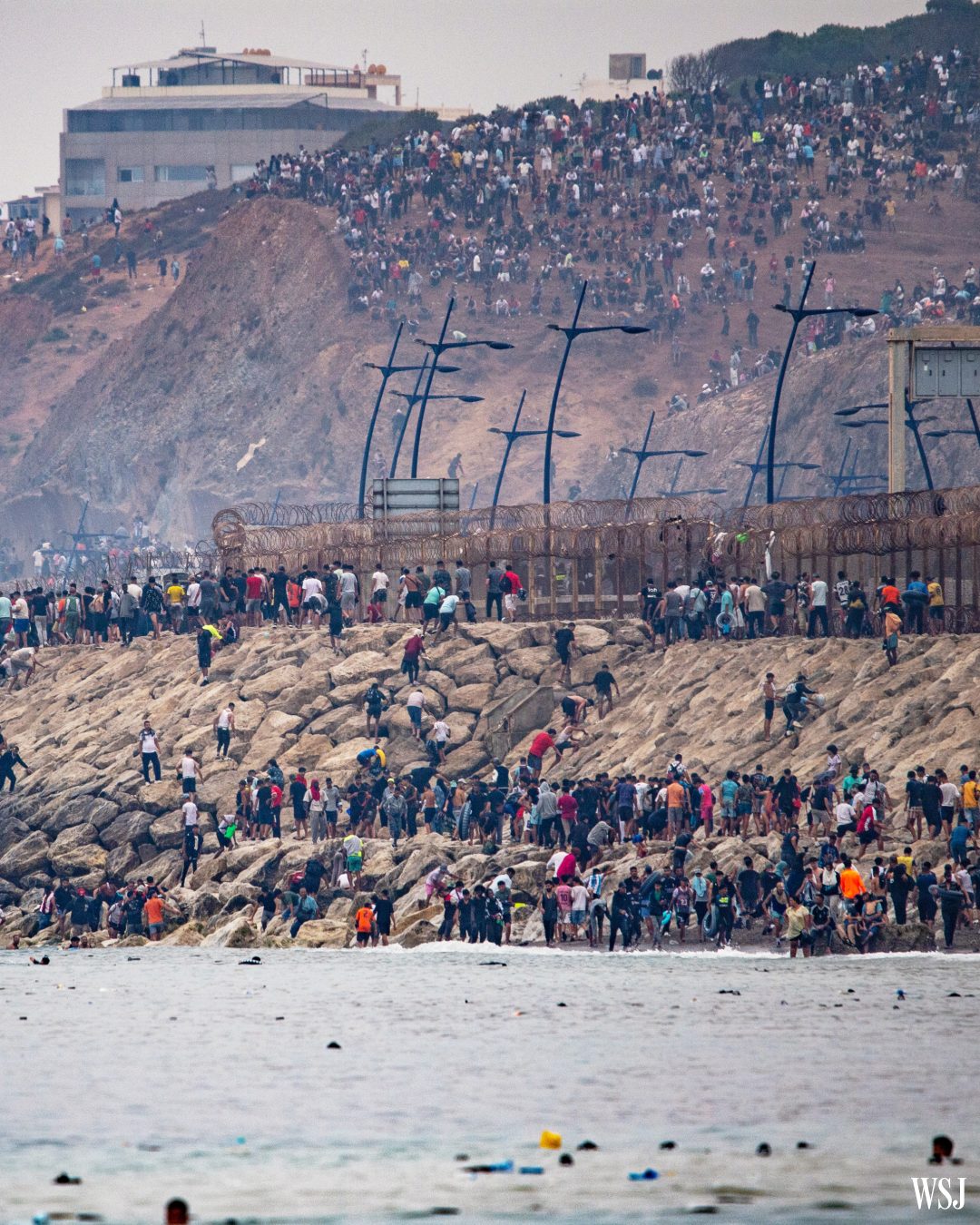
Uncertainty remains in the Spanish territory of Ceuta, even as some of the estimated 50,000 Moroccan men who crossed into the enclave voluntarily return home.
The men, most of whom appeared to be of military age, reportedly spent the day looting before beginning their return to Morocco. Many complained of hunger and said they had been unable to find food in the towns they entered.
The mass return followed a chaotic day in which Spanish authorities deployed additional police and military personnel after the border was overwhelmed by the influx.
Despite condemning the incursion as a threat to Spain’s territorial integrity, Prime Minister Pedro Sánchez and the security forces appeared relatively restrained in their response, with several videos showing officers pleading with the men to return.
“What happened deserves our full reproach, our full condemnation,” Sánchez said while announcing the additional deployment.
The incident has triggered a fierce political debate. Right-wing groups and commentators in Spain and elsewhere blamed the country’s socialist government, arguing that its migration policies are encouraging desperate migrants from Africa and the Middle East to attempt to enter Spain.
Sánchez, however, attributed the mass crossing to misinformation allegedly spread by human-trafficking networks that profit from irregular migration.
The motives of those who crossed into Ceuta have also come under scrutiny, particularly because Morocco is neither a failed nor an impoverished state — conditions commonly regarded as major push factors behind irregular migration.
Spain has historically adopted relatively accommodating policies towards migrants. Successive socialist governments have regularised undocumented foreigners at various stages, dating back to the 1980s.
Although Ceuta is geographically located on the North African coast and surrounded by Moroccan territory, it remains under Spanish sovereignty. Its status dates back to arrangements surrounding the end of Spanish colonial rule in Morocco in the early 1960s.
Ironically, Morocco, like Libya, is more commonly used as a transit point for migrants from East and West Africa and the Middle East seeking to reach Europe. Many attempt the journey in makeshift boats, with frequent crossings resulting in deaths and disappearances in the Mediterranean.
The events in Ceuta also come as migration becomes an increasingly contentious issue elsewhere in Africa.
In South Africa, anti-migrant protests have pushed the African Union to discuss immigration more seriously than in the past. Pretoria has repeatedly argued that greater attention should be paid to the underlying push factors driving migration, including weak economies, poor governance and political persecution.
Spanish authorities put the number of people who died during the incident at 57. Many are believed to have drowned as thousands attempted to swim into the enclave.