


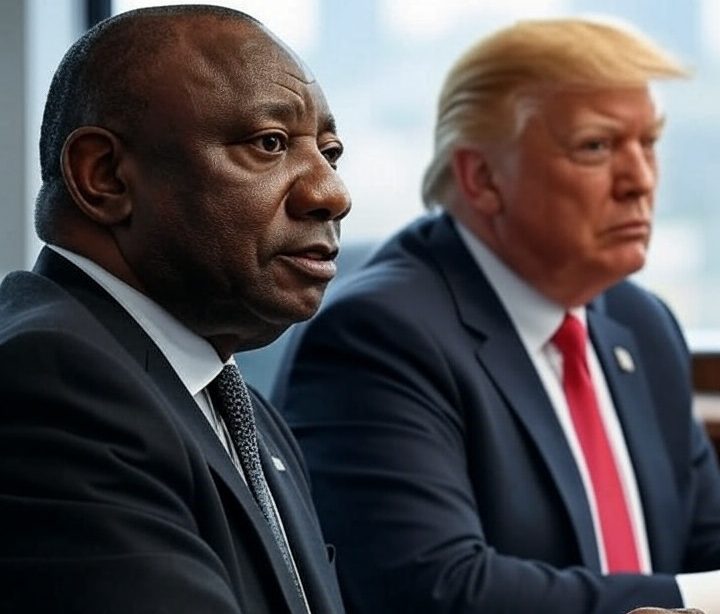
The relationship between South Africa and the United States appears to be entering another difficult phase, with Washington expressing growing frustration with Pretoria and South Africa insisting that it remains committed to dialogue.
US Ambassador to South Africa Leo Brent Bozell III has described Washington as “shocked” by President Cyril Ramaphosa’s response to a series of requests made by the Trump administration. His comments, published in Daily Maverick and echoed in recent media interviews, provide an unusually direct insight into how the United States currently views the relationship.
But they also raise a broader question: is this fundamentally a disagreement over policy, or is it becoming a disagreement over how the two countries expect each other to conduct their relationship?
According to Bozell, Washington presented Pretoria with five key “asks”. They included concerns about rural crime, the “kill the boer” chant, South Africa’s expropriation legislation, Black Economic Empowerment requirements and aspects of South Africa’s international relationships.
From the American perspective, these are not minor concerns. Washington argues that certain South African policies create problems for American businesses, raise questions about property rights and discrimination, and warrant a response from the South African government.
Pretoria, however, disputes the suggestion that it has simply ignored those concerns. South African officials have maintained that the government has engaged with Washington and that some of the issues raised are already being addressed through existing legal or policy processes.
The disagreement therefore appears to be less about whether the two countries have discussed these issues and more about whether Washington believes Pretoria has done enough.
That distinction is important.
Washington’s position
The Trump administration has made clear that it is prepared to use diplomatic and economic pressure when it believes foreign governments are pursuing policies contrary to American interests.
The visa restrictions announced by Secretary of State Marco Rubio represent one example. Washington said the measures were directed at foreign nationals it considers responsible for, or complicit in, policies involving uncompensated land seizures, race-based discrimination and incitement of violence against minority groups.
Bozell has suggested that these measures should not necessarily be regarded as the end of Washington’s response.
From Washington’s point of view, there is a straightforward argument for taking a firmer approach. Governments routinely assess the domestic policies of countries with which they trade and cooperate. They also have the right to decide the conditions under which their citizens, companies and officials engage with foreign states.
If American policymakers believe South Africa’s policies create unacceptable risks for investors or fail to address serious concerns about violence and discrimination, it is reasonable for Washington to raise those issues and attach consequences to its position.
The more difficult question is what happens when the two governments fundamentally disagree about the evidence, the appropriate remedy or the legitimacy of the underlying policy.
Pretoria’s position
South Africa’s response has been that it remains willing to engage with Washington but does not accept the premise that American demands can simply determine South African domestic policy.
That position is also understandable.
Land reform, economic transformation and affirmative-action policies are deeply connected to South Africa’s history and remain politically significant domestically. The South African government argues that policies such as Black Economic Empowerment are intended to address inequalities created by decades of apartheid-era exclusion.
Similarly, the country’s expropriation legislation is part of a long-running domestic debate over land ownership and redistribution.
That does not settle the debate over whether those policies are effective, economically sustainable or attractive to investors. Nor does it invalidate concerns raised by Washington.
It does, however, explain why Pretoria may be reluctant to treat American objections as instructions that must simply be implemented.
The land question illustrates the problem
The dispute over expropriation is perhaps the clearest example of the competing positions.
Washington has expressed concern about legislation that allows for the possibility of nil compensation in certain circumstances.
South Africa has maintained that the legislation must be understood within its constitutional framework and that questions about its legality are ultimately matters for South African institutions, including the courts.
Both sides have a legitimate interest in the issue.
For Washington and American investors, property rights and legal certainty are important considerations when deciding whether to commit capital.
For South Africa, land reform remains an unresolved consequence of its history, and the government has political and constitutional reasons for pursuing policies aimed at addressing it.
The difficult part is finding a policy that addresses historical inequality without creating unnecessary uncertainty for investment.
That is a policy debate rather than something that can be settled simply by accusing one side of being unreasonable.
Crime and the “kill the boer” controversy
The same complexity exists around rural crime.
South Africa has a serious violent-crime problem, and concern about the safety of rural communities deserves attention regardless of political affiliation or race.
Washington’s decision to raise rural security with Pretoria is therefore not inherently unusual.
The controversy becomes more complicated when crime statistics and political rhetoric are used to support broader claims about the treatment of particular communities.
The “kill the boer” chant has become especially contentious because supporters and critics disagree over its meaning, context and political significance.
For Washington, the rhetoric represents a serious concern about incitement and the protection of minorities.
For South African officials and others who reject the American interpretation, the issue is more complicated and cannot necessarily be separated from the country’s political history and ongoing debates about land and inequality.
There is room for legitimate disagreement over those interpretations. What matters is that the underlying questions about violence and public safety are not lost in the political argument.
Economic interests could become the biggest casualty
Perhaps the most consequential aspect of the dispute is not diplomatic rhetoric but economics.
The United States and South Africa have significant commercial interests in one another. Areas such as energy, telecommunications and critical minerals could provide opportunities for increased investment and cooperation.
Yet investment depends heavily on predictability.
American companies may hesitate if they believe South Africa’s regulatory environment presents unacceptable political or legal risks. South African businesses, in turn, could face difficulties if worsening diplomatic relations lead to restrictions on trade, investment or access to the American market.
This creates incentives for both governments to prevent the political dispute from becoming a broader economic confrontation.
Neither side benefits automatically from escalation.
The danger of talking past each other
The most worrying feature of the current dispute may be the apparent gap between how Washington and Pretoria interpret the same events.
Bozell says Washington made its expectations clear and received a response that failed to address its concerns.
South African officials say Pretoria has engaged and remains committed to finding solutions through dialogue.
Those positions are not necessarily mutually exclusive.
A government can respond to another country’s demands without accepting the premise behind them. Conversely, the government making the demands can conclude that a formal response does not amount to meaningful action.
That appears to be where the relationship currently stands.
The danger is that every subsequent action becomes evidence supporting the other side’s worst interpretation.
Washington sees resistance and increases pressure.
Pretoria sees increased pressure and becomes less willing to make concessions.
The cycle then becomes increasingly difficult to break.
What happens next?
The future of the relationship will depend partly on whether the two governments can distinguish between areas where compromise is possible and areas where their interests genuinely diverge.
There may be scope for cooperation on trade, investment, energy, critical minerals and security even while disagreements over land reform, economic policy and foreign affairs continue.
At the same time, neither government can realistically expect the other to abandon all of its domestic priorities simply to preserve diplomatic harmony.
Washington has the ability to impose costs on the relationship, but South Africa also has its own foreign-policy interests and domestic political considerations.
The real test will be whether both governments can use their leverage without allowing the relationship itself to become collateral damage.
For South Africa, that means recognising that domestic policies can have consequences for international investors and strategic partners.
For the United States, it means recognising that pressure has limits and that policies rooted in another country’s constitutional and political system may not be changed simply because Washington demands it.
The current dispute is therefore not a simple story of one government being right and the other being wrong.
It is a clash between competing interests, political priorities and interpretations of what a bilateral relationship should look like.
The challenge for both sides is to determine where those differences can be managed, where compromise is possible and where disagreement must simply be accepted.