



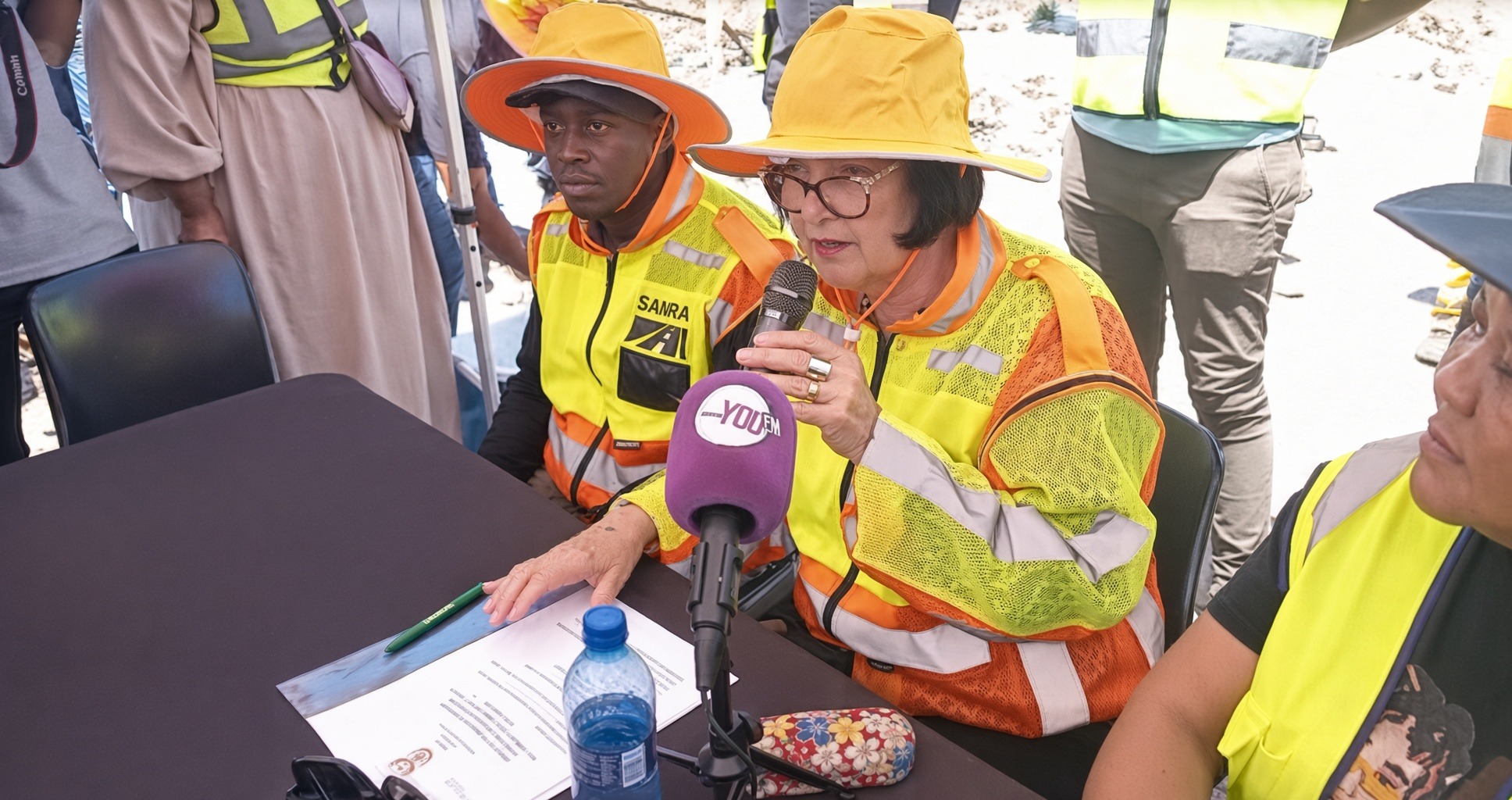
The South African National Roads Agency SOC Limited (SANRAL) has spent more than R86 million on the R52 Community Development Project in Koster, near Rustenburg in the North West, with R19 million directed towards supporting micro-enterprises and strengthening local economic participation.
The investment was highlighted on Friday by Transport Minister Barbara Creecy during a high-level oversight visit to the project, which is designed to improve road infrastructure while creating employment, developing local suppliers and expanding business opportunities for communities along the route.
Creecy was accompanied by Bojanala Platinum District Executive Mayor Suzan Nthangeni and a SANRAL delegation led by board chairperson Thamsanqa Phili.
The project, which involves upgrading a 38.7-kilometre stretch of road connecting Koster to the N4 towards Rustenburg, is 68% complete, with completion scheduled for November 2027.
“The construction period for the R52 project leading to the N4 in Rustenburg is 36 months. It began in May 2024, and the intention is to complete it in November next year,” Creecy said.
“We are confident that the SANRAL board chairperson will ensure that the project is completed on time, but so far, I am very pleased with the progress made on the 38.7km stretch.”
Local businesses benefit from infrastructure investment
Beyond road construction, the project is generating economic opportunities for small businesses and historically disadvantaged groups, with SANRAL targeting the allocation of 30% of the work to local subcontractors.
According to Creecy, the project has created 161 jobs, including 146 positions filled by young people and 77 by women. These figures reflect overlapping categories.
A further R19 million has been spent on 57 micro-enterprises supplying goods and services to the project. Of these businesses, 18 are youth-owned and 13 are women-owned.
The figures highlight the role of public infrastructure spending in opening up procurement opportunities for small enterprises, enabling them to gain experience, generate revenue and potentially strengthen their capacity to compete for future contracts.
Creecy praised SANRAL’s approach to local economic empowerment, particularly its support for youth- and women-owned businesses.
“What you can see is that SANRAL is principled in empowering communities, supporting youth- and women-owned businesses. Here in Reagile, we are walking the talk,” she said.
Skills development key to long-term economic benefits
Creecy said the project’s long-term value should be measured not only by the jobs created during construction, but also by whether workers acquire transferable skills that can support future employment and business opportunities.
“A critical question we must always answer is: what happens to our workforce when the construction ends?” she said.
“By embedding robust, future-proof training into this initiative, we are ensuring that when this project concludes, our workers are left with portable, high-value capabilities that guarantee long-term livelihood security.”
The emphasis on skills development reflects a broader economic challenge associated with infrastructure projects: ensuring that temporary construction employment translates into sustainable livelihoods after contractors leave the site.
For participating micro-enterprises, the experience could also provide an opportunity to build track records, strengthen operational capacity and position themselves for future infrastructure and public-sector procurement contracts.
Improved road infrastructure to support trade and mobility
The R52 project is expected to improve connectivity between Koster and the N4 corridor towards Rustenburg, supporting passenger transport, freight movement and daily commuting.
Creecy said the road’s engineering design incorporates improved shoulders, safer overtaking opportunities and measures to address gradients, hills and bends.
“When you build a road like this, what it will have are proper shoulders and proper opportunities for overtaking,” she said.
She added that the engineering interventions were intended to improve road safety and usability for freight operators, passenger transport services and local commuters.
Improved connectivity could also support the movement of goods, reduce transport-related constraints for businesses and strengthen access to economic opportunities across the surrounding region.
Meanwhile, Nthangeni urged community members to protect the project and ensure that its benefits extend to local residents.
As construction progresses, the project’s broader economic impact will depend not only on the completion of the road, but also on whether local businesses can build on the contracts, skills and employment opportunities generated by the investment.

