



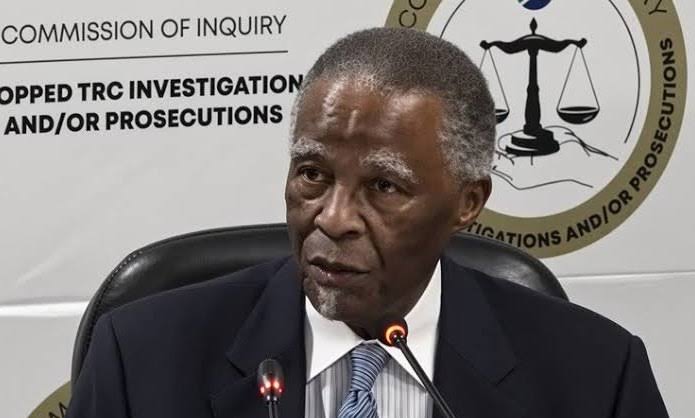
Former President Thabo Mbeki has strongly denied any political interference in the prosecution, or lack thereof, of more than 300 cases referred by the Truth and Reconciliation Commission (TRC) to the National Prosecuting Authority (NPA) for a final decision.
Mbeki testified before the Khampepe Commission of Inquiry, also known as the TRC Cases Inquiry, on Monday. His testimony drew sharp criticism from the Foundation for Human Rights (FHR), which represents 25 families of apartheid-era victims and survivors who have spent decades waiting for accountability.
Speaking on YOU FM Newshour, FHR attorney and programme officer Vuya Nako said Mbeki’s testimony focused on the balancing process required to implement the TRC’s processes and ensure justice and peace in a democratic South Africa.
“By and large, no one disputes that at all. But what the former President didn’t do, or hasn’t done at this stage of his testimony, is really speak to what the commission is about and answer questions, take accountability or even tell us who could be held accountable for the failure to prosecute the TRC cases after they were handed over to the NPA.
“Our position, therefore, as the FHR and the families, victims and survivors of apartheid-era crimes, is that it was disappointing not to hear what we were hoping to hear,” Nako said.
In his written and oral evidence, Mbeki firmly stated that he did not “direct, authorise or approve” the suppression or halting of any prosecutions arising from cases referred by the TRC.
He also dismissed longstanding allegations of an informal or clandestine agreement with apartheid-era military and police generals to shield them from criminal liability, describing the claims as a “complete fabrication”.
The FHR argued that, following Mbeki’s testimony on Monday, its clients were no closer to discovering the truth.
“There’s nothing new that came out in the former President’s evidence today that shed any light on the non-prosecution of these matters or brought the families any closer to understanding exactly what hindered the prosecutions they have been seeking to pursue for decades.
“Unfortunately, no answers were provided today,” Nako said.
Mbeki also publicly dismissed evidence given by former National Director of Public Prosecutions Advocate Vusi Pikoli and his then deputy, Dr Silas Ramaite, regarding alleged executive interference.
Both testified before the inquiry that former Justice Minister Brigitte Mabandla had explicitly instructed them to suspend TRC cases pending the introduction of new prosecutorial guidelines.
“At this stage, that is something we probably need more time to assess, especially in conjunction with our legal team, which is working on this matter.
“The evidence still needs to be assessed to enable us to respond properly to the former President’s testimony,” Nako added.
Meanwhile, the Foundation remains hopeful that some missing pieces of the puzzle will emerge when three former Cabinet ministers — Mabandla, Ronnie Kasrils, who served as Minister of Intelligence Services, and Charles Nqakula, who held the Safety and Security and Defence portfolios — appear before the commission later this week.
Mbeki is expected to conclude his testimony before the commission on Tuesday.
Former President Jacob Zuma’s testimony has been postponed due to ill health.

