


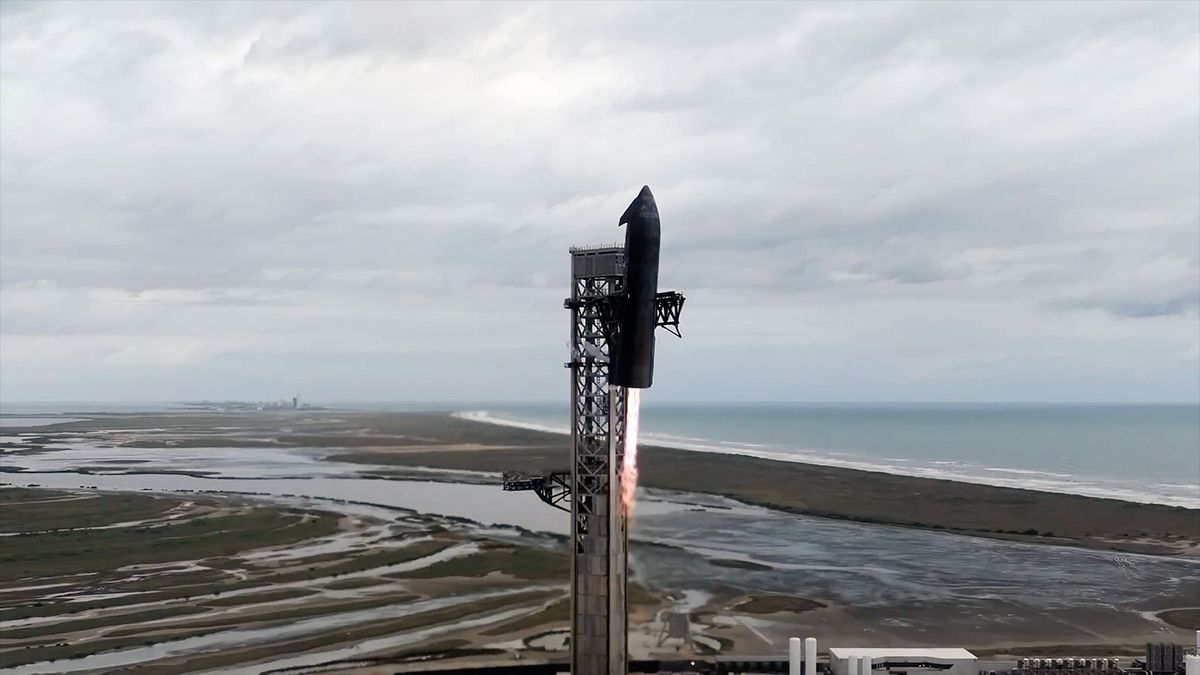
SpaceX has achieved a major milestone in rocket technology after its Starship spacecraft was successfully caught by giant mechanical arms during its return to Earth, marking a significant step towards fully reusable spaceflight.
SpaceX has made history after successfully catching the upper stage of its Starship rocket at its Starbase facility in Texas following a 22-hour journey in orbit.
The achievement marks the first time the spacecraft’s upper stage has returned from orbit to a controlled, upright landing directly into the grasp of the launch tower’s giant mechanical arms, known as Mechazilla.
The historic manoeuvre represents a major breakthrough in the company’s efforts to develop a fully reusable rocket system that could significantly reduce the cost of space travel.
Starship, which stands 171 feet tall, descended through thick clouds before reigniting its engines to manoeuvre into a vertical position and slowly lower itself into the tower’s mechanical arms.
The spacecraft had completed 14 orbits of Earth during its approximately 22-hour mission, travelling at an altitude of about 161 miles (260 kilometres).
During the flight, it also deployed 26 Starlink satellites into orbit.
Super Heavy booster fails to complete its return
While the Starship spacecraft achieved its historic landing, SpaceX did not recover both sections of the rocket.
The Super Heavy booster, which forms the lower section of the two-stage launch vehicle, successfully carried Starship into space after lifting off from the company’s Starbase facility.
However, the booster failed to complete its planned return to the launch pad and crashed into the sea approximately 10 minutes after liftoff.
This meant SpaceX fell short of its broader objective of recovering both rocket stages during the mission.
Why the Starship catch matters
The successful catch is an important step in SpaceX’s long-term ambition to make spaceflight more affordable through rocket reusability.
The company’s system is designed to allow both the Super Heavy booster and Starship spacecraft to return to Earth and be recovered for future missions.
Unlike conventional rockets, which are largely discarded after launch, a fully reusable system could reduce the need to manufacture new launch vehicles for every mission.
The technology is also central to Elon Musk’s ambitions for future missions to the Moon and Mars.
Although the booster recovery remains a challenge, the successful return and catch of Starship’s upper stage represents a significant engineering milestone for SpaceX and the future of commercial spaceflight.