



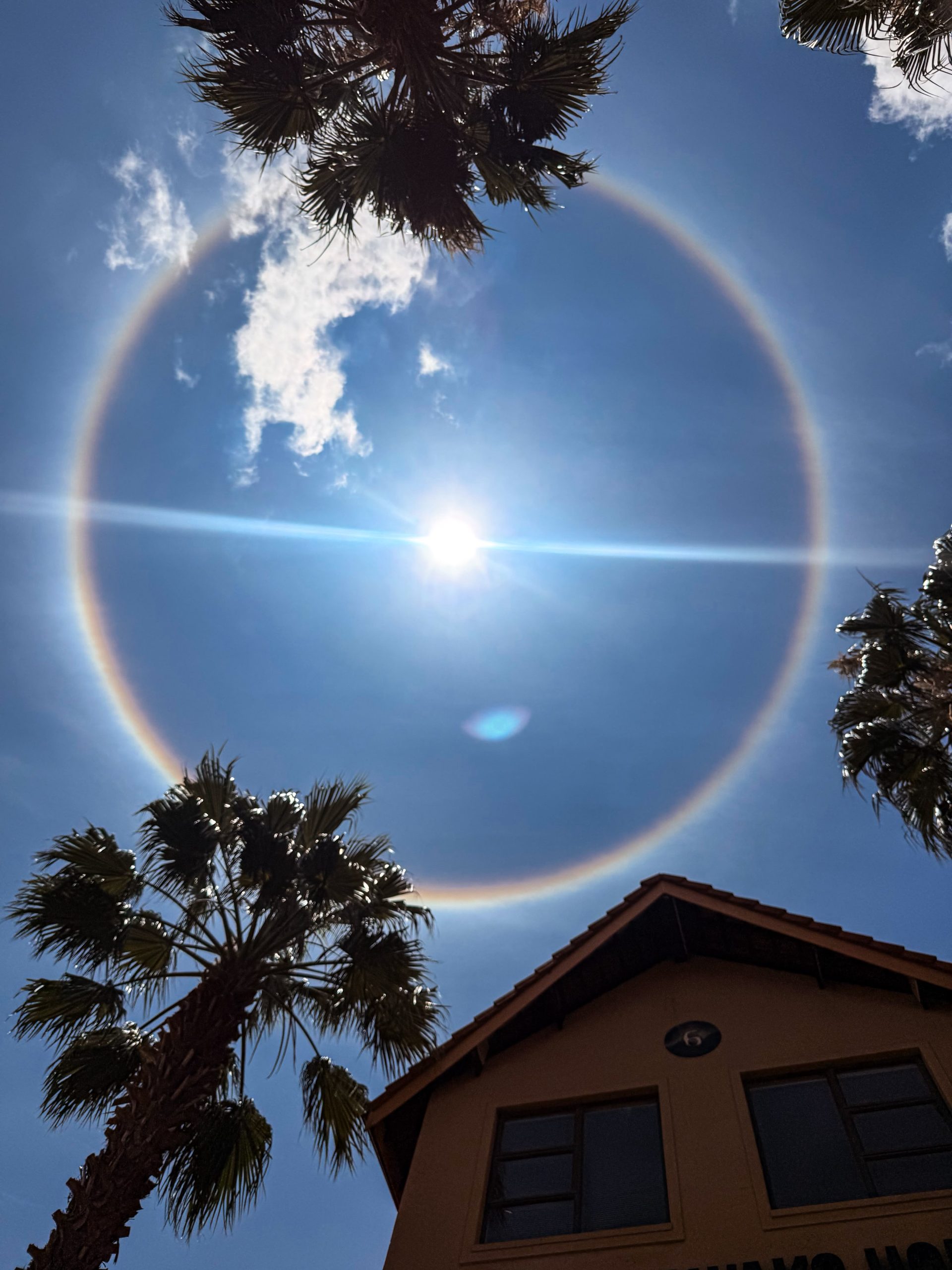
A large ring of light surrounding the Sun has caught the attention of people looking up at the sky. However, a professor at Wits University says the unusual sight is a natural optical phenomenon known as a 22-degree solar halo.
Professor Jennifer Fitchett from the University of the Witwatersrand explains that the ring forms when sunlight passes through tiny ice crystals found in thin clouds high in the atmosphere.
She says the ice crystals have a hexagonal shape, causing sunlight to bend, or refract, as it passes through them. This creates a circular ring around the Sun.
“It’s a very unusual phenomenon where we’ve got a thin circle of clouds that completely surround the Sun. This is called a 22-degree halo,” Fitchett says.
The phenomenon occurs in cirrus clouds, which are thin clouds found approximately eight to 10 kilometres above the ground.
Fitchett says the halo is not a sign of a specific weather event and should not be regarded as a reliable warning that rain is on the way.
However, she notes that darker cumulus clouds were also moving in, suggesting that further rainfall could be expected, possibly accompanied by thunderstorms similar to those experienced the previous evening.
“These halo clouds sometimes are indicative of rain, but not in isolation,” she says.
Is the solar halo linked to extreme heat and El Niño?
The unusual sight comes at a time when parts of the world are experiencing extreme heat and unusual climate conditions.
Fitchett says the phenomenon is not directly linked to these conditions, including concerns about a potential Super El Niño.
Instead, she describes it as a natural optical effect that occurs from time to time when the right atmospheric conditions are present.
People warned not to stare directly at the Sun
While the solar halo may be beautiful to photograph, Fitchett has warned people against looking directly at the Sun for extended periods.
She explains that the brightness of the Sun can be harmful to the eyes, even when a halo is visible around it.
She advises people to take a quick photograph using their mobile phones rather than standing and staring at the phenomenon.
The 22-degree solar halo is therefore a natural optical phenomenon, rather than a sign of an approaching disaster or an unusual weather event.

