



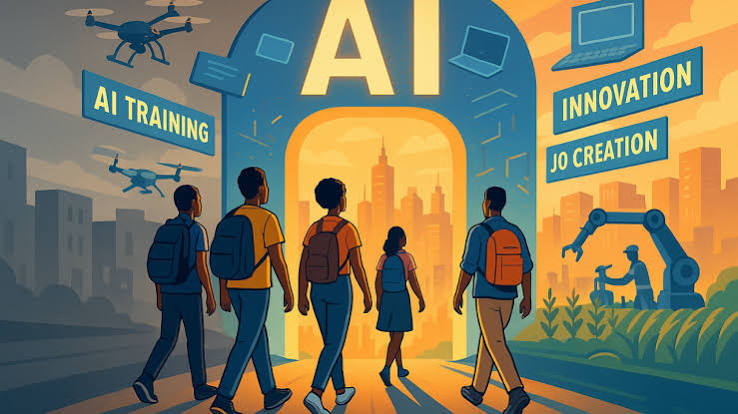
President Cyril Ramaphosa says South Africa will develop an Artificial Intelligence (AI) Action Plan following a week-long working visit to Silicon Valley in the United States, where government representatives engaged with leading technology companies, academics and young South African innovators.
The plan is expected to outline immediate priorities for the country’s participation in the rapidly evolving AI sector, translating lessons from the visit into practical outcomes for South Africa.
In his weekly letter to the nation on Monday, Ramaphosa said the delegation visited the headquarters of Cisco, Palo Alto Networks, Google and Alphabet, while also participating in engagements at Sacramento State University.
The delegation included 30 students from universities and Technical and Vocational Education and Training (TVET) colleges, as well as technology start-up founders and entrepreneurs developing AI-driven solutions.
Young people at the centre of the AI drive
Ramaphosa said the decision to include young people in the delegation was deliberate, arguing that students and entrepreneurs needed exposure to international technological developments and opportunities to build networks with global industry leaders.
Among those who benefited was a South African founder developing an AI-powered educational platform, who had the opportunity to pitch his business directly to a Google executive.
Another entrepreneur is developing a large language model focused on African languages, while students used the trip to explore research opportunities, academic collaborations and the potential role of AI in sectors such as healthcare.
A student from a TVET college in the Vaal engaged with students at Sacramento State University to explore possible future study pathways. Meanwhile, a postgraduate student from the Eastern Cape is examining how AI could be incorporated into university curricula.
The delegation also included a student researching how AI could be used in public healthcare to support medical decision-making and improve hospital workflow management.
South Africa wants to move beyond being an AI consumer
The visit comes as South Africa seeks to position itself to benefit from the global AI boom while confronting longstanding challenges, including unemployment, poverty, inequality and unequal access to digital infrastructure.
The government has increasingly identified AI as a potential tool to improve public services, boost productivity, support innovation and create new economic opportunities.
However, developing the sector will require investment in computing infrastructure, data centres, reliable electricity, digital connectivity, skills development and local research capacity.
Ramaphosa acknowledged that adopting AI would require more than simply gaining access to technology. He said the country would need to prepare its education system, institutions and workforce for the changes ahead.
The government has also emphasised the importance of protecting people from AI-related risks, including cybersecurity threats, privacy violations, potential job displacement and the misuse of technology.
AI policy still needs to be reworked
South Africa’s AI policy process has already encountered setbacks. In June, Cabinet approved the withdrawal of the draft national AI policy, which had been published for public comment, saying it needed to be reworked to establish appropriate national standards for the ethical use of AI.
The policy is intended to support innovation, job creation, skills development and responsible AI adoption, while ensuring that the benefits of the technology are not concentrated among a small number of businesses or individuals.
Ramaphosa said South Africa must develop its own capabilities, strengthen cybersecurity, protect critical infrastructure and establish legal and regulatory frameworks that balance innovation with privacy, intellectual property, human rights and the public interest.
Drawing on the words of struggle stalwart Pixley ka Isaka Seme, Ramaphosa said Africa must not remain on the margins of the industrial world. He argued that knowledge and education would be critical to ensuring the continent participates meaningfully in the next technological revolution.
He said South Africa needed to ensure that AI was used to address its developmental challenges and that young people were equipped to help shape the country’s technological future.
The President said the ultimate goal was to put the power of technology at the service of all South Africans.

