




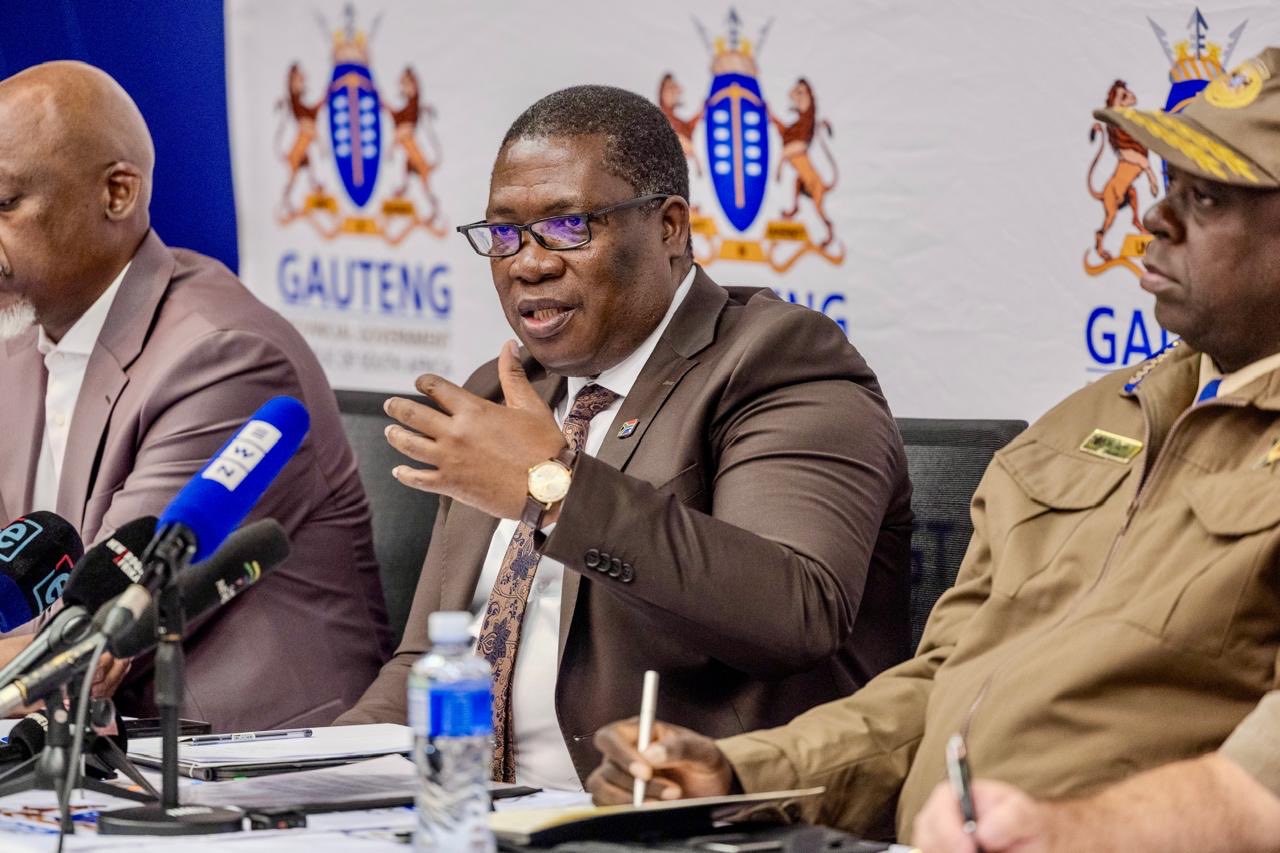
Gauteng Premier Panyaza Lesufi has announced a sweeping transformation of the province’s controversial community wardens, known as Amapanyaza, who will soon serve as provincial traffic wardens, border patrol officers, and by-law enforcers.
Briefing the media in Johannesburg on Wednesday, Lesufi said the move follows months of review, retraining, and legal alignment to integrate the wardens into Gauteng’s formal law enforcement framework.
“The wardens will cease to exist in their current format. They will now form part of the Gauteng Traffic Police, the Special Law Enforcement Unit, and other strategic partners,” Lesufi said.
The premier explained that the redeployment aims to strengthen visible policing, traffic control, and border security in partnership with the Border Management Agency. He added that the restructuring places all officers under a clear legal mandate, drawing authority from the National Road Traffic Act and Section 334 of the Criminal Procedure Act, which designates them as peace officers.
Training and Integration
Lesufi said more than 8,800 wardens have already completed intensive training in criminal law, ethics, firearm use, and public order management. Others are undergoing further instruction through the Road Traffic Management Corporation (RTMC) and 13 accredited traffic colleges.
Those who do not qualify for full traffic officer certification will be absorbed into municipal by-law enforcement or government security roles.
Legitimacy and Impact
Lesufi stressed that the initiative is not meant to replace the South African Police Service (SAPS), but to support and supplement existing law enforcement structures under the province’s Integrated Crime and Violence Prevention Strategy.
“We want to focus on fighting crime rather than arguing about mandates,” he said. “With this new structure and training, Gauteng will have a legitimate, professional force to help reclaim our communities.”
According to Lesufi, early signs are encouraging Gauteng recorded a 7.9% drop in overall crime in the last quarter and a 25% decline in road fatalities during the previous festive season.
National Criticism
However, not everyone agrees with the move. KwaZulu-Natal Police Commissioner Lieutenant General Nhlanhla Mkhwanazi has questioned the legality of the Amapanyaza programme, calling its original implementation “unlawful.”
Speaking before Parliament’s Ad Hoc Committee earlier this month, Mkhwanazi said he raised concerns with national police leadership when the programme was first introduced.
“When the premier of Gauteng, with good intentions to fight crime, started a unit that by law should not exist the Mapanya-panya that is famous I said this is illegal,” Mkhwanazi told Parliament.
“The premier has good intentions, but it cannot be done. The law doesn’t allow it.”
Lesufi, meanwhile, insists that the restructuring now addresses those very legal concerns transforming what began as a controversial anti-crime initiative into a formally recognized, trained, and regulated provincial law enforcement force.
“Criminals are coordinated our response must be equally united,” Lesufi said.