




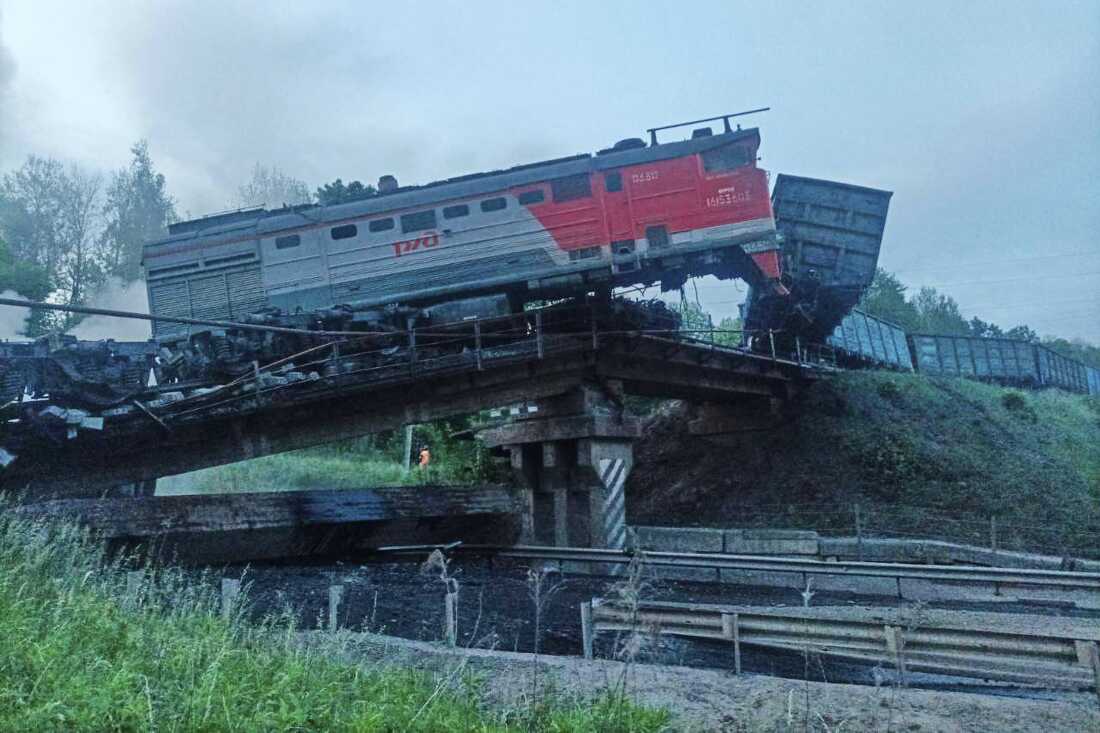
At least seven people were killed and 69 others injured when two bridges were blown up in the Bryansk and Kursk regions of Russia, as tensions escalated ahead of planned peace negotiations aimed at ending the protracted war in Ukraine. The Russian Investigative Committee confirmed today that both incidents are linked, asserting that they were deliberate acts of sabotage.
The Bryansk incident occurred shortly after 10:50 pm (1950 GMT) last night when a highway bridge over a railway collapsed precisely as the Klimovo-Moscow passenger train, carrying 388 people, passed underneath. Eyewitness accounts and alarming social media footage depicted the chaos as passengers scrambled to escape from the wreckage in darkness. The force of the explosion had left mangled carriages sprawled beside the railway tracks, underscoring the disaster’s severity.
“The bridge was blown up while the Klimovo-Moscow train was passing through,” confirmed Alexander Bogomaz, the governor of the Bryansk region, speaking to Russian television. “This is a tragic day for us.”
Just four hours later, reports emerged of a railway bridge over a highway in the neighbouring Kursk region being destroyed, showering the road with debris from a freight train on an adjacent track. The simultaneous attacks have raised concerns over security in the conflict-ridden region, which has witnessed repeated assaults since Russia invaded Ukraine in February 2022. Both nations have persistently accused one another of reckless endangerment of civilians, with each denying the other’s claims.
No immediate statement has been issued by Ukraine in response to these bombings, which coincided ominously with a tentative invitation from the United States for both Russia and Ukraine to reconvene in Istanbul the following day for crucial peace talks. US officials have expressed that nearly 1.2 million lives have been impacted, either killed or injured, as a result of the ongoing conflict.
In a continuing war of words, the Ukrainian military intelligence agency, HUR, indicated that an explosion had derailed a Russian military train transporting cargo and fuel near Yakymivka within the Russian-controlled Zaporizhzhia region. While the agency stopped short of taking responsibility or clearly attributing the explosion to any group, Ukraine has previously claimed credit for various offensive operations deep inside Russian territory.
Russian politicians have swiftly attributed blame to Ukraine, asserting that the attacks are attempts at sabotage aimed specifically at undermining peace negotiations mandated by the US. Andrei Kartapolov, chairman of the defence committee of the Russian parliament’s lower house, stated, “This is definitely the work of the Ukrainian special services. All this is aimed at toughening the position of Russia and stoking aggression before the negotiations.”
Amidst the braided narratives of conflict and diplomacy, US President Donald Trump has publicly urged both sides to reach an agreement, threatening to withdraw support for Ukraine should they fail to do so, potentially shifting the responsibility of backing Ukraine onto European allies.
Despite ongoing political negotiations, warfare continues to intensify. Both Russia and Ukraine have conducted extensive drone operations, with Russian troops reportedly making advances in key areas along the eastern front. As Ukraine has hesitated to confirm its attendance at the forthcoming talks in Turkey—pending receipt of Russia’s formal proposals—a leading US senator cautioned that Moscow should brace for renewed, substantial sanctions.


