


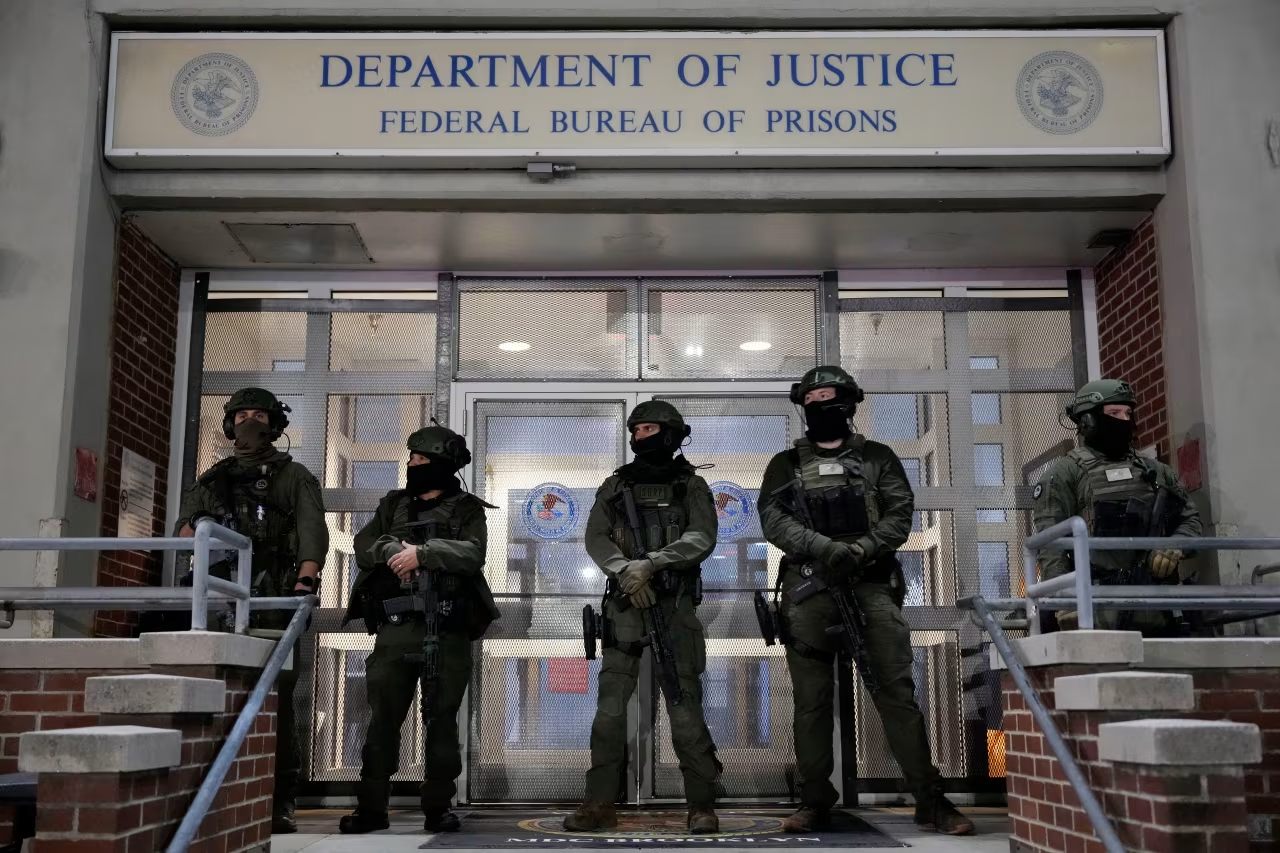
After American forces captured President Nicolás Maduro and his wife, Cilia Flores, during a large-scale military strike early on January 3. Maduro, who had been inaugurated for a controversial third term in January 2025 following disputed 2024 elections, was flown to New York, where he arrived late Saturday and is now detained at the Metropolitan Detention Center in Brooklyn ahead of federal charges.
President Donald Trump announced the operation, codenamed Operation Absolute Resolve, on social media, stating that U.S. forces “successfully carried out a large-scale strike against Venezuela” with no American casualties. He posted images of Maduro in custody aboard the USS Iwo Jima and being escorted by DEA agents upon arrival in New York. Trump declared that the U.S. would temporarily “run the country” until a “safe, proper, and judicious transition” to civilian rule, adding that private companies would rebuild Venezuela’s oil infrastructure.
The meticulously planned raid involved elite Delta Force units, CIA intelligence, FBI Hostage Rescue Team, and over 150 aircraft. Strikes targeted military sites, including Fuerte Tiuna in Caracas, neutralizing air defenses and enabling helicopters to extract Maduro from his compound. One U.S. helicopter took fire but remained operational. Chairman of the Joint Chiefs of Staff Gen. Dan Caine described the operation as months in preparation, with detailed intelligence on Maduro’s movements.
U.S. Attorney General Pam Bondi unsealed a new indictment charging Maduro, Flores, their son, and others with narco-terrorism conspiracy, cocaine importation, possession of machine guns and destructive devices—expanding on 2020 charges accusing the regime of running a “narco-state” to flood the U.S. with drugs. Maduro is expected to appear in Manhattan federal court as early as Monday.
Venezuelan opposition leaders celebrated the development. María Corina Machado, the 2025 Nobel Peace Prize laureate, proclaimed the “hour of freedom” and urged Edmundo González Urrutia—widely seen as the legitimate 2024 election winner, now in exile in Spain—to assume the presidency. González stated the opposition is prepared for national reconstruction, calling for the release of political prisoners and a peaceful transition.
Vice President Delcy Rodríguez condemned the action on state television as a “barbaric” violation of sovereignty, demanding Maduro’s immediate release and asserting he remains Venezuela’s only president. Venezuela’s Supreme Court reportedly ordered Rodríguez to assume interim duties, though reports conflict on her response. Streets in Caracas remained largely quiet, with small government-organized protests.
International reactions were sharply divided. Allies like Cuba, Iran, and China denounced the strikes as illegal aggression and “state terrorism,” with Cuba rallying thousands in Havana and the UN Security Council scheduling an emergency meeting. Some U.S. allies expressed concern over sovereignty violations, while others called for a democratic transition under González. Protests erupted in supportive nations, and Venezuelan expatriates in Miami and elsewhere rejoiced.
The capture ends Maduro’s 13-year rule amid economic collapse, mass emigration, and accusations of authoritarianism and drug trafficking. Questions remain about Venezuela’s interim governance, U.S. long-term involvement, potential instability, and the operation’s legality under international law.