





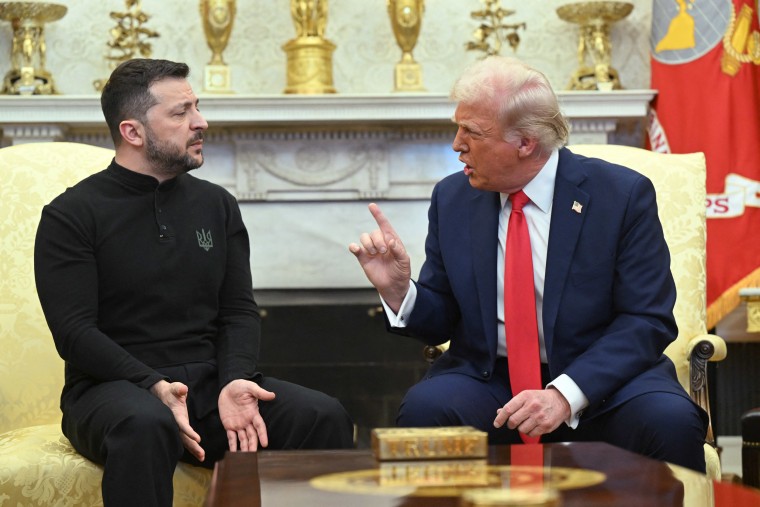
The Oval Office, typically a space for diplomacy and decorum, became a battleground of contrasting ideologies when Ukrainian President Volodymyr Zelensky confronted former President Donald Trump over the complex web of the Russia-Ukraine conflict. This tense exchange underscored the stakes not just for Ukraine, but for global security, as Zelensky delivered a powerful warning that echoed through the political landscape.
Zelensky’s message was clear and urgent: to appease Russia is to invite catastrophe. “If you think that if you will speak very loudly about the war—” he began, only to be cut off by Trump’s irritated retort: “He’s not speaking loudly. Your country’s in big trouble.” For Zelensky, the stakes are immensely personal; he has spent years defending his nation from invasion, while balancing the fragile unity within Ukraine against Russia’s relentless aggression.
In what many observers deem a fundamental miscalculation, Trump framed the ongoing war as a binary conflict, where both sides must share the blame. “You have a damn good chance of coming out OK because of us,” Trump asserted, warning Zelensky that he was “gambling with millions of lives.” This prompted an emotional reaction from the Ukrainian leader, who insisted that a further rapprochement with Moscow would not just harm Ukraine but would also jeopardise European stability.
Trump’s rhetoric prompted a fierce backlash. “Don’t tell us what we’re going to feel. You’re in no position to dictate that,” he shot back, escalating tensions within the room. As the gravity of this moment unfolded, Trump’s dismissive comments about American aid reflected a deep-seated frustration within a political climate punctuated by polarisation.
“The war has been a drain on American taxpayers,” Trump stated, referencing the $350 billion aid that had been provided, a figure he attributed to Biden’s administration. In another pointed moment, he rebuked Zelensky for a perceived lack of gratitude, asking whether Zelensky had thanked the U.S. during their meeting and accusing him of unfairly campaigning for the Democrats during key election periods, particularly following a visit to a munitions factory in Pennsylvania.
The backdrop of this exchange was a palpable atmosphere of division, where the weight of domestic US politics loomed over discussions that could shape the future of global security. Zelensky’s ambassador, Oksana Markarova, was visibly distressed, an image that encapsulated the precariousness of Ukraine’s diplomatic stance in the face of American political squabbles.
As Zelensky steadfastly pushed back against the criticisms from Trump, it raised questions about the implications of standing firm against a powerful figure while navigating the fraught relations with a nation whose war of aggression threatens to engulf Europe. In this moment, Zelensky emerged as a symbol of resilience, but the price for his defiance could very well be the security of his homeland.
This moment, rich with historical significance, could well determine the trajectory of an era marked by conflict and fragile alliances.


