


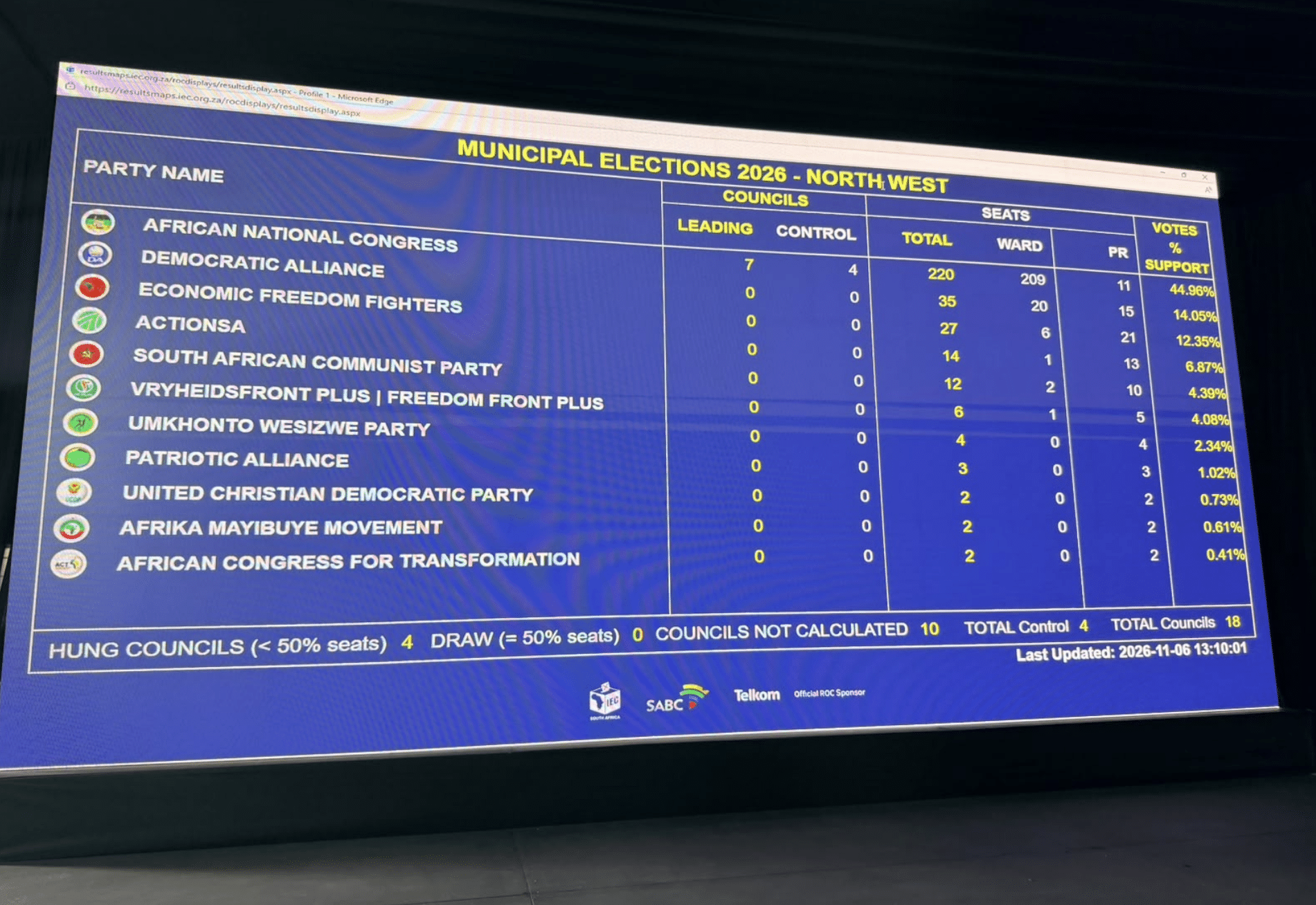
South Africa is heading towards another period of coalition politics, with several municipalities expected to have hung councils following the 2026 Local Government Elections.
As vote counting reached 82% of voting districts on Friday, 6 November 2026, the results pointed to a fragmented political landscape, with no single party securing an outright majority in several key municipalities.
According to Eyewitness News (EWN), the Democratic Alliance (DA) is leading in Gauteng’s three metropolitan municipalities — Tshwane, Johannesburg and Ekurhuleni. However, the party has not secured the 50% plus one majority needed to govern independently in any of the three metros.
The African National Congress (ANC) and ActionSA are reportedly in a close contest for second place in these municipalities, setting the stage for potentially complex coalition negotiations.
ActionSA Open to Coalition Discussions
ActionSA national chairperson Michael Beaumont has indicated that the party is willing to negotiate with any political party, provided there is agreement on a shared programme of government.
Beaumont said potential coalition partners would need to commit to an approach that prioritises service delivery for all residents.
The party’s position highlights the importance of coalition agreements in determining how municipalities will be governed and how local service-delivery priorities will be implemented.
Political Support Differs Across Provinces
While the DA is leading in Gauteng’s three major metros, the ANC continues to record substantial support in municipalities across Limpopo and the Eastern Cape.
The party has already secured more than 50% of the vote in several municipalities in these provinces, according to EWN.
Nationally, the ANC is leading the vote count with 31%, followed by the DA and the uMkhonto weSizwe (MK) Party.
Final Results Could Determine Coalition Outcomes
With counting and verification still underway, the final results will be crucial in determining which parties have the numbers to form municipal governments.
The expected hung councils mean political negotiations could play a decisive role in shaping local governance, particularly in major metropolitan areas where no party has secured an outright majority.
The coming days are therefore likely to see political parties assess their options as they prepare for negotiations that could determine the direction of municipalities over the next five years.