




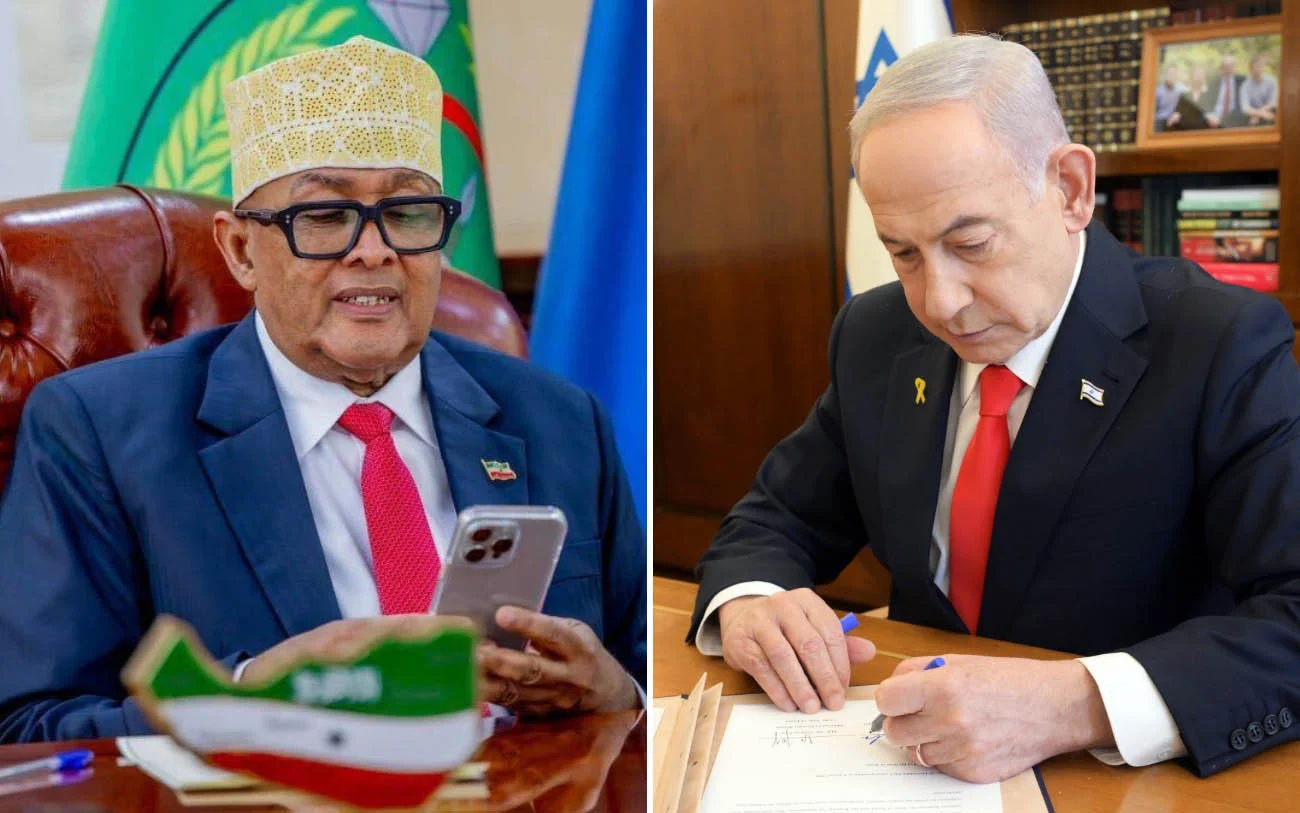
Israel on Friday became the first United Nations member state to formally recognize the Republic of Somaliland as an independent and sovereign nation, more than three decades after the breakaway region declared independence from Somalia in 1991.
Prime Minister Benjamin Netanyahu, along with Foreign Minister Gideon Sa’ar, signed a joint declaration of mutual recognition with Somaliland President Abdirahman Mohamed Abdullahi during a phone call. Netanyahu described the move as “in the spirit of the Abraham Accords” — the U.S.-brokered normalization agreements that expanded Israel’s ties with several Arab states — and pledged immediate cooperation in agriculture, technology, health, economy, and security.
“This is a seminal and historic partnership,” Netanyahu said, inviting Abdullahi to visit Israel soon. Somaliland’s president hailed it as a “historic moment,” stating his country aspired to join the Abraham Accords and commit to regional peace and prosperity.
Somaliland, a former British protectorate with its own government, currency, passports, and democratic institutions, has maintained relative stability compared to the rest of Somalia but has long been denied international recognition due to fears of encouraging separatist movements across Africa.
The decision triggered swift and sharp backlash from Somalia, the African Union (AU), Arab states, and other regional bodies.
Somalia’s federal government condemned the move as an “unlawful step,” “deliberate attack,” and “illegal aggression” on its sovereignty, insisting Somaliland remains an “integral and inseparable” part of the country. President Hassan Sheikh Mohamud vowed diplomatic and legal countermeasures.
The African Union firmly rejected the recognition, with Commission Chairperson Mahmoud Ali Youssouf stating the body “rejects any initiative or action aimed at recognizing Somaliland as an independent entity.” He reaffirmed the AU’s commitment to Somalia’s unity and territorial integrity, citing the organization’s Constitutive Act and the 1964 Organization of African Unity resolution respecting post-colonial borders. The AU warned the move risks “setting a dangerous precedent with far-reaching implications for peace and stability across the continent.”
Arab states and organizations were equally vocal. The Arab League called it a “clear violation of international law” and a “flagrant infringement” on state sovereignty. The Gulf Cooperation Council (GCC) and Organization of Islamic Cooperation (OIC) echoed these concerns, with a joint statement from over 20 countries — including Egypt, Saudi Arabia, Qatar, Turkey, Iran, and others — rejecting the recognition and warning of threats to regional security in the Horn of Africa and Red Sea.
Egypt, a key regional player, coordinated with Somalia, Turkey, and Djibouti to denounce the action as interference undermining Somali stability.
The European Union and United States reaffirmed support for Somalia’s territorial integrity, with the EU calling for dialogue between Mogadishu and Hargeisa.
While celebrations erupted in Somaliland’s capital Hargeisa, with crowds waving flags and projections of Israeli symbols, the recognition highlights Israel’s push for strategic alliances in the Muslim world and Africa amid ongoing regional tensions.
Analysts note Somaliland’s strategic location on the Gulf of Aden as a potential factor, offering Israel a foothold in the vital Red Sea corridor. However, the widespread opposition underscores the enduring international consensus against altering Africa’s post-colonial borders.
Reactions continue to unfold, with emergency meetings planned by the Arab League and calls for broader diplomatic responses.


