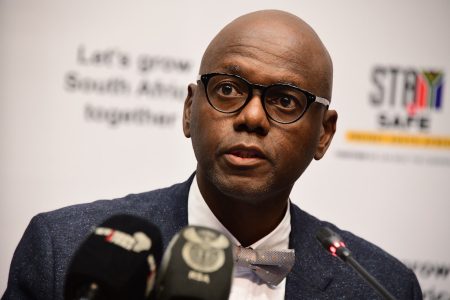




At the Madlanga Commission, Lt-General Nhlanhla Mkhwanazi on Day 2 of his testimony has exposed unsettling communications and privilege within South Africa’s law enforcement agencies. Under scrutiny for allegations of corruption and political interference, this commission, established by President Cyril Ramaphosa, aims to reveal the unhealthy nexus between crime syndicates and police officials.
Central to Mkhwanazi’s testimony was his account of Vusimuzi “Cat” Matlala, a convicted individual reportedly engaging in dubious conversations even from behind bars. According to Mkhwanazi, Matlala boasted to businessman Mr. Rafadi about the expected promotion of Shadrack Sibiya to succeed Lt. General Godfrey Lebeya as the next head of the Hawks.
Mkhwanazi offered crucial details during his testimony held at the Brigette Mabandla Justice College in Pretoria. He characterised Matlala’s remarks as indicative of the profound influence that crime syndicates wield over law enforcement processes. “Matlala’s response to Mr. Rafadi is that they gave it to General Sibiya already,” Mkhwanazi stated, highlighting concerns regarding the integrity of appointment processes within the police. “This is what Matlala is saying, and we know the filling of the vacancy of the DPCI head is the responsibility of the Minister of Police. Perhaps Mr Matlala knew something we did not know,” he concluded.
Mkhwanazi’s testimony went beyond this emerging narrative of manipulation, detailing the unorthodox privileges Matlala had benefited from while interacting with law enforcement agencies. He recounted how Matlala had his vehicles registered by the Deputy Chief of Police in Ekurhuleni, essentially masquerading them as official municipal vehicles, an act that contravenes the Traffic Act which restricts blue lights to legitimate law enforcement vehicles.
“He took these vehicles and caused the municipality to take the blue lights that belong to the municipality. The blue lights are supposed to be for law enforcement vehicles within the municipality, and he fitted those blue lights in these vehicles,” Mkhwanazi described, raising alarming questions about the misuse of authority and resources.
In a further twist to the unfolding narrative, Mkhwanazi disclosed that Matlala was found with a cellphone inside his prison cell at Kgoshi Mampuru Correctional Services Facility, pointing to a potential collusion involving the Commissioner of Correctional Services, Samuel Thobakgale. “The commissioner called me because, after watching the address, he felt that he must send credible Correctional Service officials to go and inspect this detained person, Cat Matlala,” Mkhwanazi explained, revealing the alarming ease with which Matlala accessed communication devices from within prison walls.
The revelations shared by Mkhwanazi underscore a disturbing trend within South African law enforcement, where the opacity and influence of crime syndicates may endanger the integrity of the justice system itself.
As the Madlanga Commission continues, public scrutiny intensifies on the mechanisms that govern South Africa’s justice and policing frameworks.